
Walk into a flying theater and the first thing that hits you is not the picture. It is where the sound comes from. A helicopter sweeps overhead and the rotor noise is above you. A whale passes the nose of the ride and the low frequency arrives from the left, exactly where the animal appears. Nothing about that experience is accidental — and none of it is possible if the loudspeakers are hanging in front of the screen.
This is the problem an acoustically transparent LED dome solves. It is the reason almost every serious flying theater and dome cinema built in the last five years specifies a perforated LED dome screen instead of a solid one — and the reason a solid LED wall, however good its picture, can quietly ruin an otherwise excellent immersive venue.
This article explains what acoustic transparency really means on an LED dome, how the perforation is engineered, what it costs you in picture quality and structure, and what to write into your specification so you get a dome that sounds as good as it looks.
What "acoustically transparent" actually means
An acoustically transparent LED dome is a dome screen built from perforated LED panels, where the open area is large enough for sound to pass through the screen with negligible loss. On our dome platform the perforation rate is 50%, and measured sound transmission loss stays under 5% across the speech and music bands.
The concept is not new: perforated projection screens have been used in cinemas for decades so that the center channel could sit behind the picture. What is new is doing it on an LED surface, where every perforation hole competes with pixels for space, and where the panel still has to carry structural load, seal against weather and hold micron-level splicing tolerance across a curved surface.
Two numbers decide whether a dome is genuinely transparent or merely marketed as such:
- Open area (perforation rate). Below roughly 25%, high frequencies begin to disappear; a solid panel is effectively a low-pass filter.
- Measured transmission loss, by frequency. Ask for a curve, not a single figure. A dome that loses 3% at 500 Hz but 20% at 10 kHz will sound dull and closed no matter what the datasheet claims.
Why a solid LED wall destroys a dome show
The loudspeaker dilemma
Put the speakers in front of the screen and the sound is visibly detached from the image — in a dome the audience is surrounded by picture, so every speaker becomes a visible object hanging in the sky. Put them behind a solid screen and you get mud: high frequencies attenuated, intelligibility lost, and the screen itself radiating reflections back into the room.
Worse, a rigid surface inside a sphere creates the acoustically worst possible geometry. The dome focuses reflections toward the audience, smearing transients and inflating reverberation time. A perforated screen behaves far more like an acoustically absorbent boundary than a mirror.
What solid panels do to sound, mechanically
At 10 kHz the wavelength of sound is about 34 mm — the same order as an LED module's thickness and the gaps between cabinets. Any continuous surface of that scale blocks, reflects and diffracts those frequencies. The audible result is a dome that sounds as if the audience is wearing a blanket: dialogue loses consonants, cymbals lose air, and object-based audio panning across the dome collapses into a flat smear.
And then there is object-based audio
Modern dome shows are mixed in object-based formats where each sound has a three-dimensional position — including height. Height channels physically sit above and behind the dome apex. With a solid screen there is nowhere to put them, so the mix is folded down and the ceiling of the sound field disappears. On Dolby Atmos-class formats this is not a subtle loss; it removes one third of the creative palette.
How a perforated LED dome is engineered
The hole pattern is a design, not a drill
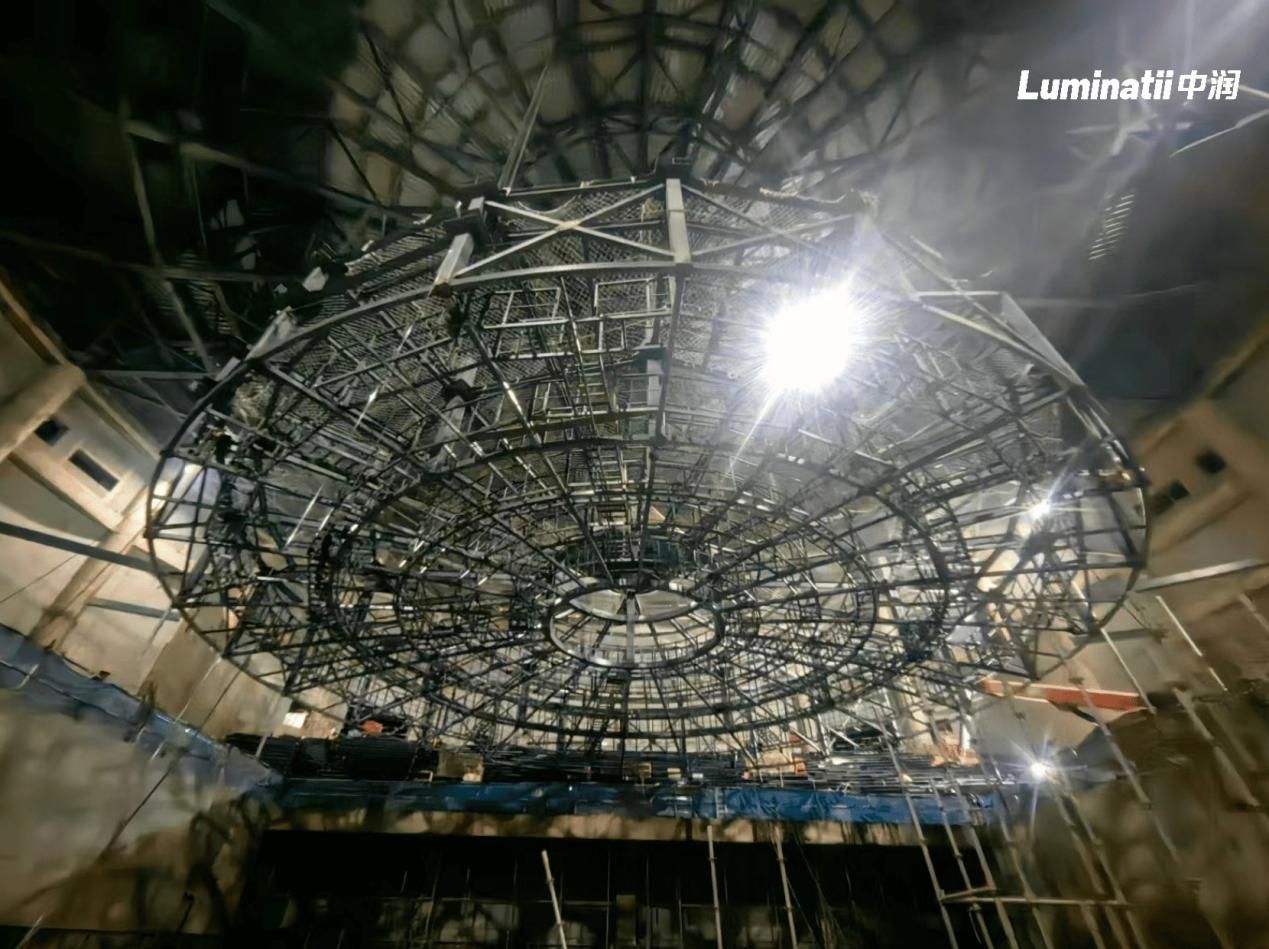
Every perforation is positioned between pixels so that the emitting area stays continuous to the eye. The pattern, hole diameter and spacing are calculated against three constraints at once: acoustic open area, optical fill factor, and mechanical strength of the panel. Modules are laid out in triangular and trapezoidal formats with independently adjustable angles, because a sphere cannot be tiled with rectangles without gaps.
Structure and weight
Our perforated dome panels weigh 8.5 kg per square meter in the 60 m Kongtong Island installation — roughly half the industry norm of 15–25 kg/m². On a 5,300 m² dome that is hundreds of tonnes of load removed from the steel and the building, which is often what makes a dome project feasible inside an existing structure at all.
Proving it acoustically
Our dome projects are specified with sound transmission loss below 5% and audio-visual synchronization error below 0.02 seconds. The second number matters as much as the first: an acoustically transparent screen only helps if picture and sound remain locked together, which is why the playback chain, the media server and the show-control system are commissioned together rather than separately.
Keeping the picture seamless
Perforation removes emitting area, so brightness budget and viewing distance have to be planned together. On our platform the dome still delivers 1,200 nit at the screen surface, 10,000:1 contrast, NTSC 90%+ color gamut, brightness uniformity deviation ≤ 5% and color deviation ≤ 2ΔE. At normal dome viewing distances the perforation is invisible; the audience sees one continuous surface, not a grid.
Why flying theaters and dome cinemas need it most
Audio-visual coherence is the whole illusion
The human brain localizes sound by sight when the two are close together in time — the ventriloquism effect. Keep the error under about 20 milliseconds and the audience accepts that the picture is making the sound. Push beyond it and the illusion breaks: riders feel the audio coming from somewhere else, and the ride instantly feels cheaper than it is. Our 0.02 s sync specification exists precisely to stay inside that window across a dome with multiple projection and playback nodes.
Surround arrays hidden behind the screen
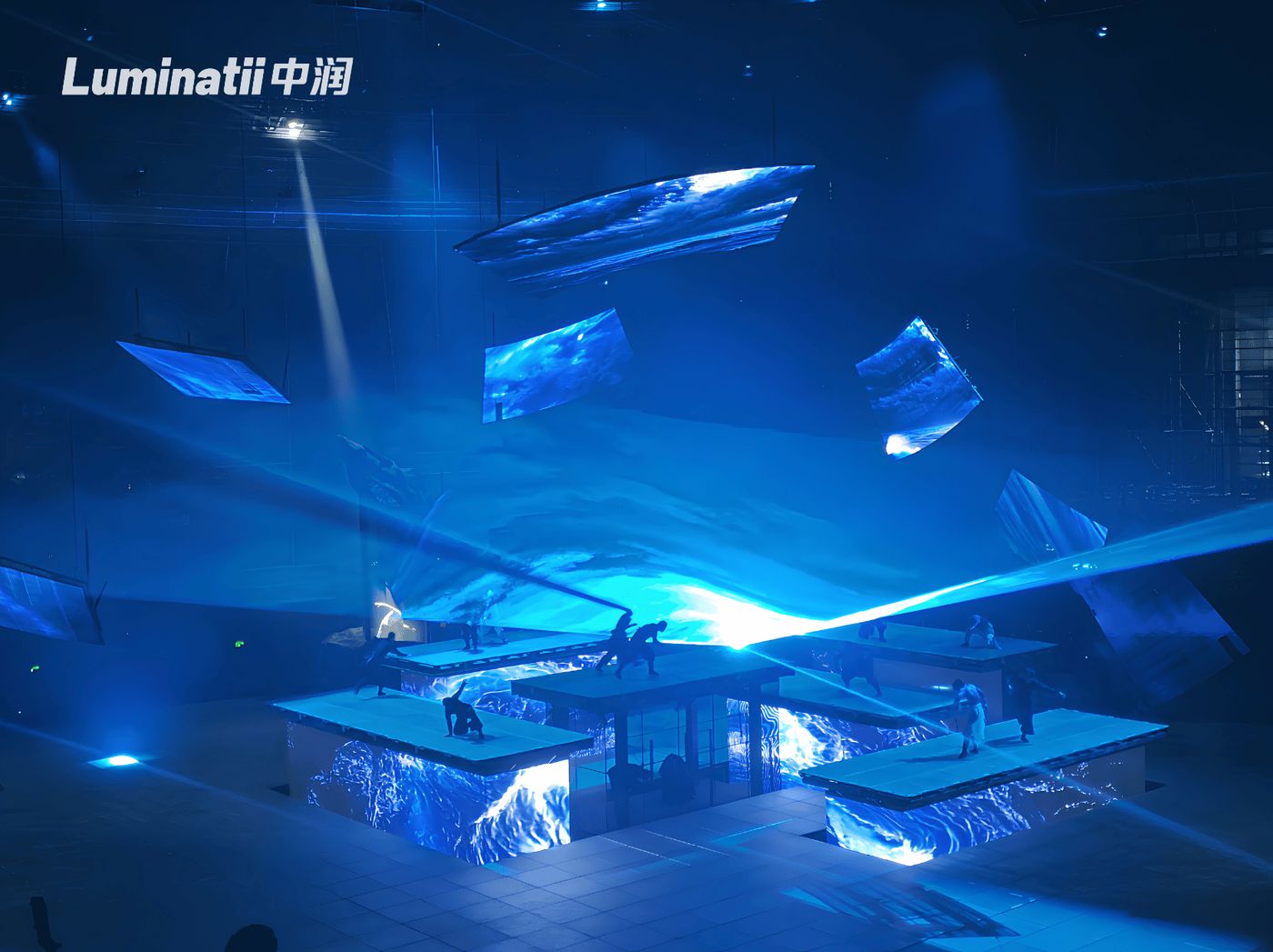
On the 60 m Kongtong Island dome, surround loudspeaker arrays are mounted behind the perforated screen shell, so the entire dome becomes the sound source. Combined with four 3D wire systems flying performers through the space and eight sets of kinetic lifting and opening LED panels, the venue relies on sound and picture sharing the same physical location — impossible with a solid screen.
Where the first row sits
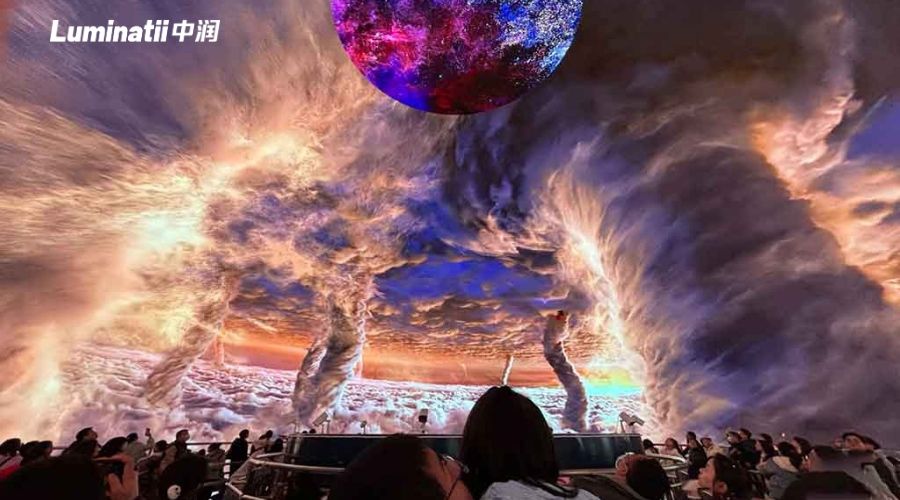
In a flat cinema the front row is a compromise. In a dome, the audience is inside the image, so seats near the perimeter sit close to where surround speakers are hidden. Acoustic transparency removes the barrier between the audience and the audio system, which is why dome cinemas can use steeper seating and place guests closer to the screen without the sound feeling "behind glass".
The three trade-offs — and how to handle them
1. Light output and contrast
Perforation reduces emitting area, so a transparent dome needs a brightness reserve. Ours is specified at 1,200 nit with high gray scale and 16-bit processing, which keeps both highlights and shadow detail intact. If a supplier quotes the same brightness for solid and perforated versions of the same pitch, one of the two numbers is wrong.
2. Structural strength
A perforated panel is not a weaker panel — it is a differently engineered one. Load paths move to the frame and the pixel substrate, and the module is calculated for dead load, wind and seismic cases at the project's location. On outdoor installations the perforation also has to survive rain ingress, salt fog and thermal cycling; our outdoor products are IP65 rated with a dedicated anti-moisture, anti-dust and anti-salt-fog package proven on the island project off the Shandong coast.
3. Dust and maintenance
Open area means air moves through the screen — good for acoustics and HVAC load, less good for dust. The answer is design, not frequent cleaning: positive pressure in the cavity behind the dome, filtered supply air, sealed cable entries, and front and rear service access so one technician can replace a module. Our domes are maintained from both sides, which keeps long-term operating cost low on a 5,000 m² surface.
Perforated LED dome vs perforated projection dome
Projection domes have used perforated screens for years, so the acoustic principle is familiar. The differences are practical:
- Brightness: an LED dome is self-emissive and stays readable under ambient light; projection needs darkness and loses contrast with any stray light.
- High-frequency loss: perforated projection screens typically attenuate the top octave; a well-engineered perforated LED dome keeps loss under 5% because the open area is larger and the panel thinner.
- Maintenance: no lamps, filters or blending alignment — LED service life exceeds 100,000 hours, with only occasional module replacement.
- Sharpness: no edge blending, no focus drift, no geometric softness at the dome edge; every pixel is a real pixel, up to 8K on the 5,300 m² Kongtong dome.
- Power: our dome draws a maximum of 150 W/m² on full white at 1,200 nit, roughly one quarter to one third of conventional indoor LED domes — and a fraction of the electricity a large projection array needs for equivalent luminance.
What to put in your specification
If acoustic performance matters to your project — and in a flying theater it is the project — write these items into the tender instead of accepting a datasheet claim:
- Perforation rate as a percentage, plus the hole pattern drawing.
- Transmission loss curve from 100 Hz to 16 kHz measured on a production panel, not a prototype.
- Audio-visual sync latency at the playback output, with the test method named.
- Brightness and uniformity at the specified pitch, with the measurement grid defined.
- Panel weight per square meter, so the steel and building loads can be verified independently.
- Service access — front, rear or both, and how many technicians per module.
- Acoustic sealing at panel joints, which is where transparency is usually lost in practice.
- Loudspeaker rigging coordination, so speaker positions are engineered with the dome structure rather than retrofitted.
One further recommendation from experience: build a mock-up. A two-by-two-meter perforated dome section, measured and listened to before production starts, settles arguments that no brochure can.
Projects where the sound comes through the screen
Luminatii has delivered 20+ large LED dome projects from 5 m to 60 m in diameter, most of them acoustically transparent:
- Kongtong Island, Yantai — 60 m diameter, 5,300 m². Asia's largest LED dome, engineered and opened in about 180 days, with 8 sets of kinetic lifting and opening panels, four 3D wire systems, six mechanical doors and ten lifting floor displays. Surround audio sits behind the perforated dome shell.
- Huangshi dinosaur park — 22 m and 28 m, 720° configuration. Two acoustically transparent domes combined with digital floor screens, running as the park's main visitor attraction since June 2024.
- Chengdu Happy Valley — 22 m flying theater dome, and a 7 m flying theater dome in Shenzhen: picture, motion platform and audio synchronized as one show.
- Beijing 5 m and 8 m domes, Guiyang 14 m, Changzhi 20 m — smaller immersive venues where transparent acoustics still decide whether the show convinces.
- Philippines — 26 m full outer sphere, our reference for outdoor LED ball screens.

Frequently asked questions
Does perforation reduce image quality?
Not at normal dome viewing distances. The holes sit between pixels, the fill factor is compensated optically, and the surface is calibrated to ≤ 5% brightness uniformity and ≤ 2ΔE color deviation. What perforation does require is a brightness reserve, which is why a transparent dome is specified at 1,200 nit rather than the lower figures common on solid panels.
Can any LED dome be made acoustically transparent?
Technically most can, but the perforation must be designed into the module from the start — hole pattern, pixel layout, structure and sealing all change together. Retrofitting perforation onto an existing solid panel design usually produces either poor acoustics or poor structure, often both.
How much sound is actually lost?
Under 5% across the speech and music bands on our platform, with 50% open area. Ask any supplier for a measured frequency curve; a single percentage without a method is not a specification.
Do I still need acoustic treatment inside the dome?
Yes. A transparent screen removes the barrier, but a sphere still focuses reflections. Absorption behind the screen, diffusers at the base ring and careful speaker aiming are part of a complete design — we coordinate these with your acoustician rather than treating the screen as a substitute.
Is a transparent dome more expensive?
There is a modest premium in the panel itself and in the structural coordination around speaker rigging. In a flying theater it is almost always recovered elsewhere: no visible speaker arrays, no compromise in the mix, no artificial acoustic treatment to hide the screen, and a shorter commissioning period because sound and picture are designed together.
What is the difference between 50% perforation and a transparent LED screen?
They solve different problems. A transparent LED screen (glass-wall or film type) is designed for see-through visibility; an acoustically transparent LED dome is designed for sound transmission while remaining visually opaque. In a dome you want the second: the audience should see picture, not the machinery behind it.
Sound is half the dome
Most dome budgets are argued over pixels and diameter, and most dome disappointments turn out to be acoustic. If your project is a flying theater, a dome cinema or any venue where the audience sits inside the image, the perforated LED dome is not an upgrade — it is the difference between a show that convinces and a screen that merely displays.
Send us your venue drawings, seating plan and audio concept. We will return a dome proposal with perforation specification, measured transmission data, sync targets, panel weights and an itemized budget — and, if you are comparing against a solid-screen offer, a straightforward explanation of what that offer will sound like in ten years.
Request a technical proposal · See the LED dome screen platform · Read all 60 buyer questions