
Of all the numbers on an LED dome quotation sheet, none generates more confusion than LED dome pixel pitch. Buyers often arrive with a flat-screen mindset — smaller pitch, sharper picture, better investment — and then discover that inside a curved, immersive theater the logic is different. Pitch interacts with dome diameter, seating geometry, coverage area and even how the human eye behaves in peripheral vision. Choose it by copying a flat-wall rule of thumb and you will either pay for pixels nobody can resolve, or ship a dome where front-row viewers can count individual lamps.
We have delivered more than 20 large LED dome projects ranging from 5 m to 60 m in diameter, from 5 m and 8 m exhibition domes in Beijing to the 60 m, 5,300 m² Kongtong Island dome in Shandong — the largest LED dome in Asia. Across that range, the pitch decision has never been "smaller is better." It has been a reverse calculation that starts with the room, not the spec sheet. This article walks through that calculation the way our engineering team runs it.
What LED Dome Pixel Pitch Actually Measures
Pixel pitch is the center-to-center distance between two adjacent LED pixels, measured in millimeters: P2 means 2 mm, P1.875 means 1.875 mm. Because pixels sit on a regular grid, pixel density of a dome screen follows an inverse-square relationship. Halve the pitch and you quadruple the pixels per square meter — and roughly quadruple the module count, the drive channels, the data load and the calibration workload that arrive with them.
| Pixel pitch | Pixels per square meter | Rule-of-thumb minimum viewing distance | Where it typically fits |
|---|---|---|---|
| P1.5 | about 444,000 | about 1.5 m | Close-range exhibit domes, compact training domes |
| P1.875 | about 284,000 | about 1.9 m | Premium small and mid-size immersive domes |
| P2 | about 250,000 | about 2 m | Mid-size immersive domes and flying theaters |
| P2.5 | about 160,000 | about 2.5 m | Mid and large domes with moderate seating distance |
| P3 | about 111,000 | about 3 m | Large domes, 20 m class and up |
| P4 | about 62,500 | about 4 m | Very large domes with distant seating |
Two cautions apply to this table. First, the minimum-viewing-distance column is a widely used rule of thumb from flat-panel practice: the closest comfortable viewing distance in meters is roughly in the same ballpark as the pitch in millimeters. Second — and this is where domes diverge sharply from flat walls — the single-distance assumption behind that rule does not survive contact with a spherical room.
Why the Flat-Screen Pitch Formula Breaks Inside a Dome
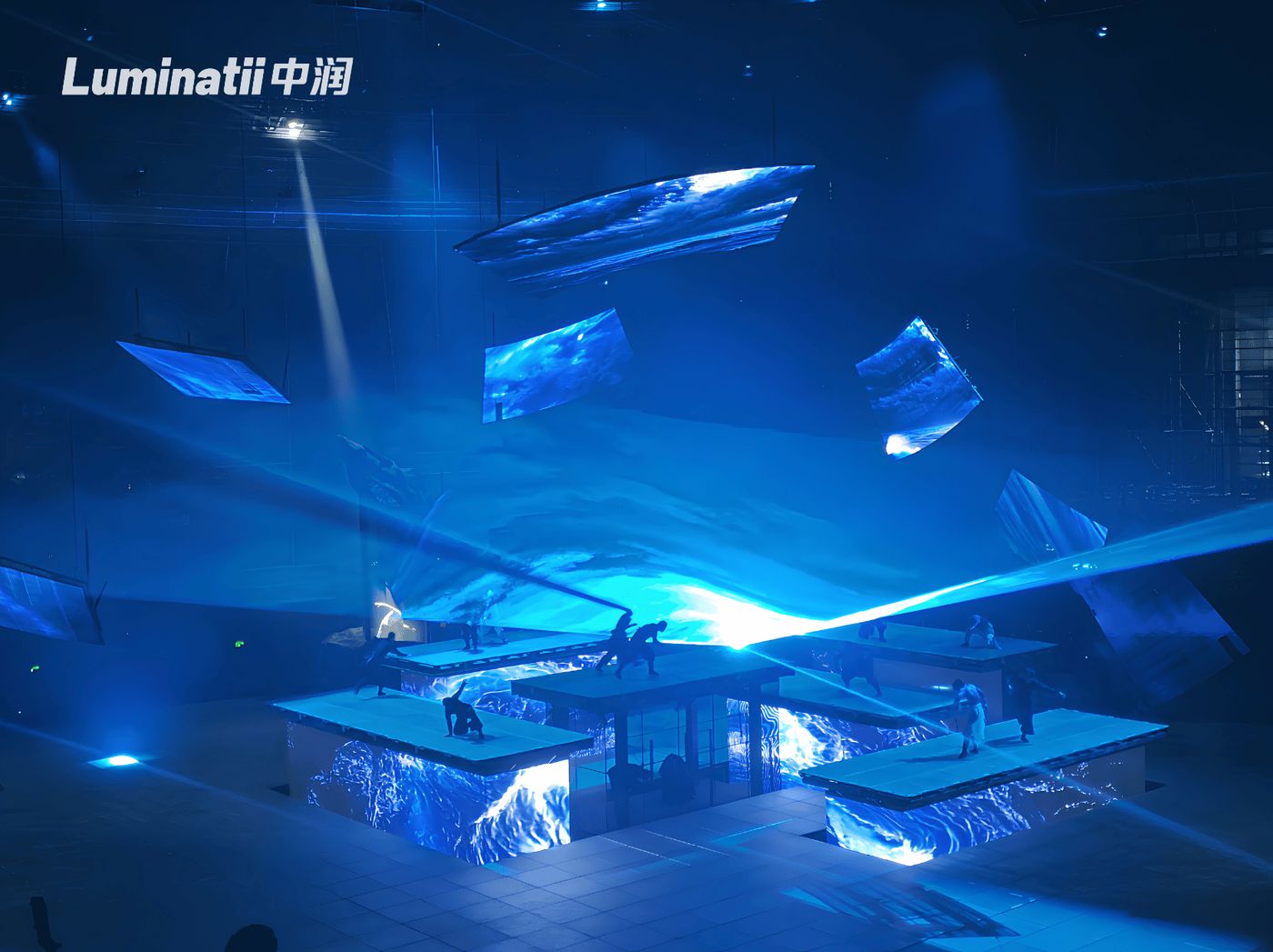
A flat LED wall is engineered around one distance: viewer to screen. A dome is not. The geometry of a spherical venue scatters viewing distances across an order of magnitude, and it changes how the eye itself works against the image:
- On a mid-size dome, the nearest viewers may sit only a few meters from the screen near the spring line, while viewers on the opposite side see the apex 20 m or more away. One pitch value, two very different acuity demands.
- A large share of the dome sits in the audience's peripheral field, where the eye resolves far less detail than at the center of gaze. Content in those regions reads as motion, color and luminance — not fine texture.
- Along the curve, pixels are viewed at increasingly oblique angles, so pixel structure becomes visible earlier than the flat-screen formula predicts. The rule of thumb needs margin, not trimming.
- Module geometry decides whether any of this stays invisible. Trapezoidal and triangular modules with independently adjustable angles are the precondition for a seamless spherical surface, and seam quality at those junctions is noticed long before pixel density is.
We cover the module-level mechanics of that last point in seamless LED dome splicing. The takeaway for pitch selection is simple: on a dome, the errors buyers notice first are geometric — seams, brightness bands, color shifts — not resolution.
Diameter, Screen Area and the Pixel Budget
Screen area grows with the square of diameter, which means the pixel budget grows just as fast. A hemisphere carries approximately 2 times pi times the radius squared of active screen area, and every step up in diameter multiplies module count, power and structural load. The table below runs that arithmetic for the delivered diameter range of 5 m to 60 m:
| Dome diameter | Hemisphere screen area (approx.) | Total pixels at P2 | Total pixels at P3 |
|---|---|---|---|
| 8 m | about 100 m² | about 25 million | about 11 million |
| 14 m | about 308 m² | about 77 million | about 34 million |
| 22 m | about 760 m² | about 190 million | about 84 million |
| 30 m | about 1,414 m² | about 353 million | about 157 million |
| 60 m | about 5,655 m² | about 1,414 million | about 628 million |
These figures are illustrative geometry, not project specifications — actual designs vary with coverage shape, module format and content plan. Our 60 m Kongtong Island dome, for example, carries 5,300 m² of active screen area, slightly under a full hemisphere, because coverage is shaped by the venue's architecture and its eight sets of retractable LED screens. At the smaller end of the same delivered range sit a 7 m flying theater dome in Shenzhen, a 14 m dome in Guiyang, a 20 m dome in Changzhi, a 22 m flying theater at Chengdu Happy Valley, and the 22 m plus 28 m paired 720-degree domes at Huangshi Dinosaur Park.
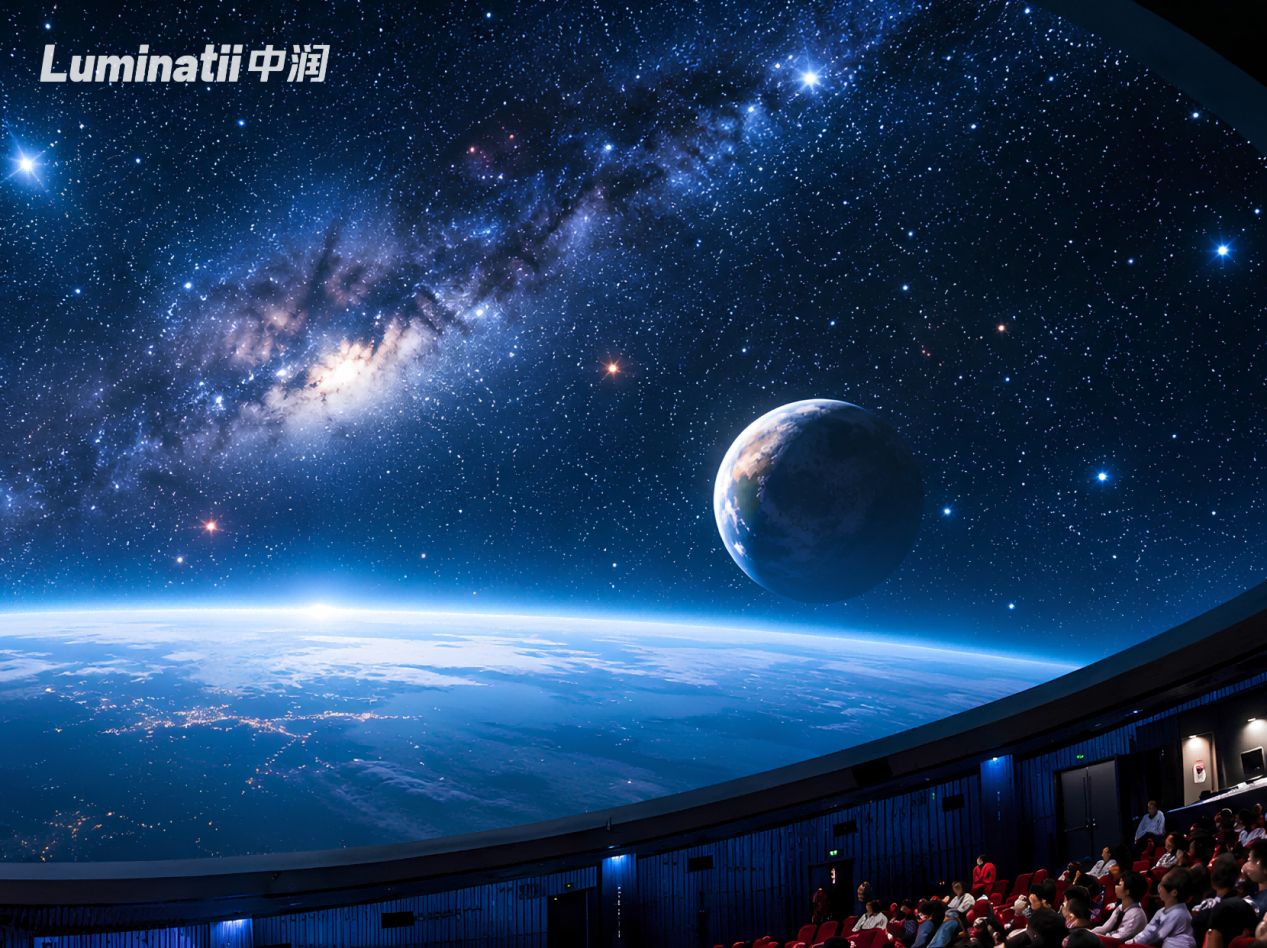
The practical consequence of that table is counterintuitive for first-time buyers: on large diameters, even a "coarse" P3 yields pixel counts that flat-screen projects never approach. The question is never whether the dome is sharp enough in absolute terms — it is whether the density is placed where the nearest viewer can benefit from it. For more on how diameter drives the rest of the design, see how to choose LED dome diameter, or browse the delivered project portfolio.
The Case Against Over-Specifying Pitch
Every step down in pitch multiplies module count, and with it the number of seams to align, the hours of calibration, the spare-module pool and the processing load. On a 20 m class dome, the difference between P2.5 and P1.875 is measured in tens of thousands of additional modules — not a rounding error in any discipline of the project.
Meanwhile, what actually dominates perceived image quality in a dark immersive theater is rarely raw density. It is brightness uniformity across the curved surface, chroma consistency between modules, and gray-scale depth in dark scenes. On our domes these are controlled to a brightness uniformity deviation of 5 percent or less, a chroma deviation of 2 delta-E or less, and 16-bit gray processing — because large sky, starfield and night scenes expose any inconsistency far more readily than they expose a missing million pixels. A denser grid of poorly matched modules looks worse than a coarser grid of well-calibrated ones.
Density also pushes weight and power in the wrong direction. The screen surface of our 60 m dome weighs 8.5 kg per square meter, well under the 15 to 25 kg per square meter that is common in the industry, and draws 150 W per square meter at full-white peak at 1,200 nit. Finer pitch adds modules, drivers and steel — costs that compound through structure, HVAC and operation. In most dome projects we design, the pitch that survives the reverse calculation is coarser than what the client first assumed, and the budget it frees up goes into uniformity, calibration and content fit, where the audience can actually see the difference. The full engineering context is on our LED dome screen product page.
Matching Pitch to Seating: A Six-Step Reverse Calculation
- Fix the geometry first: dome diameter, coverage shape — full dome, partial dome, or dome with digital floor — and the seating layout.
- Measure the nearest viewer's distance to the screen surface. This distance sets the ceiling on usable pitch.
- Apply the rule of thumb with margin: keep pitch no larger than roughly one millimeter per meter of that nearest-viewer distance.
- Check the far end. If the farthest row sits three to four times beyond the threshold, you can usually coarsen one pitch class and redirect the savings.
- Size the content chain against the screen's native resolution — media server, playback nodes and content production format — so the display and the pipeline are planned together, not sequenced.
- Validate with real content at native resolution on a sample of installed modules before production freeze, under the venue's actual ambient light.

Seating deserves one extra warning. The most common layout mistake we see is placing rows closer to the screen than the pitch can support, usually in an attempt to raise capacity. Those viewers get the worst seat in the house: full awareness of pixel structure, maximum oblique viewing angle and the least immersive field of view. It is cheaper to fix the section drawing than to retrofit the screen.
Questions Buyers Ask About Dome Pixel Pitch
Is a smaller pixel pitch always better?
No. Pitch buys resolution only where the audience can resolve it. In a dome, that is a ring of seats near the spring line, not the whole room. Once the nearest-viewer distance clears the threshold for a given pitch class, additional density is invisible to every seat in the venue. The budget is almost always better spent on uniformity, chroma consistency and gray performance — the parameters that govern what a dome actually looks like in a dark theater.
P2, P3, P4 — what actually changes between them?
Density and everything that scales with it. Going from P2 to P3 removes about 56 percent of the pixels per square meter, which means fewer modules, fewer seams to calibrate, less drive load, less weight and a lower screen budget — and a higher minimum viewing distance, from roughly 2 m to roughly 3 m. P4 halves the density again and suits venues where no viewer comes within 4 m of the surface. The classes are not good or bad; each matches a band of nearest-viewer distances.
We want to run 8K content. What does that mean for pitch?
8K is a content and processing specification, not a pitch specification. On a large dome the native pixel count can comfortably exceed an 8K content pipeline; on a small dome it may be lower. What matters is planning the screen's native resolution, the content production format and the playback system as one decision — that is how the 60 m Kongtong Island dome delivers 8K across its 5,300 m² surface. If content is designed after the screen is frozen, expect remapping work and compromised sharpness; if the display resolution is fixed early, the content team can master for it from day one.
Should we fix the dome diameter first or the pixel pitch first?
Neither in isolation. The scenario, content type, viewing distance and budget define the diameter; the diameter and seating layout define the pitch; the pitch then feeds back into feasibility through weight, power and structure. Treat it as one iterative loop rather than a sequence. Two venues with identical diameters can deliver very different experiences if their pitch, calibration and seating differ — which is why comparing domes on diameter alone is not a reliable way to buy.
Every dome project we engineer starts with the room: the diameter, the seating plan, the content ambitions and the nearest viewer's seat. Send those basics to our project team and we will run the pitch calculation with you — including the cases where the right answer is a coarser, better-calibrated dome than the one you expected to buy.