Factory-direct LED Dome & Spherical Displays — Shenzhen, China
✉ enquiries@luminatii.com
☎ +86 177 0402 4640

For a natural-science museum in Hezheng, Gansu, we built a 6 m-diameter indoor LED sphere — 131 m² of P3 surface in the shape of the planet itself, standing on the museum floor where every visitor walks straight into it.
In the natural-science hall at Hezheng, Gansu, the centerpiece is a planet: a 6 m-diameter indoor LED sphere, P3 pitch, 131 m² of display surface, standing directly on the museum floor. Visitors do not view it from a distance — they walk up to it, around it, and watch the earth turn, weather systems move and night fall across continents at true global scale.
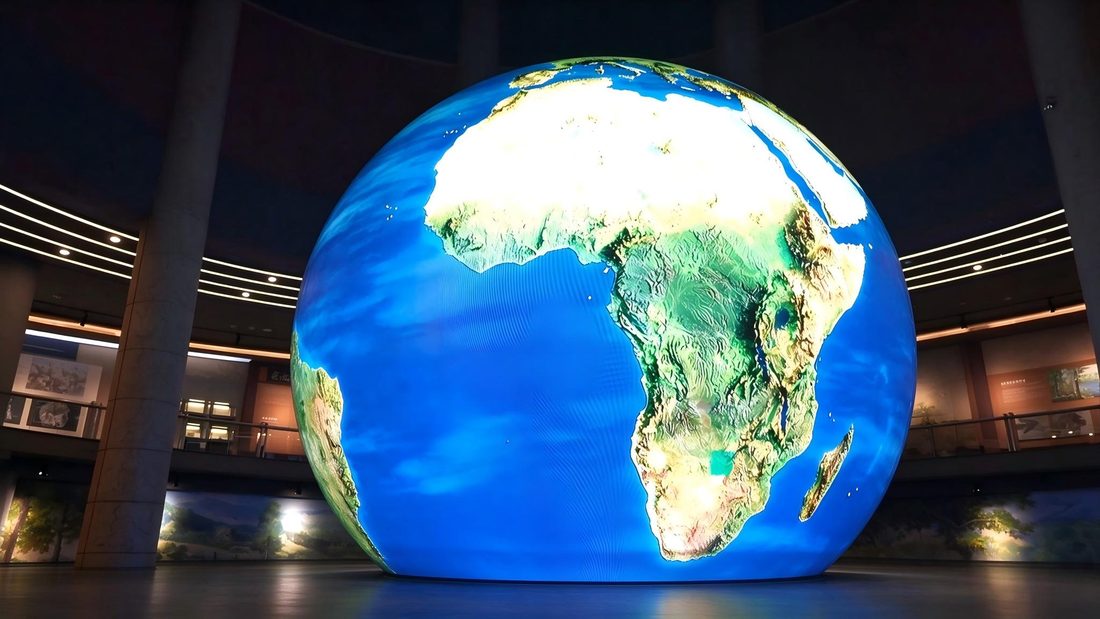
A spherical display is the rare screen whose geometry is the message. For earth science, astronomy and geography content, the sphere does what no wall can: it shows the whole system at once, from any angle, with no frame deciding what the visitor sees.
Above the sphere, the hall's star-ceiling completes the scene — the exhibit reads as a planet under a sky, which is exactly the story the gallery tells. Museum spheres in detail →
A museum sphere looks effortless on the floor and is precise underneath. Four systems decide whether it performs for a decade of daily opening.
A concealed base ring carries the sphere's weight into the hall slab. At 6 m the loading is manageable for a standard museum floor — the structure disappears visually, so the planet appears to rest on the ground like an object, not stand on legs like a machine.
Every sphere converges at its poles. We engineer the panel layout there deliberately — the top and bottom sectors are calculated so imagery compresses gracefully instead of breaking — and we warp content against the as-built geometry so the earth map lands correctly at every latitude.
Museum halls run controlled lighting, so the sphere does not need outdoor brightness — it needs calibrated color and low-brightness stability, so deep ocean blues and night-side city lights stay clean at the brightness levels visitors experience at close range.
Front service access means a gallery technician — not our engineer — can replace any module with the sphere playing. For a museum that cannot close an attraction for maintenance, this is the difference between a decade of uptime and a slow fade.
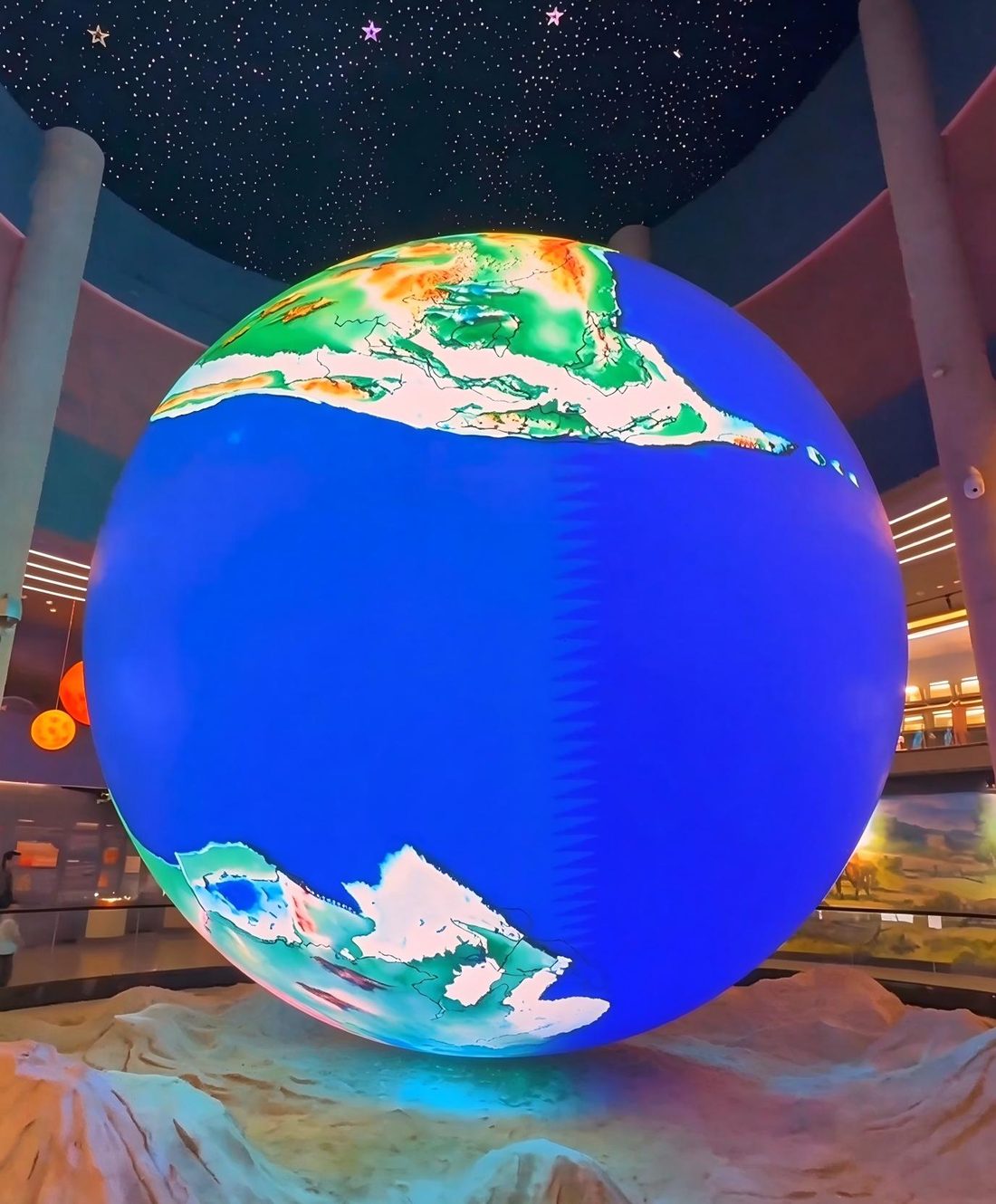
Curators notice the same thing after a sphere opens: the hall's traffic pattern reorganizes itself around the object.
A flat screen creates a queue facing one direction. A sphere invites 360° circulation — visitors spread around it, sightlines stay open, and docent groups can gather on all sides simultaneously. Hall capacity effectively rises without adding floor area.
At P3, visitors standing a meter from the equator see crisp continents and readable labels — the sphere rewards proximity instead of punishing it. That is why pitch discipline matters more on museum spheres than on distant media facades: the viewing distance here is measured in arm's lengths, and the content is designed to be read, not just watched.
Guides pause the earth rotation, zoom to a region mid-lecture, and hand the story to the next group with a playlist touch. Content control stays with museum staff, not an AV contractor — which means school programs, themed weeks and event formats evolve with the museum's calendar instead of waiting on a service visit.
None of this required special architecture: the sphere stands on the standard hall floor, runs within the gallery's lighting budget, and is serviced by the museum's own technicians. That is the practical definition of a well-sized museum sphere — big enough to anchor the hall, small enough to live inside it. Choosing a museum sphere →
Sphere content is its own craft, and it outlasts the opening ceremony when the museum can update it without an engineer.
| Content type | What visitors see | Who produces it |
|---|---|---|
| Live earth | Cloud cover, day-night terminator, seasons rotating in real time | Standard earth-data feeds mapped to the sphere |
| Deep time | Continental drift, ice ages, extinction events across geological time | Museum's own science team plus spherical-format producers |
| Themed programming | Astronomy weeks, environment days, exhibition tie-ins | Playlist updates — no re-mapping, no downtime |
| Brand & events | Anniversary takesovers, evening gala backgrounds | Any motion designer; we commission the warp once |
The mapping is commissioned against the as-built panels, so any spherical-format master produced afterwards plays correctly the day it arrives. Spheres for exhibition halls →
A practical note for exhibition planners budgeting sphere content: spherical masters are produced by a growing pool of agencies in standard formats, and once the warp is commissioned, playing a new film is a playlist edit — measured in minutes, not production cycles. Museums that treat the sphere as a programming platform, refreshed monthly rather than fixed at opening, report that it keeps drawing repeat local visitors years later. The screen's shape makes people look once; the content schedule makes them come back.
The Hezheng sphere sits in the middle of our delivered indoor range — 2 m to 26 m, with other diameters built to order. The same engineering shows up at every size.
| Diameter | Best fit | Delivered reference |
|---|---|---|
| 2–4 m | Gallery exhibits, entrance features | Indoor exhibit spheres |
| 5–10 m | Museum centerpieces, science halls | Hezheng 6 m, P3, 131 m² |
| 12–20 m | Atrium anchors, exhibition halls | Indoor landmark spheres |
| Outdoor / 20 m+ | City landmarks, building facades | Philippines 26 m outdoor sphere → |
Send us the hall drawings and your content plan — we will reply with a diameter, a pitch and a mounting concept before any commercial discussion. Museum sphere engineering → · How our sphere factory works → · All delivered projects →
Because the subject is a planet. A globe is the only display whose shape matches its content — continents wrap without distortion, the day-night terminator rotates naturally, and visitors walk around the object the way they would around a sculpture. A flat or singly-curved wall always compromises one of those.
On a floor-standing base structure designed for the hall's slab loading, with the sphere's weight spread through a concealed base ring. The hall needed no special reinforcement at this diameter — one reason 6 m is the sweet spot for museum atriums.
Pole geometry is engineered, not ignored: panel layout at the top and bottom is calculated so the image pinches as little as possible, and content is mapped to the as-built sphere so earth imagery lands correctly at every latitude.
Front service — modules are accessed from outside the sphere. A museum technician can swap a module during opening hours without special access equipment or closing the gallery.
We have delivered indoor spheres from 2 m up to 26 m. Below roughly 4 m a sphere reads as an exhibit object; from 6–10 m it becomes the room's centerpiece; above that it starts to demand architectural integration like our landmark spheres.
Send your venue drawings, dome diameter and content plan — our engineers reply within one business day with a tailored configuration.
Get a Free Quote