Factory-direct LED Dome & Spherical Displays — Shenzhen, China
✉ enquiries@luminatii.com
☎ +86 177 0402 4640

An LED sphere is the hardest geometry in our industry: every panel is a different shape, every row a different circumference, and outdoors the whole thing has to survive wind, rain and salt. We manufacture them from 2 m to 26 m diameter — indoor globes, outdoor landmarks and embedded spheres.
Wrap a flat LED cabinet around a sphere and it will touch at one point and gap everywhere else. Every row of a sphere has a different circumference, which means every module in that row needs a different trapezoid angle — and the poles need a shape that does not exist in any catalogue.
Look closely at a cheap LED sphere and you will see it: the silhouette is a polygon, not a circle. That happens when a supplier builds the sphere from standard flat modules and accepts the steps between them. It photographs well from a distance and looks wrong the moment a client walks up to it.
We generate the module geometry from the sphere model itself. Each latitude band gets its own trapezoid angle, the pole caps get their own pattern, and the panel connectors are adjustable in two axes so the installer can close the seam on a curved surface rather than forcing it.
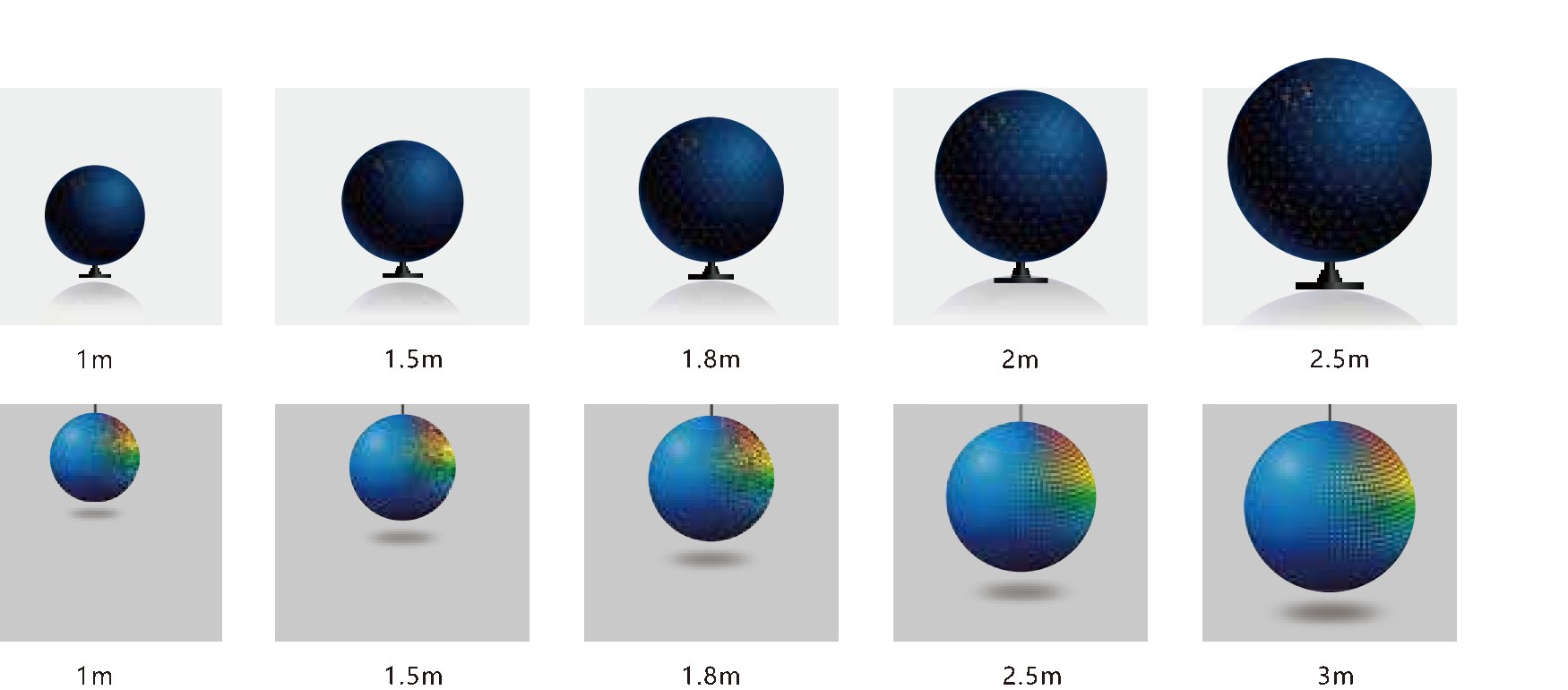
Indoor globe, outdoor landmark, embedded sphere or hanging sphere — the manufacturing differences are in sealing, structure and access, not in the pixel.
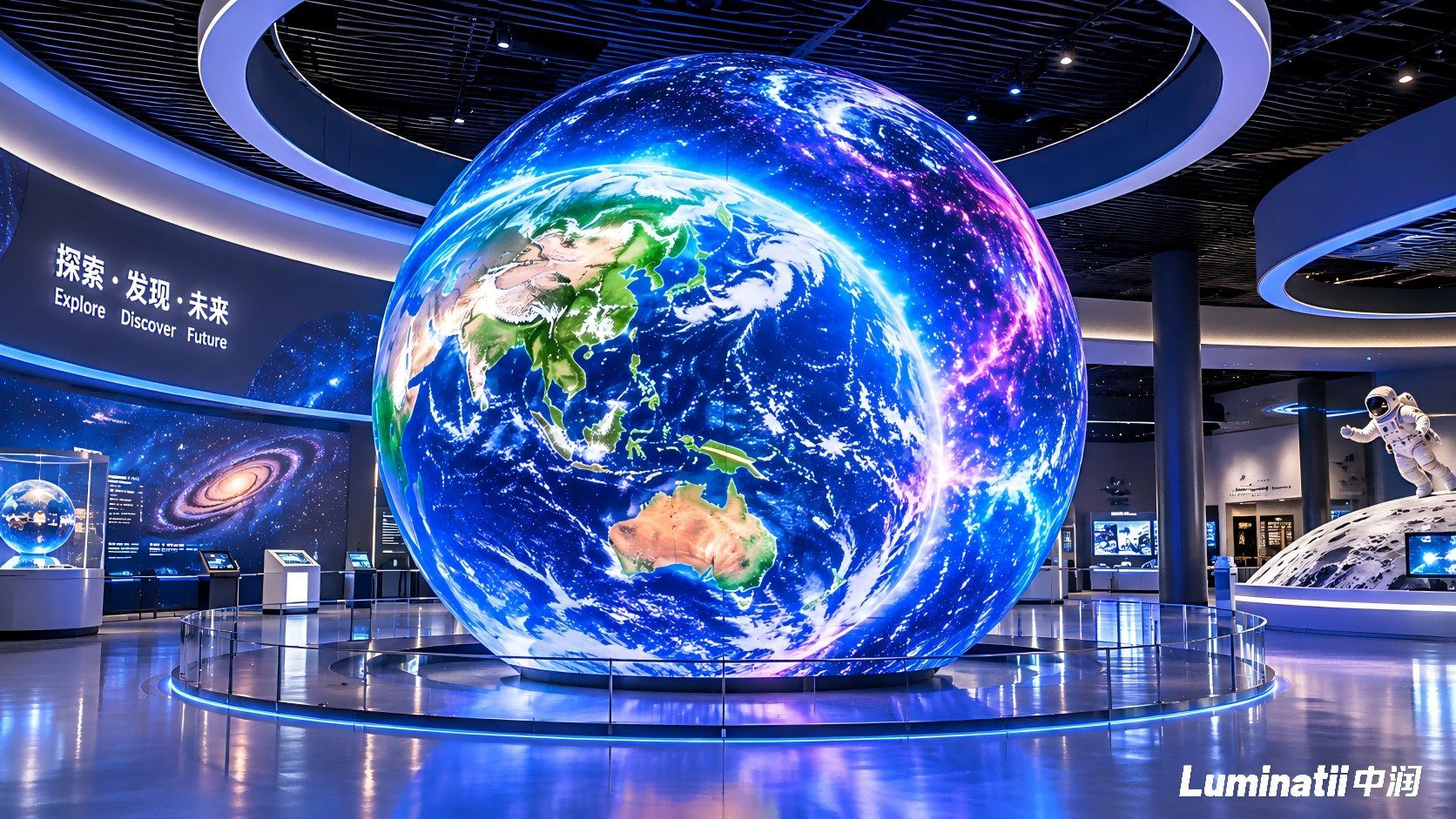
Science centers, museums, exhibition halls and corporate atria. Fine pitch, front service, quiet cooling, and a surface finish that reads correctly under interior lighting.
IP65, high brightness, wind-load calculated, with rear walkways and internal access. Built to run unattended for years in a city square or on a building roof.
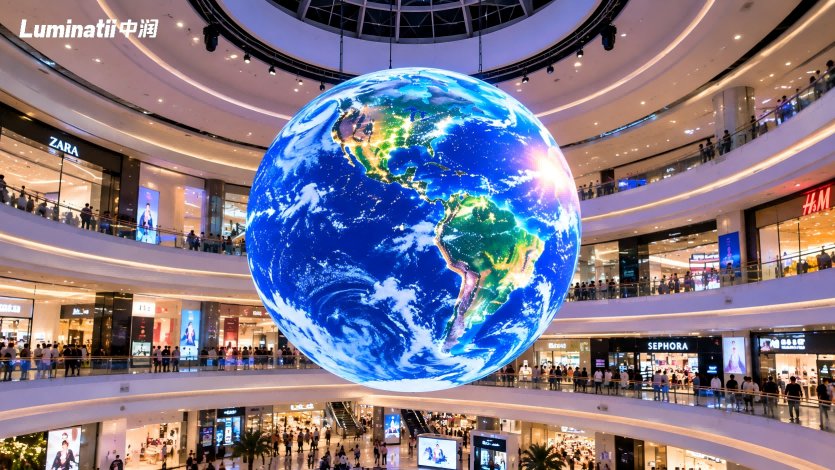
Suspended from a roof structure in an atrium: the suspension points, shell stiffness and service access are one calculation. Front service keeps maintenance off the void.
Full spherical LED display specification and configurations →
An indoor globe is a display. An outdoor sphere is street furniture that happens to be a display — and it will be judged by how it looks after three summers, not on the day it is switched on.
| Requirement | How we solve it |
|---|---|
| Water and dust | IP65 sealing on modules and cabinets, gasketed joints, sealed power and control boxes |
| Coastal corrosion | Salt-spray treatment on the screen assembly, galvanised or coated structure |
| Wind load | Structure calculated for the project location, including the local design wind speed |
| Heat | Internal airflow path designed with the shell, not added afterwards; power boxes on aluminium profiles |
| Access | Rear walkway and internal ladder where the sphere is roof-mounted; front service where it hangs over a public void |
| Cable exposure | AC and network routed inside the cabinet — nothing hanging on the visible surface |
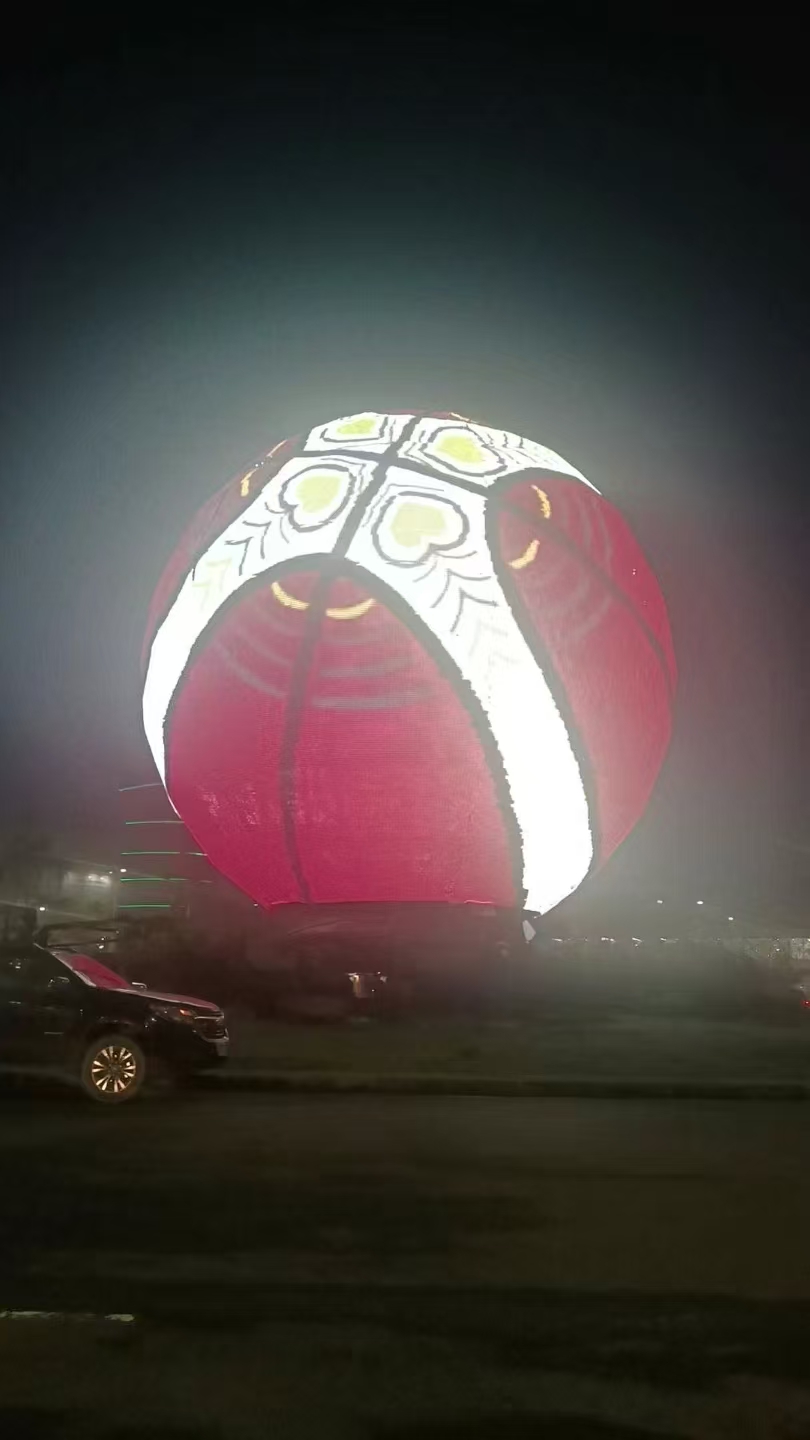
Our largest outer sphere to date is 26 m in diameter, delivered in the Philippines. At that size the structure is no longer a display bracket — it is a building envelope with a display on it, and the access strategy decides whether the client can maintain it without renting a crane every quarter.
The same engineering applies down the range. A 6 m museum globe in Hezheng, Gansu, uses the same module logic at a completely different scale, because the geometry problem does not change with size — only the structure does.
Shenzhen engineering, Huizhou production. The trapezoid modules, the connectors and the internal frame are all made to our drawings rather than sourced from a catalogue.
A sphere order starts as a 3D model, becomes a panel schedule, and only then becomes a production order. The line builds the modules band by band, so the panels that will sit next to each other on site are also tested next to each other in the factory.
Before shipment, every band is trial-fitted. If a seam does not close in Huizhou, it will not close in Manila either — and finding that out in the factory costs a fraction of finding it out on a scaffold.
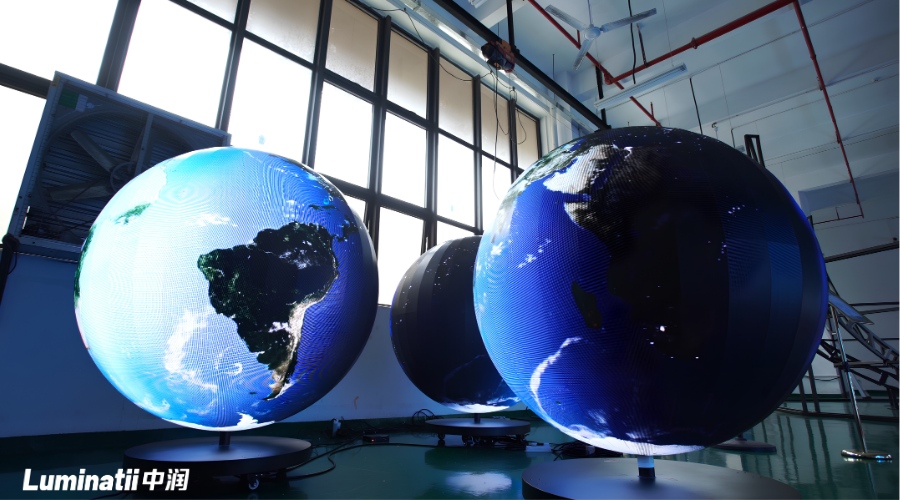
| Parameter | Value |
|---|---|
| Delivered diameter range | 2 m – 26 m (custom beyond) |
| Pixel pitch | P1.5 – P6 depending on viewing distance and indoor/outdoor use |
| Brightness | 1,200 nit indoor platform · higher for outdoor configurations |
| Contrast | 10,000 : 1 |
| Refresh rate | 7,680 Hz with 16-bit grayscale |
| Color | NTSC 90%+ · deviation ≤ 2ΔE |
| Uniformity | Brightness deviation ≤ 5% across the surface |
| Ingress protection | IP65 outdoor, with humidity / dust / salt-spray treatment |
| LED lifetime | > 100,000 hours |
| Service | Front and rear, single-operator module replacement |
| Certifications | CE (EMC + LVD) · FCC · UL/IEC 62368-1 · ISO 9001 / 14001 / 45001 |
From a 26 m outdoor landmark to a 6 m museum globe — plus the structural work behind them.
| Project | Diameter | Type |
|---|---|---|
| Philippines — outdoor landmark sphere | 26 m | Full outer sphere, IP65, front and rear service |
| Hezheng — Gansu museum globe | 6 m | Indoor globe display for a paleontology museum |
| Shopping mall atrium spheres | 2 m – 5 m | Suspended globe displays, front service |
| Science center globes | 3 m – 8 m | Interactive earth and astronomy globes |
Project photographs and site records → · The buyer's guide to spherical LED displays →
Spheres are easy to render and hard to build. These questions are cheap to ask and expensive to get wrong.
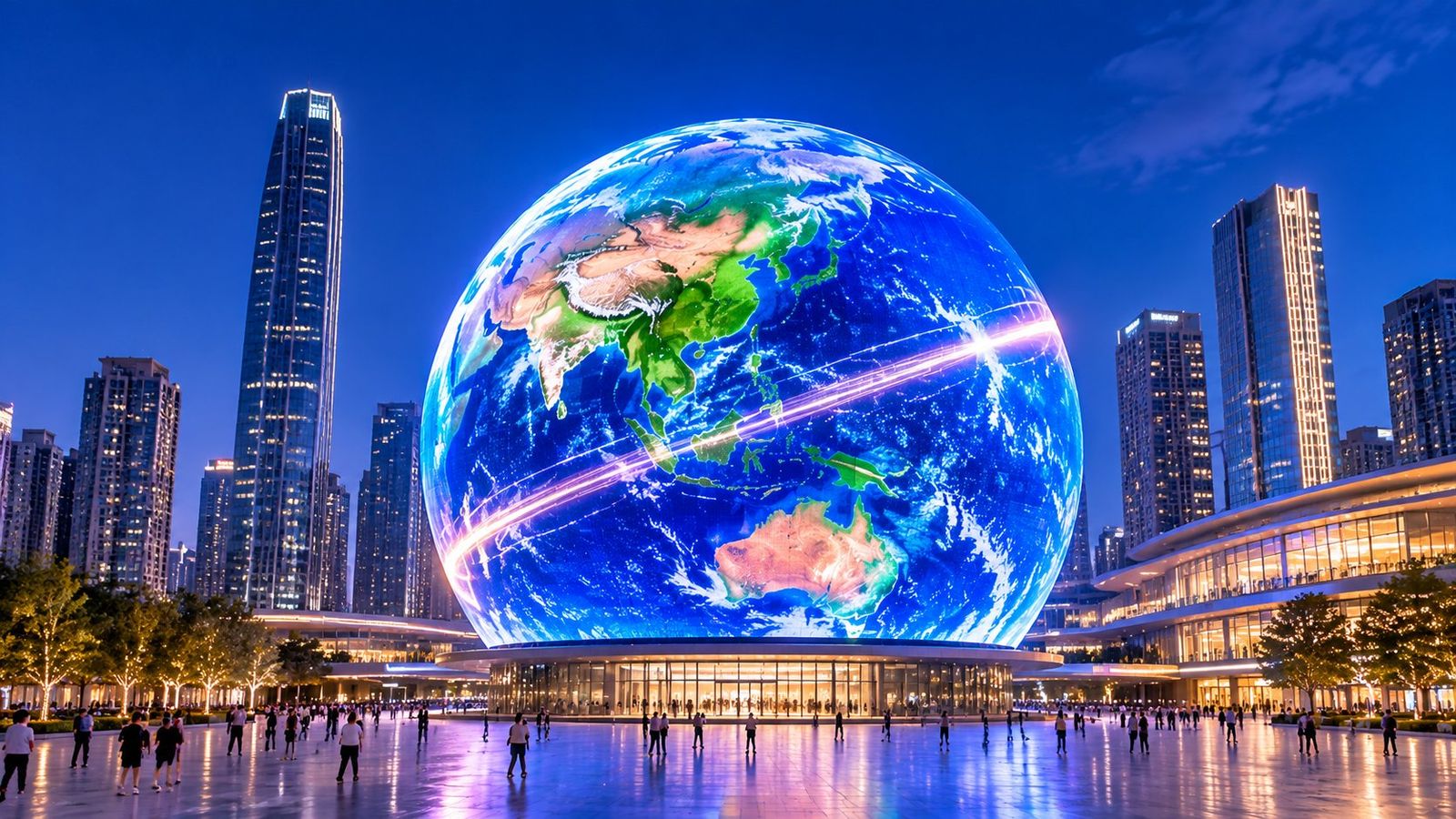
We have delivered spherical LED displays from 2 m to 26 m in diameter, including a 26 m full outer sphere in the Philippines. Beyond 26 m the structure becomes a building in its own right, and we design it as one — the diameter is not the constraint, the foundation and wind load are.
A dome is viewed from inside: the LED surface faces the audience and is usually acoustically transparent so audio can pass through. A sphere is viewed from outside: the LED surface faces the public, must be weatherproof, and is normally built with front or rear service access. The manufacturing geometry is related, but the engineering priorities are opposite.
Yes. A full outer sphere is a 360° display with no back. We map content around the full surface, and for landmark installations we split the sphere into zones so the equator can run one show while the poles carry branding or a clock.
Our outdoor spheres are rated IP65, with additional treatment for humidity, dust and salt spray for coastal sites. The power and control boxes are sealed and internally routed, and the structural connections are galvanised or coated to the project's corrosion class.
Front and rear service are both available depending on the mounting. For a hanging mall sphere, front service means a technician can replace a module from a lift without dismantling the shell; for a roof-mounted landmark, we design a rear walkway and internal access so maintenance never depends on scaffolding.
Yes. The internal space frame, the suspension or base connection and the screen are engineered together. That matters most for hanging spheres, where the suspension points, the shell stiffness and the panel gaps are one calculation — not three.
Send your venue drawings, dome diameter and content plan — our engineers reply within one business day with a tailored configuration.
Get a Free Quote