Factory-direct LED Dome & Spherical Displays — Shenzhen, China
✉ enquiries@luminatii.com
☎ +86 177 0402 4640

A dome cinema runs eight shows a day, seven days a week, for a decade. That is a different brief from a ride or a one-off attraction: the picture has to be identical at show 4,000, and the surface has to be serviceable between screenings.
Attractions open once and impress once. A dome cinema has to be equally good at the 10:30 school screening and the 19:00 evening show, six months after opening, with a queue outside.
The screen is the one component in the building that cannot be adjusted during a show. If a module fails, the audience sees it — so the design has to make a module change a five-minute task that a venue technician can do between screenings, not a service call from another country.
That is why front and rear service, single-operator replacement, the large-buckle power boxes and internal cable routing matter more in a cinema than in a one-off attraction. They are not features; they are what keeps the schedule running.
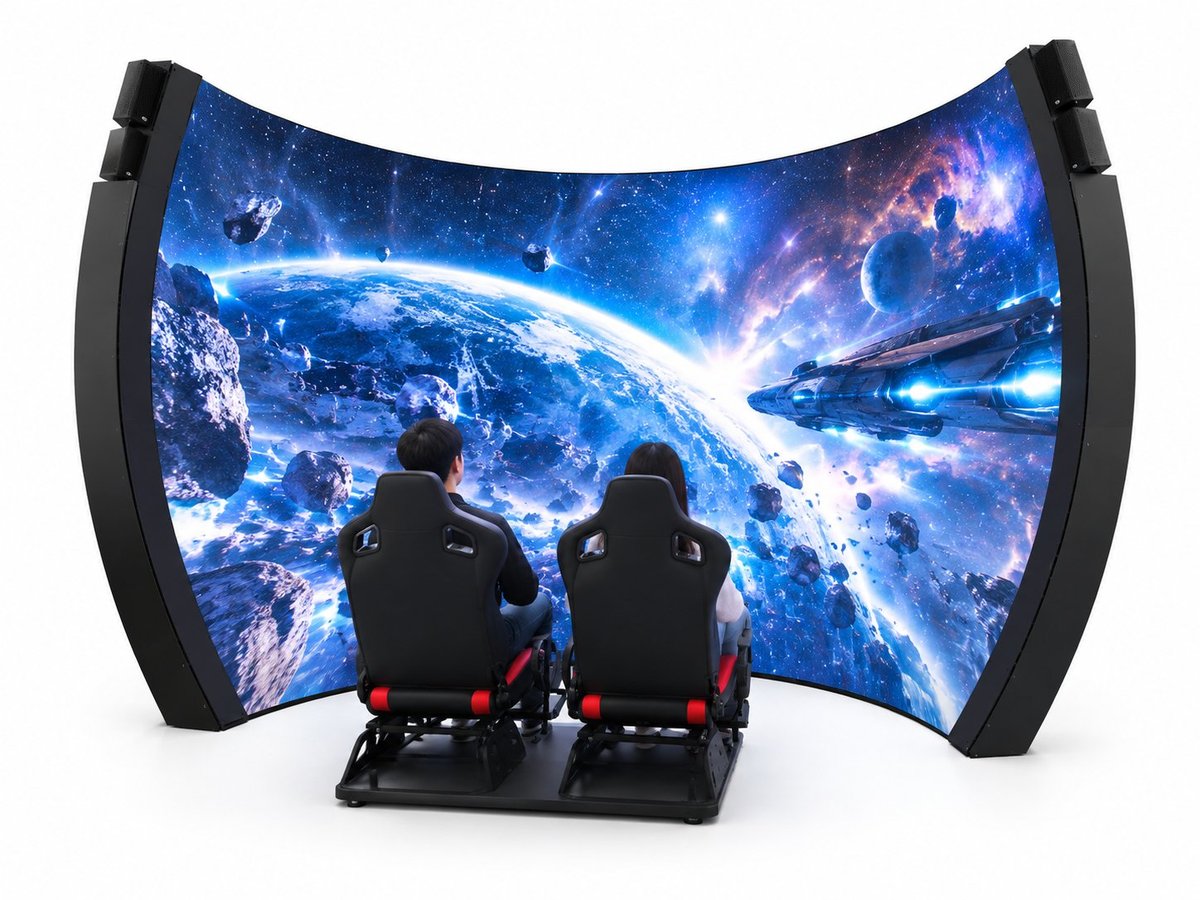
Most dome cinemas are not full hemispheres in empty rooms. They are cut spheres inside raked auditoriums, with an entry portal, a projection-free ceiling and a last row that sets the pitch.
A tilted dome puts the image in front of the audience instead of above them. It is the single biggest comfort decision in a dome cinema, and it turns the panel layout into a cut-sphere problem we model in 3D.
Domes are usually cut at the bottom to meet the floor and at the front to make an entry. Every cut changes the panel count and the structure — and it is why a catalogue dome rarely fits an existing room.
Pitch is calculated from the furthest seat. Push the last row back two metres and the pitch has to tighten, which changes panel count, power draw and heat load — a chain reaction that starts with the seating plan.
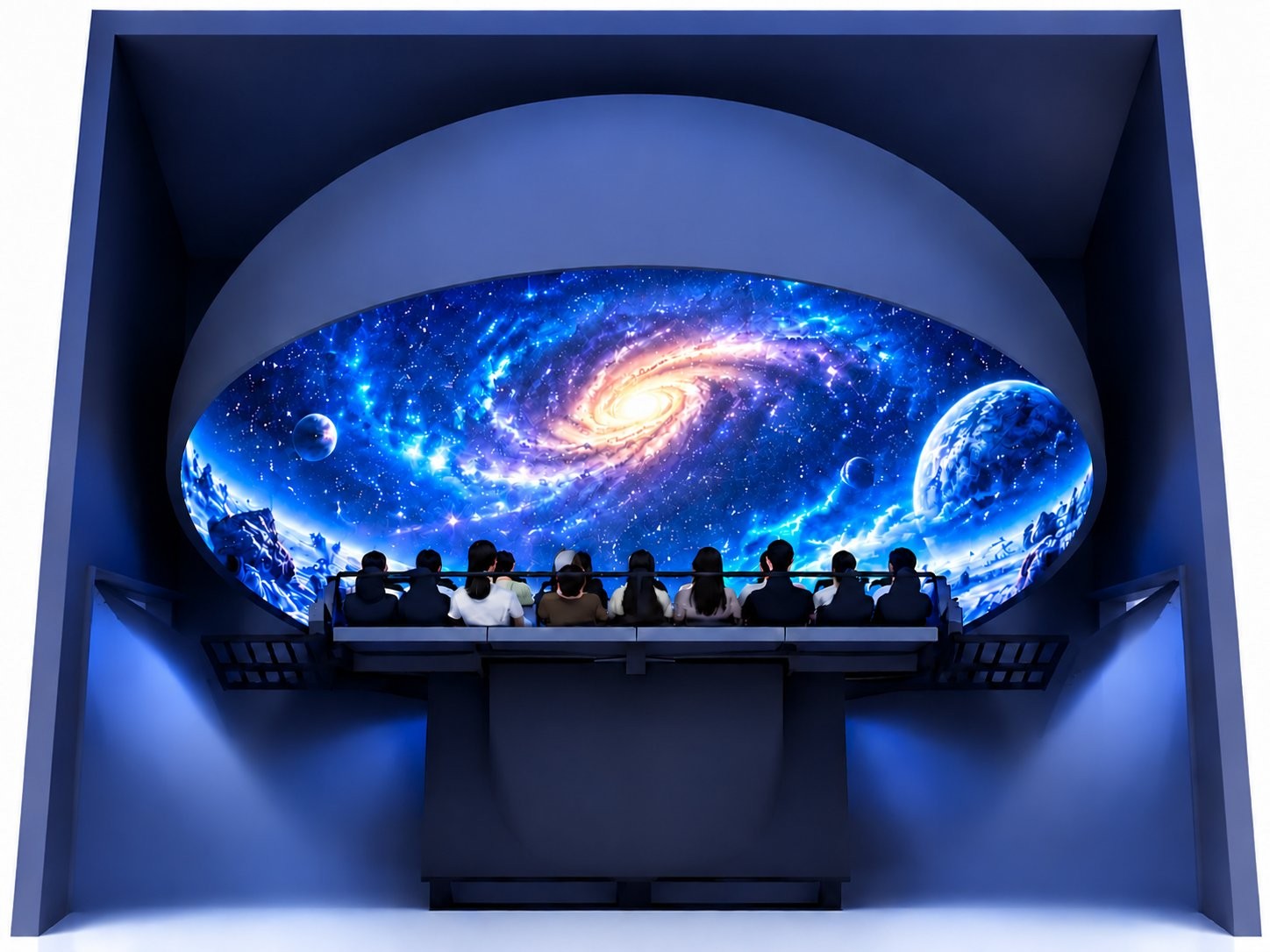
A dome cinema with a good screen and a bad seating rake is a bad cinema. Sight lines to the lower rows are the hardest part of the layout: the horizon sits low on the surface, and a seat that is too far forward loses it behind the row in front.
We ask for the seating plan early, not because we sell seats, but because the panel layout and the pitch both depend on where the audience actually sits.
Audiences forgive a lot in an attraction. In a cinema they compare the picture to a flat screen they saw last week — and the first thing they notice is whether the dark parts of the image are actually dark.
| Parameter | Value | What the audience sees |
|---|---|---|
| Contrast | 10,000 : 1 | Night scenes and space stay black instead of grey |
| Brightness | 1,200 nit at the screen face | Even illumination from the horizon to the zenith |
| Uniformity | ≤ 5% deviation | No bright patch or dim corner across the dome |
| Color deviation | ≤ 2ΔE | Skin tones and skies read as one color, not a gradient of panels |
| Grayscale | 16-bit | Smooth gradients in fog, water and star fields |
| Refresh | 7,680 Hz | No flicker on camera — for trailers and social content |
The comparison buyers should make is not LED versus projector in the abstract, but this: after four years of 3,000 shows, which surface still looks like the day it opened? Read the full LED and projection dome comparison →
A dome cinema lives on content. The screen has to accept a licensed fulldome film on Monday and a locally produced show on Friday without a re-commissioning project in between.
Fulldome masters arrive in different projections — fisheye, equirectangular, or a bespoke format from the producer. The playback system warps and blends them onto the physical panel map, and it has to do so consistently enough that the horizon line sits at the same height in every film.
The alternative — a playback system that needs an engineer on site to change a film — is how dome cinemas end up running the same show for three years.
We train the operator team at handover, including how to recover from a source failure mid-show — the one scenario every cinema eventually meets.
One question comes up at every cinema project: does the screen have to be acoustically transparent? Not necessarily. In a fixed-seat cinema the audio design can place surrounds around and below the dome, and a solid surface is cheaper and slightly brighter. But if you want the sound stage to sit inside the picture — which is what makes a dome feel different from a very large flat screen — the 50% perforated surface lets you put the array behind the screen with under 5% loss and an audio-visual sync error below 0.02 seconds.
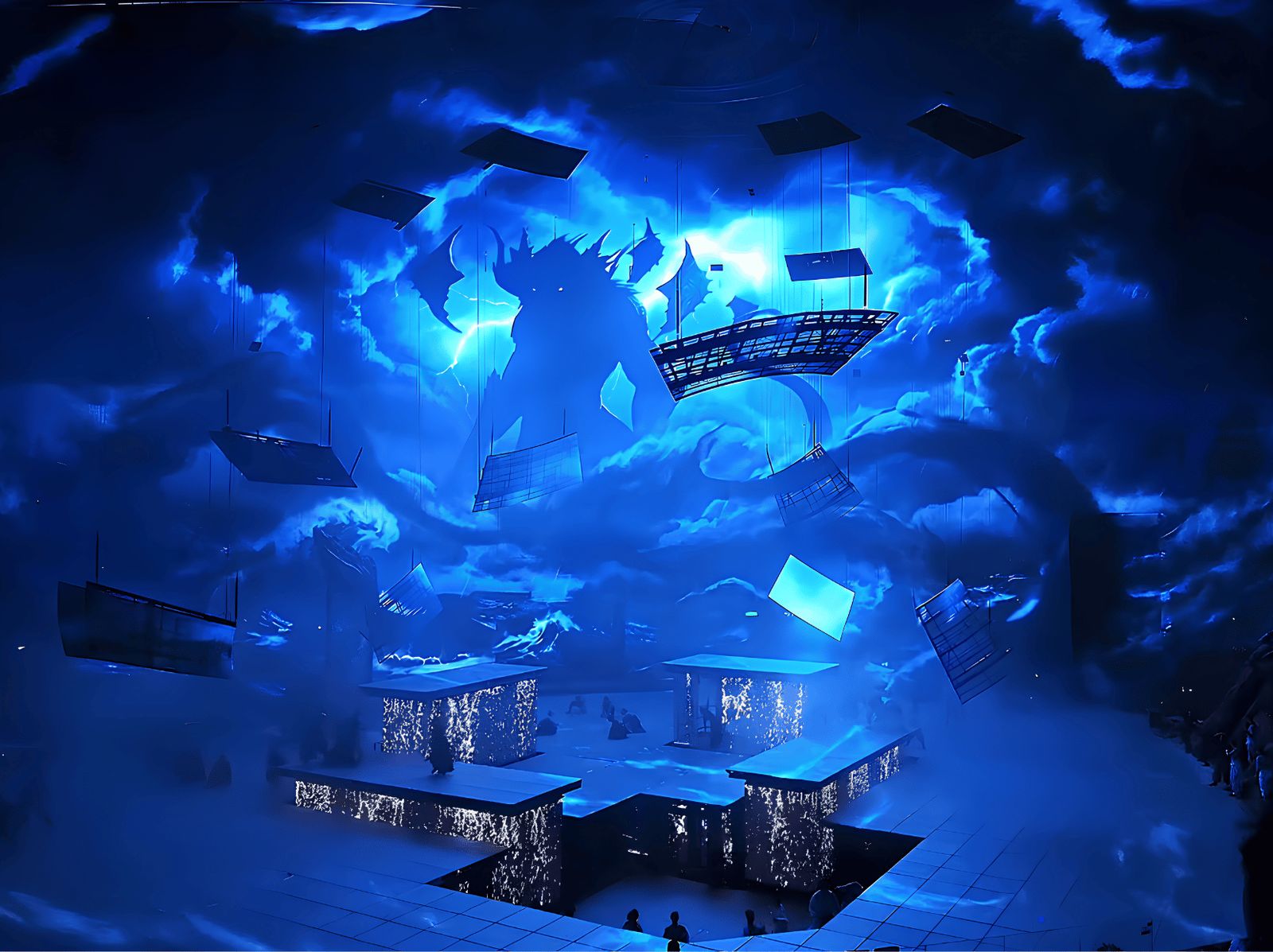
From compact exhibit cinemas to a 60 m kinetic dome with a full show programme.
| Project | Diameter | Operating model |
|---|---|---|
| Kongtong Island — Shandong | 60 m | Large-format show dome with 8 kinetic screens, 6 mechanical doors and live performance |
| Dinosaur Dream Factory — Huangshi | 22 m + 28 m | 720° dual dome with digital floor, running daily since June 2024 |
| Changzhi — Shanxi | 20 m | Acoustically transparent inner dome for scheduled screenings |
| Guiyang — Guizhou | 14 m | Cultural-tourism dome with a recurring show |
| Beijing twin domes | 5 m / 8 m | Compact exhibit cinemas with a continuous daily programme |
Dome screen technical platform → · All applications → · Project record →
The audience. In a flying theater the seats move and the dome is part of a ride; in a dome cinema the seats are fixed and the dome is the whole experience. That changes the pitch calculation — a cinema sets it from the back row, a flying theater from the nearest seat — and it changes the service strategy, because a cinema has to be maintainable between screenings.
Usually, yes, in a raked auditorium. A tilted dome faces the audience instead of sitting flat overhead, which puts more of the image in the primary field of view and reduces the strain of looking up for 40 minutes. The tilt changes the panel layout from a hemisphere to a cut sphere, which we model rather than approximate.
It follows the diameter and the layout. A 10 m dome is a small auditorium, a 20 m dome a medium one, and the 60 m Kongtong dome is a large-format attraction with a different operating model entirely. Seat count and sight lines decide the diameter long before the screen does.
Yes. Fulldome content is authored as a fisheye or equirectangular master, and the playback chain warps it onto the dome. We commission the mapping against the as-built panel map so the horizon line and the pole land correctly, which is what makes a licensed film look the way its maker intended.
Module replacement is a single-operator task from the front or the rear walkway, and the panels are designed so a module can be changed without disturbing its neighbours. Routine cleaning is a dry process on the screen face; nothing requires scaffolding in the auditorium.
Less than a projection dome does. An LED surface emits its own light, so a dome cinema can operate with some ambient light — useful for daytime openings, school groups and emergency egress lighting. The room still needs to be controlled, but it does not have to be a black box.
Send your venue drawings, dome diameter and content plan — our engineers reply within one business day with a tailored configuration.
Get a Free Quote