Factory-direct LED Dome & Spherical Displays — Shenzhen, China
✉ enquiries@luminatii.com
☎ +86 177 0402 4640

IP65 is a two-digit code that hides a decade of engineering. On an outdoor dome or sphere, water does not politely fall: it is driven by wind into every joint, carries salt in coastal air and dust in dry climates. Here is what sealing a curved screen actually involves — and why the maintenance plan matters as much as the rating.
IP65 looks like a checkbox. In practice it is a design commitment that touches module construction, connectors, cable entries, thermal path and service strategy — and it is tested by a decade of weather rather than by a certificate. The first digit, 6, means dust-tight. The second, 5, means protected against water jets. For an outdoor dome or sphere, those are the right targets: driven rain, spray cleaning, and dust that finds every unsealed seam.
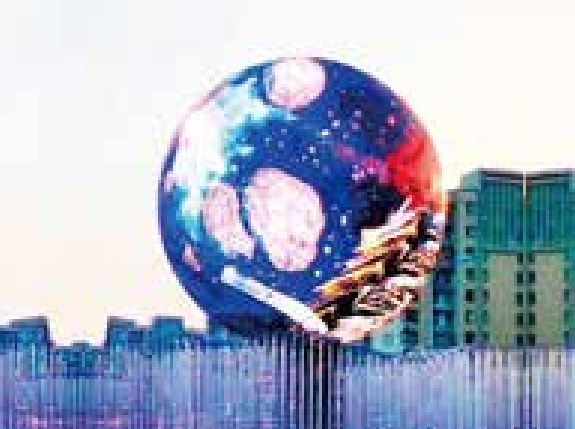
Every one of those is a curved-surface problem: a sphere has joints in more orientations than a flat wall, so a sealing strategy designed for a planar screen does not transfer.
Rain rarely defeats a module face. It defeats the places where systems meet — and those places are where procurement should look.
| Weak point | What fails | Our approach |
|---|---|---|
| Cable entries | Water tracking along the cable into the enclosure | Cabling routed inside the module enclosure; entries sealed, not merely covered |
| Module joints | Capillary action drawing water between modules | Sealing at the joint geometry, with service access preserved |
| Connectors | Corrosion in salt air, intermittent contacts | Materials and finishes specified for salt fog, not just fresh water |
| Power boxes | Heat trapped by sealing, then condensation | Aluminium profile enclosures with large-latch access: dissipate heat, service quickly |
| Structural interface | Water pooling where screen meets steel | Interface details designed with drainage and access in mind |
The pattern is that sealing and serviceability pull in opposite directions — a perfectly sealed box is a box nobody can open. Our design resolves it with front-and-rear access: technicians reach modules without breaking the weather seal of the whole sphere, and the seal at the module boundary is restored as part of the standard swap procedure. How swaps work in practice →
Materials carry as much of the load as geometry. Fasteners, connector plating and enclosure finishes are chosen for the atmosphere the sphere will live in, not for a generic outdoor case, and the specification states salt-fog protection explicitly so it can be verified rather than assumed. On a coastal landmark that is the difference between a screen that opens with a clean surface and one that opens with a corrosion map forming around every joint.
Ask any outdoor supplier to put the protection class, the salt-fog specification and the seal-inspection interval in the same document. If the three appear together, the design was thought through as a system; if only the IP number appears, you are looking at a marketing line rather than an engineering commitment.
The clearest outdoor case in our delivered range is a 26 m diameter full exterior sphere in the Philippines — a coastal installation, specified to IP65, designed as a night-time landmark where the screen is the building. It is the kind of project where every sealing decision is tested daily by sea air.
| Requirement | Why it matters on this project | Design response |
|---|---|---|
| Full exterior surface | Every square metre faces weather; there is no sheltered side | Complete sphere specified to IP65, not a facade-only treatment |
| Coastal atmosphere | Salt fog attacks contacts and finishes | Salt-fog protection included in the specification |
| Night-time landmark | The sphere is the attraction, so any dark module is a visible defect | Parallel drive design plus calibrated uniformity across the surface |
| Public location | Service access must be safe and unobtrusive | Rear access from service platforms; routine work by the venue's own team |
Client details on that project are confidential, and we do not publish figures we have not been authorised to share — but the engineering pattern is the same one we apply to every outdoor sphere, from a 2 m display globe to a 26 m landmark. The Philippines 26 m case →
An outdoor sphere competes with sky and sun, so its 1,200 nit output is used differently from an indoor dome's: content is graded for daylight legibility first and night drama second. Our screens carry that headroom, and the schedule shifts with the light.
Wind load becomes a primary design case rather than a check, with pressure varying across the curved surface. Steel, fixings and interface details are calculated per project — there is no "standard" outdoor sphere structure.
A sealed enclosure traps heat, and an exterior sphere is heated from outside as well. Aluminium profile power boxes, ventilation of the structure cavity and material choice all serve the same goal: keep the electronics inside their operating window.
Seal inspection joins the schedule as a seasonal item. Coastal sites get the tightest rhythm, because salt damage compounds: a small breach found early is a module swap, while the same breach found late is a rebuilt section.
Indoor domes still benefit from the same discipline — a sealed interior sphere faces dust and humidity, not rain — which is why our module architecture is shared across the range and only the protection class changes. Outdoor spheres as a product → · Sphere manufacturing → · Talk to the dome team →
One final procurement point that buyers rarely raise until it is too late: who inspects the seals, and how often? IP65 is not a permanent property. Gaskets compress, sealant ages, fixings loosen under thermal cycling, and a single failed seal on a coastal sphere can corrode an enclosure from the inside out. Write the inspection rhythm into the operating plan — seasonal for coastal and humid sites, annual for dry inland installations — and keep a small stock of spare modules so a repair is same-week rather than same-quarter. Protection is a rating on day one and a routine thereafter.
The first digit (6) means dust-tight: no dust ingress. The second (5) means protection against water jets from a nozzle — not continuous immersion. For outdoor LED screens that is the correct target: rain driven at an angle, wash-down cleaning and spray, rather than submersion. A supplier claiming IP68 for a dome screen is usually overstating, because the connectors and service openings are the weak points, not the module face.
Salt. Salt-laden moisture deposits on surfaces, sits in joints, and attacks metals and contacts in ways fresh water does not. A screen that survives rain in an inland city can corrode near the sea within a couple of seasons unless salt-fog protection is specified in materials and finishes. Our outdoor screens are specified for salt fog, not just water.
A sphere presents a changing profile to the wind: pressure distribution varies across the surface, and uplift and local suction appear in different zones. The structure is calculated per project for the site's wind load, and the screen's fixing details follow that calculation. A flat-screen wind assumption cannot simply be reused — which is why structural design and screen design belong together.
It can be maintained, but scheduling becomes part of the plan. Rear access from service platforms lets technicians work behind the screen without dismantling it, front access covers the interior where applicable, and seal inspection is a scheduled item rather than a reaction to a fault. In coastal installations we recommend the inspection rhythm be set by season, not by failure.
It constrains the design rather than degrading it: sealing around a module adds material at the edges, so narrow-bezel construction and careful thermal design matter more outdoors. Heat is the real trade-off — a sealed enclosure traps heat, which is why our power boxes use aluminium profiles for dissipation and why ventilation of the structure behind the screen is part of the design.
Send your venue drawings, dome diameter and content plan — our engineers reply within one business day with a tailored configuration.
Get a Free Quote