LED dome brightness is the specification most often quoted in a dome contract and the one most often left undefined. A buyer reads 1,200 nits on a datasheet, compares it with a flat LED wall quoted at 1,500 nits, and concludes the dome is the dimmer product. The same buyer then sits inside a 22 m dome and finds the screen almost painful during a white-out frame, and flat and gray during a night scene. Both reactions are accurate, and neither is about the number on the datasheet.
Luminatii Technology Co., Ltd. has delivered more than 20 large LED dome projects between 5 m and 60 m in diameter, from the paired 5 m and 8 m domes in Beijing to the 60 m, 5,300 m² dome on Kongtong Island in Shandong. The pattern is consistent: the domes that look best are not the ones with the highest number attached, but the ones where peak luminance, black level, perforation and room light were decided as one problem instead of four.
What follows is how our engineering team thinks about it: what a nit measures, why a dome needs fewer than a flat wall, what perforation costs in apparent brightness, where the contrast actually goes, what extra nits cost in power and heat, and the questions that make two brightness claims comparable.
What a Nit Measures, and What It Hides
A nit is one candela per square meter — a property of the emitting surface, measured at that surface, independent of viewing distance. Move twice as far away and each pixel covers a quarter of the retinal area, but light per unit area per steradian does not change. That is why a nit figure needs no reference to room size, and why it is so easy to compare two numbers describing different viewing situations.
Three things the number hides matter more than the number. First, where it is measured — on the bare LED surface, on a perforated screen face, before or after calibration. Second, at what drive condition — a panel can reach a headline figure at a current that shortens its life. Third, the black level, because a display that reaches 1,200 nits but only falls to 1 nit does not have the contrast the brochure implies.
This is the specification set behind the domes we deliver. Every row has to be measured.
| Parameter | Specification | How it is measured | Why it decides the picture |
|---|---|---|---|
| Peak white luminance | 1,200 nit | Screen face, full-white field, after calibration and warm-up | Headroom for highlights and for content graded bright |
| Contrast ratio | 10,000:1 | Full white against full black, same instrument and distance | Sets black level, and therefore depth in dark scenes |
| Brightness uniformity | Deviation of 5% or less | Grid across the dome, normalized to a reference point | Stops sky, cloud and star fields from showing patches |
| Grayscale processing | 16-bit | Driver and processing chain, gray ramp test | Keeps low-gray gradients from banding |
| Peak power | 150 W/m² at 1,200 nit full white | Full-white field, at the distribution board | Sizes feeders, transformers and cooling |
The table says nothing about the room, though. It does not say that 1,200 nits is right for every venue. Brightness is a match between a screen and an environment, and the environment is the variable buyers control least. The LED dome screen range is engineered to that match rather than to a headline figure.
Why a Dome Needs Fewer Nits Than a Flat Wall
The human eye does not measure luminance. It adapts to the mean luminance of whatever fills the visual field, then reports everything else relative to that. With a flat LED wall in a lit room, the wall occupies perhaps 20 to 40 percent of the field and the room the rest; the eye adapts to the room, so the wall must be several times brighter than the room to look bright at all. In a dome, the screen is the field. There is no competing surround, because every direction the audience can look without turning their head is screen.
The geometry makes that quantitative. A flat screen filling 60 degrees of the field subtends about 0.84 steradians. A hemisphere subtends about 6.3. At identical surface luminance the dome therefore delivers roughly seven times the light into the eye — and a screen filling only 30 degrees is a factor of thirty. That is why a 1,200 nit dome reads as brighter than a 1,500 nit wall, and why pushing a dome to wall-level numbers produces glare rather than impact.
A second effect runs the same direction: content. Fulldome footage is not white; a typical show spends most of its running time well below peak, and the frames that hit peak are short. Peak luminance gives those frames somewhere to go — it does not describe the average frame.
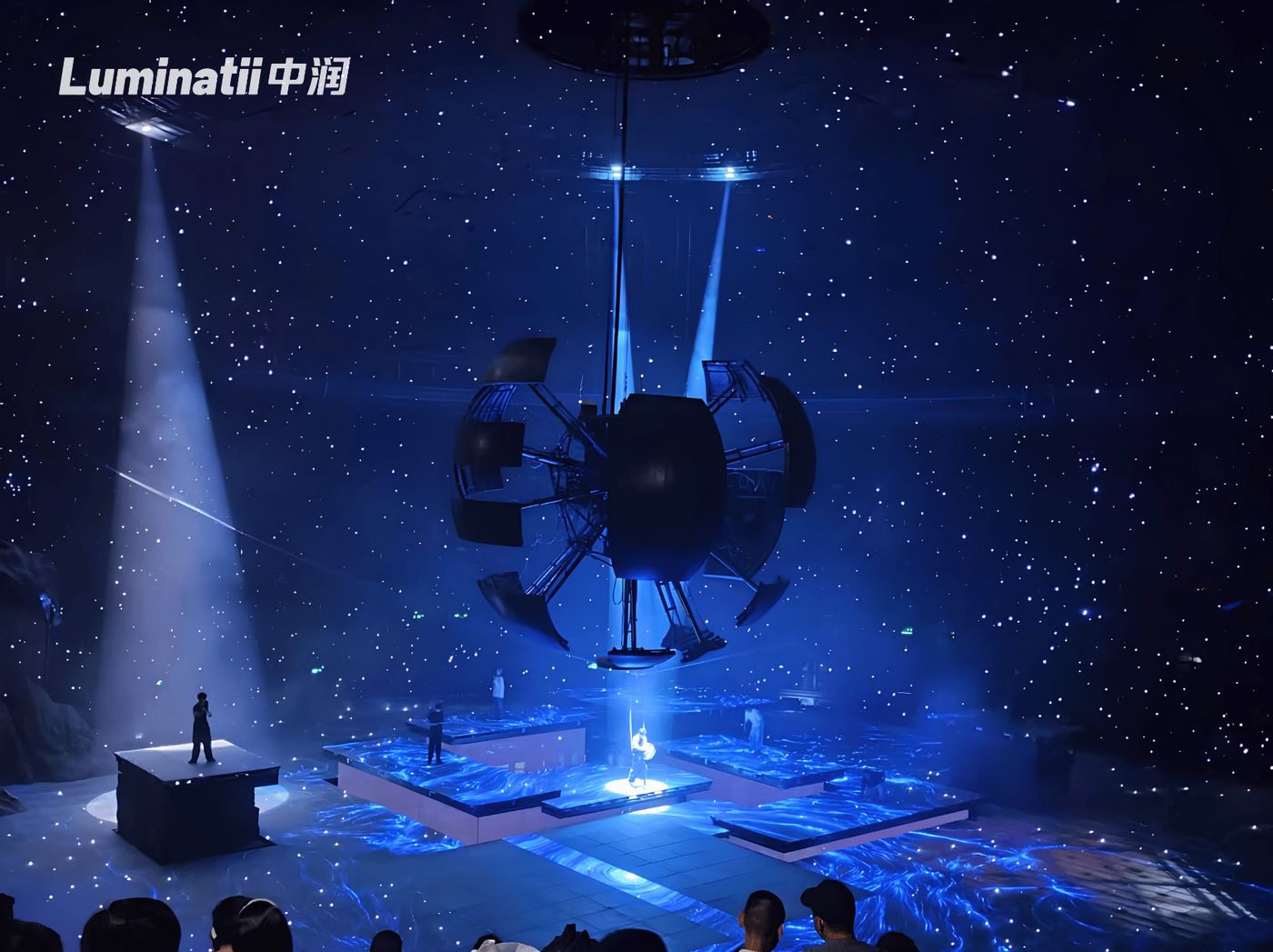
This is also where refresh and grayscale stop being separate specs. A 7,680 Hz refresh with 16-bit gray processing keeps a bright, fast-moving frame from strobing as the camera pans. Push brightness up without that headroom and the artifacts show first in exactly the content a dome is built for: flight, orbit, water, fire.
The Perforation Tax on LED Dome Brightness
Most large domes are acoustically transparent, and that decision has a brightness cost that never appears on a datasheet. The screens we build run 50 percent open area, with transmission loss below 5 percent across the speech and music bands — what allows a surround system to sit behind the picture with audio and video locked to within 0.02 seconds. On the Kongtong dome the surround array is mounted behind the perforated shell, alongside eight liftable and openable screen sections, four 3D wire-rigging sets, six mechanical doors and ten lifting floor panels.
Half the screen area is holes. The 1,200 nit figure is measured on the lit LED surface; once the audience is far enough away that individual apertures fall below angular resolution — a few meters inside a dome is enough — the eye integrates the screen as a surface, and the area-averaged luminance it receives is on the order of half the lit-surface value. In round terms, a 1,200 nit perforated dome presents closer to 600 nit, while a solid outdoor sphere at the same lit-surface figure presents the full amount.
Two consequences follow. Comparing the nits of a perforated dome with the nits of a solid wall is not a comparison; it is two measurements wearing the same unit. And the sequence of decisions matters: decide whether you need acoustic transparency first, because if you do, the perforation loss is already committed, and trimming the luminance spec afterward to save power removes the headroom bright content needs. The trade-off is set out in our article on the acoustically transparent LED dome.
Contrast, Black Level, and the Ambient Light Problem
Contrast is the specification that decides whether a dome looks expensive. At a peak of 1,200 nits and a ratio of 10,000:1, the panel's own black level works out to 0.12 nit — dark enough that a star field reads as points of light against nothing at all.
That number only survives if the room lets it. A matte screen reflects a small fraction of any light landing on it. Assume roughly 2 percent diffuse reflectance, typical of a matte black screen face: general lighting putting a few hundred lux on the screen — an atrium, a museum hall with the lights up, a lobby with a glazed facade — reflects one to two nits back at the audience, ten times the panel's own black level. Contrast collapses from five figures to a few hundred to one, and extra peak brightness does not repair it, because adding nits lifts the white point while leaving the reflected floor where it was.
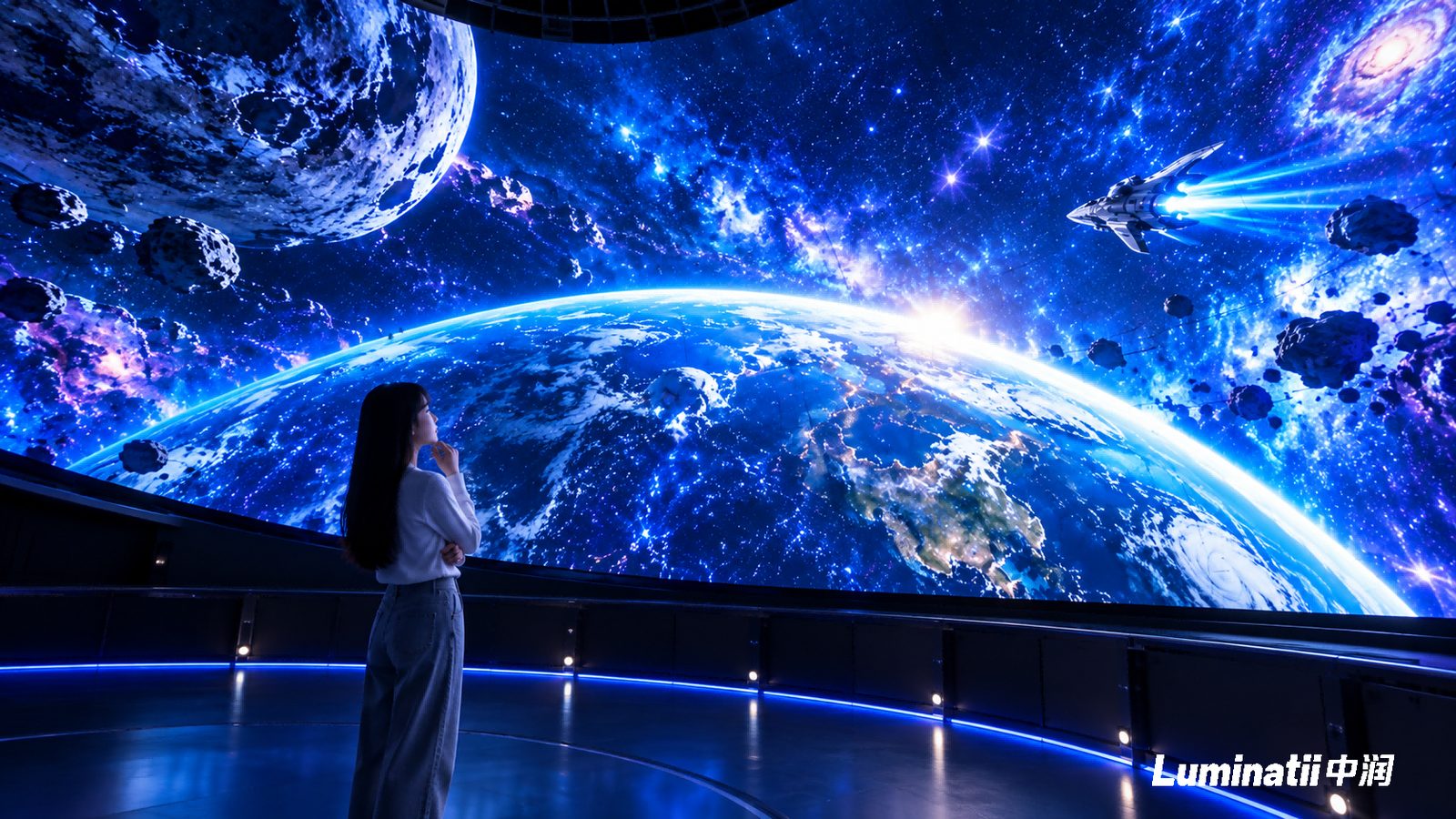
This is the most common mistake in dome specifications: comparing suppliers on peak nits when the real constraint in the building is stray light. The money is better spent on light control — matte black finishes on every surface the audience can see, no downlights aimed at the screen, a vestibule so doors do not spill daylight into a dark show, aisle lighting shielded and dimmed on cue. We would rather defend a 1,200 nit dome in a dark, well-detailed room than a brighter one in a room that fights it.
The same logic explains why 16-bit gray processing, uniformity within 5 percent and color deviation within 2ΔE matter more than another few hundred nits. Dark scenes are where dome screens are exposed: a 65,536-step gray ramp holds a slow fade out of black without stepping, and a tight uniformity tolerance keeps a cloud bank from breaking into patches as it crosses the shell. Brightness is what buyers ask about; low-gray behavior is what the audience notices.
| Venue condition | Light reaching the screen | What 1,200 nit delivers | What to fix first |
|---|---|---|---|
| Enclosed theater, black interior | Effectively none once doors close | Full contrast, highlights with headroom | Nothing — protect it with light locks and matte finishes |
| Theater with entrance or glazed-door spill | Variable, worst at show start | Contrast drops before peak brightness is ever the limit | Vestibule, door interlocks, dimming cue at start |
| Museum or atrium dome, general lighting on | Hundreds of lux at some angles | Peak is not the constraint; black level is | Shade the shell from luminaires, specify screen finish |
| Semi-open or glazed roof structure | Daylight, changing through the day | Only the darkest scenes hold their depth | Treat as hybrid; grade content for high ambient |
| Outdoor sphere (separate product line) | Direct sun | Brightness is specified per site, not by the dome figure | IP65 housing, sealed cooling, sunlight-rated spec |
The Power and Heat Behind Every Extra Hundred Nits
LED dome brightness is paid for twice: once at purchase, and again on every electricity bill for the life of the venue. At 1,200 nits full white the screen draws 150 W/m². Across the 5,300 m² Kongtong dome that is about 795 kW at full white — a figure that sizes the distribution board, the transformers and the generators, and that is almost never what the meter shows, because no show runs at full white for long.
That gap is where electrical design goes wrong in both directions. Size the supply for peak, because a white flash frame really does draw it; size cooling for average picture level plus margin; then meter the building for a season. Nearly all of the input power leaves the screen as heat, and in a dome most of it is dumped into the void between screen and structure — the same cavity that carries the audio, the walkway and the cabling. Removing it is a mechanical design problem, and far cheaper while the structure is still on paper.
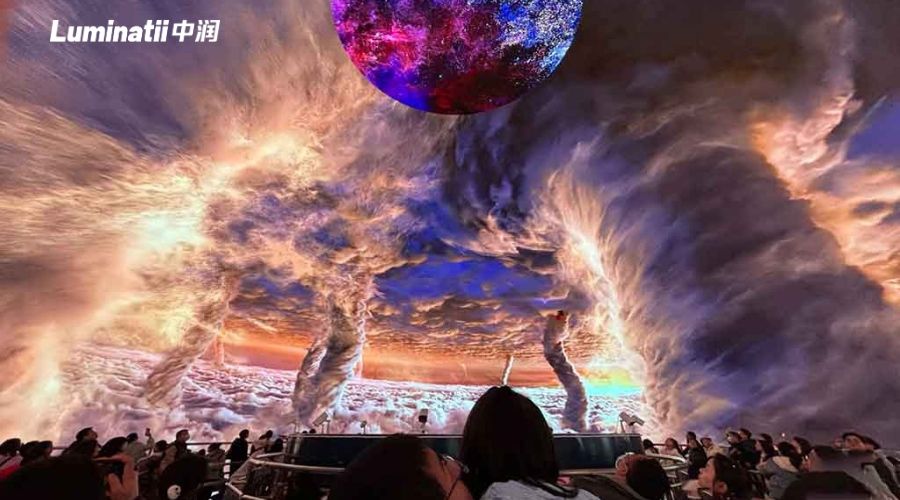
There is a lifetime cost too. The LEDs are rated above 100,000 hours, and that rating is tied to a drive condition and a junction temperature. Running the emitters harder for a brighter headline figure trades against both: shorter life, and differential color shift that surfaces years later as faint patches where one batch of modules aged differently from its neighbors. With a screen weight of 8.5 kg/m² on the Kongtong dome against an industry norm of 15 to 25 kg/m², the structure has margin to spare — the constraint on brightness is thermal and electrical, not structural.
Five questions separate a meaningful brightness claim from a marketing one:
- Is the figure measured on a full-white field, on the finished perforated screen, after calibration and warm-up?
- What is the black level in nits, and at what ambient illuminance does contrast stay acceptable?
- At what drive current is that brightness achieved, and what is the life rating at that current?
- What is the power per square meter, and what cooling load does it imply at realistic average picture level?
- How is uniformity verified after installation — which instrument, at what distance, with what pass/fail threshold?
A supplier who can answer all five is describing a product. A supplier who answers only the first is quoting a number. The relationship between pitch, viewing distance and perceived sharpness is in our pixel pitch guide.
Questions Buyers Ask About LED Dome Brightness
Is higher LED dome brightness always better?
No, and past a point it works against the show. Inside a dome the screen fills the visual field, so the audience adapts to the screen itself; too bright a screen flattens dark scenes, strains the eye and hides the low-gray detail the content was graded to show. The right figure matches the room, the content and the seating — which is why brightness belongs with the venue plan, not on a comparison table.
How do I know whether 1,200 nit is enough for my venue?
Start with the light, not the screen. If the dome closes to a dark interior with matte, unlit surfaces, 1,200 nit at 10,000:1 gives more headroom than most content uses. If general lighting stays on or daylight reaches the shell, the limit is reflected light raising the black level, and the fix is shading rather than a bigger number. Send us the room conditions and we will tell you which problem you have.
Does brightness stay consistent when the audience looks toward the edge of the dome?
Uniformity is a screen-face measurement, held to a deviation of 5 percent or less across a grid, verified after installation because the geometry of a sphere changes the measurement. What changes with seat position is the angle at which the audience views the emitters, a property of the LED optics rather than the drive electronics — which is why acceptance testing has to fix the instrument position and reference point in advance.
Do I need a dark room for an LED dome?
Not a blacked-out one, which is the practical advantage over projection. An LED dome is emissive and does not depend on a projector's light path, so it holds a usable picture with the house lights partly up. That said, "usable" and "good" are different standards: every lux landing on the screen adds to the black level, so a room that controls stray light will always look better at the same brightness.
Do outdoor spheres need the same brightness as indoor domes?
No. The outer sphere competes with sun and sky rather than a dark interior, so brightness is specified per site against actual ambient conditions, and the housing is sealed to IP65 with moisture, dust and salt-spray protection. Our reference for that line is the 26 m outdoor sphere delivered for a coastal site in the Philippines, where salt load drove the enclosure design as much as brightness did.
If you are comparing dome proposals, send us the room section, the lighting layout and the content you intend to run. We will tell you what brightness the venue can support, and where the money is better spent. Talk to the Luminatii engineering team, or review the delivered project references from 5 m to 60 m first.