Factory-direct LED Dome & Spherical Displays — Shenzhen, China
✉ enquiries@luminatii.com
☎ +86 177 0402 4640

Two domes for one compact venue in Beijing: 5 m and 8 m diameters, both sound-transparent, both P2. The photos here are from the production floor — a hemisphere of triangular and trapezoidal modules taking shape over a steel skeleton. Small diameters change the budget, not the physics.
For a compact venue in Beijing we built a pair of sound-transparent LED domes: 5 m and 8 m diameter, both P2. They are the smallest members of our delivered dome range, which stretches to the 60 m Kongtong flagship — and the photos on this page make the key point visually: the engineering does not shrink with the diameter. The same triangular and trapezoidal modules, the same XY-adjustable connectors, the same perforated screen with audio mounted behind it, applied to a hemisphere that fits in a room.
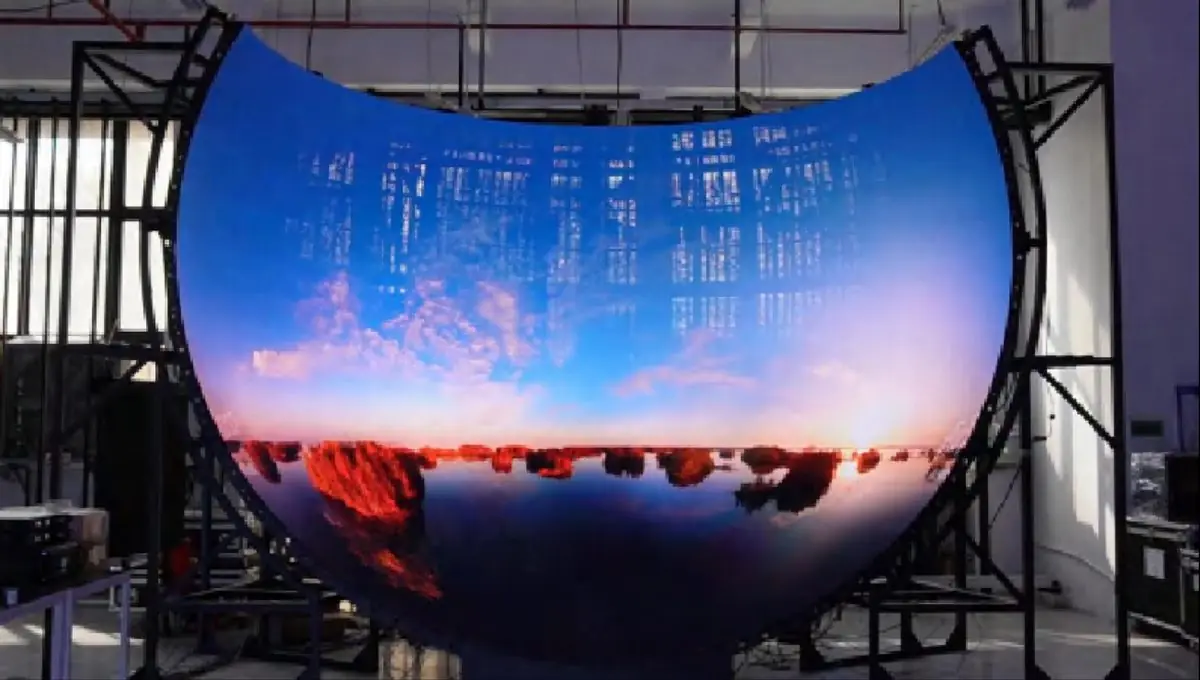
Large domes make headlines; small domes make money quietly. A 5–8 m hemisphere delivers genuine wrap-around immersion — image overhead, audio inside the picture — inside an ordinary room, on an ordinary power supply, with an installation measured in days.
Most case studies show finished venues; these photos show the work — because for buyers evaluating a dome supplier, the production floor is where quality is decided.
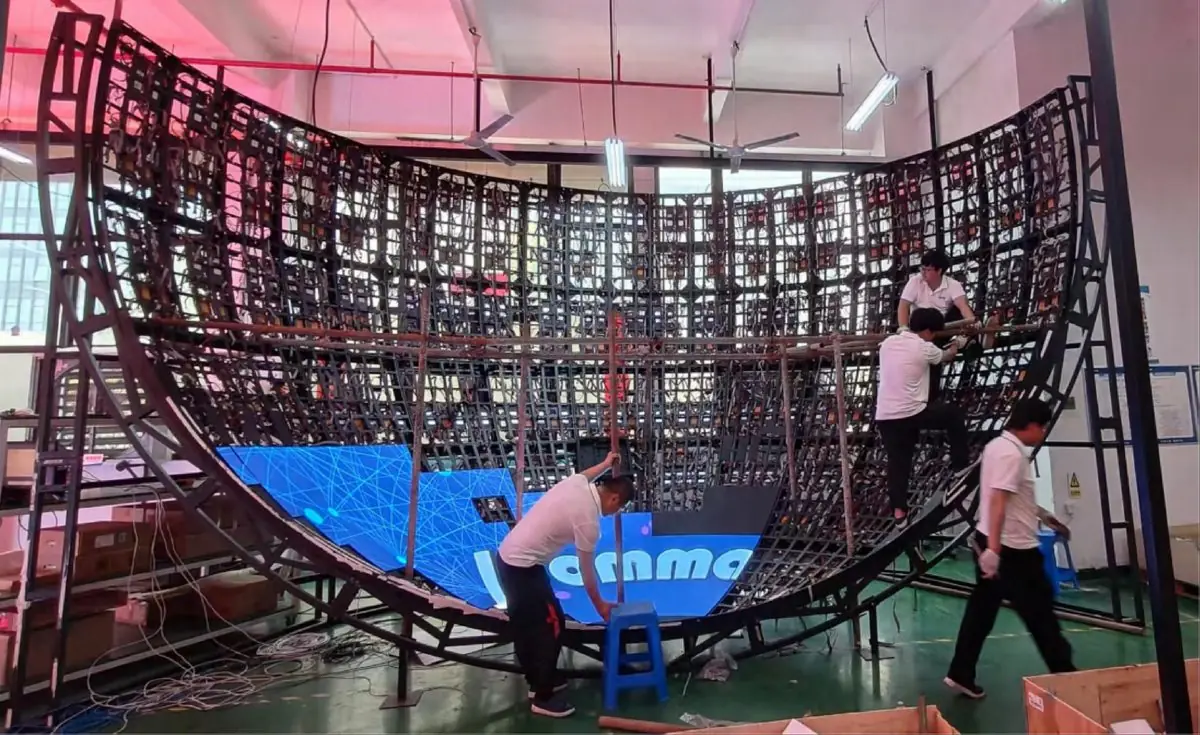
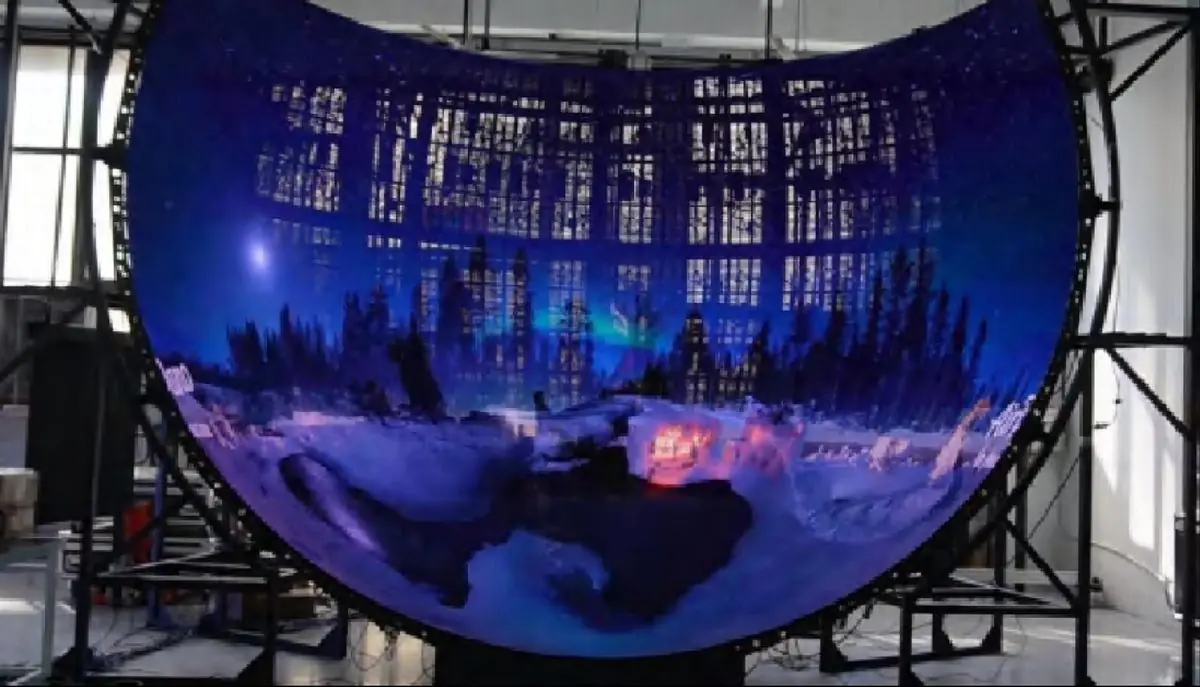
Three details worth reading. First, the steel skeleton carries the sphere: a radial rib structure sized for the diameter, surveyed before a single module lands — at 5–8 m this is a light structure, but it still sets the geometry everything else follows. Second, the modules are triangular and trapezoidal, not flat panels bent on a curve: flat tiles on a sphere produce visible joints at every row, while true spherical modules tile the surface seamlessly. Third, every connection adjusts in two directions (XY), so assembly tolerance is absorbed during installation rather than visible on the screen forever.
The final image in this sequence answers the question buyers ask most about small domes: does the picture hold up? Night city content — deep blacks, bright points of light, long gradients — is the harshest test an LED dome faces, and these frames come straight from factory testing at P2. Small screen or large, dark-scene handling is a driving-quality question before it is a pixel-pitch question. How our dome screens are built →
A hemisphere is a hemisphere. What actually changes between an 8 m dome and an 80 m ambition is a short, useful list.
| What stays the same | What changes at 5–8 m |
|---|---|
| Spherical module geometry — triangular + trapezoidal tiling | Pitch: P2 for short viewing distances instead of P4 at large diameters |
| Sound-transparent screen with audio behind it | Structure: light steel skeleton, installable inside ordinary rooms |
| XY-adjustable connectors, front-and-rear maintenance | Power and upkeep: consumption scales with area — running cost drops to a rounding error |
| High-gray, high-refresh driving for dark content | Timeline: production and installation measured in days and weeks, not seasons |
The audio point deserves emphasis, because small venues are exactly where wall-mounted speakers are most tempting — and most wrong. In a hemisphere, sound arriving from behind the audience contradicts the image overhead; the perforated screen with the audio system directly behind it fixes that at any diameter, holding transmission loss under 5% in speech and music bands and keeping audio-to-image sync inside 0.02 s. That is why we build the 5 m and 8 m domes sound-transparent by default rather than as an upgrade.
The Beijing pair points at a buyer segment the dome industry often ignores: organizations that want a genuine immersive venue without a building project.
A dome is a message amplifier at trade fairs, brand centers and showrooms: visitors step inside the product's world instead of reading about it. At 5–8 m, the whole thing ships, installs in days and can travel to the next venue — a logistics advantage no projection dome or fixed theater can match.
Museums, science centers and school programs use small domes for starfields, earth science and fulldome shorts. LED wins here on a practical point: no darkened room is required, so the dome runs continuously through opening hours with instant startup between sessions.
Operators planning a large dome often install a small one first — to test content, train staff and prove the revenue line before committing to a building. Several of our larger projects began exactly this way, which is why we treat the small format as a gateway, not a compromise.
However it is used, the operational model is the same: instant-start LED, content switched by schedule, one technician for maintenance. A venue that runs its dome from opening to closing pays little for the privilege — and updates the show as easily as uploading a file.
| 5 m Dome | 8 m Dome | |
|---|---|---|
| Format | Sound-transparent inner dome, audio behind screen | |
| Diameter | 5 m | 8 m |
| Pixel pitch | P2 — sized for short viewing distances | |
| Image performance | 1,200 nit, 16-bit gray, 7,680 Hz refresh | |
| Acoustic design | 50% perforation, < 0.02 s audio-to-image sync | |
| Service | Front and rear access, single-technician maintenance | |
Range context: these two sit at the intimate end of a delivered lineup that includes the 7 m Shenzhen flying theater, the 14 m Guizhou dome, the 20 m Changzhi sound-transparent dome and the 60 m Kongtong flagship. Changzhi 20 m case → · Kongtong 60 m case →
Diameter is decided by two honest inputs: the room's clear height and how close the audience stands. From those we size the sphere, the pitch and the audio architecture — and tell you plainly if a hemisphere is the wrong shape for your space.
| Your situation | Suggested format | Reference |
|---|---|---|
| Compact room, first dome, tight budget | 5–8 m sound-transparent dome | This page — Beijing pair |
| Small cinema footprint, thrill format | 7 m flying theater + motion seats | Shenzhen 7 m case → |
| Mid-size venue, group immersion | 14–22 m walk-in dome | Changzhi 20 m → |
| Landmark building or theme park | 28–60 m engineered sphere | Kongtong 60 m → |
Send us the room dimensions and intended use — we will return a diameter, pitch and audio plan sized to the volume, with a delivered reference attached. Custom dome options → · All projects → · Talk to the dome team →
At those diameters a true hemisphere still wraps far beyond your field of view when you stand close to it — which is exactly how small domes are laid out. Immersion comes from the geometry and the sound-transparent audio, not from raw square meters. A well-built 8 m dome with audio behind the screen feels like a different world from a flat 8 m video wall in the same room.
Small diameters mean short viewing distances, and short viewing distances expose pixel structure. P2 keeps the image photographic at two to three meters from the screen — the distance at which visitors naturally stand in a compact venue. On a 60 m dome, P4 already looks clean from the nearest row; on an 8 m dome, it would not.
Very little compared to its larger siblings. LED consumption scales with screen area, so a small dome sips power while a landmark sphere drinks; a compact venue often runs its dome all day without any special electricity provision. Maintenance is equally light — front-and-rear access means one technician can service either dome without scaffolding.
Usually yes, and that is the point of the format. A hemisphere of this diameter needs a fraction of the structural work a large sphere demands; the steel skeleton is lighter, loads are smaller, and installation happens inside a working building in days rather than months. Send us the room dimensions and we will tell you which diameter the volume actually supports.
Everything fulldome: space flythroughs, nature scenes, brand worlds, educational shorts. The screens run high-gray, high-refresh driving, so dark starfield and aurora content — the hardest class for LED — renders smoothly. For many operators, one 6-minute loop refreshed monthly is enough to keep repeat visitors coming.
Send your venue drawings, dome diameter and content plan — our engineers reply within one business day with a tailored configuration.
Get a Free Quote