Factory-direct LED Dome & Spherical Displays — Shenzhen, China
✉ enquiries@luminatii.com
☎ +86 177 0402 4640

Flat screens hide calibration errors because the eye never sees the whole surface at one angle. A dome does the opposite: the audience sits inside the screen, sweeps it continuously, and every hot module or colour drift becomes visible. Uniformity within 5% and colour within 2ΔE are not paperwork — they are the product.
On a flat video wall, a slightly dull module sits at the edge of vision, viewed at an angle, and often goes unnoticed. In a dome, the same module sits overhead in the middle of the frame — and the audience is looking straight at it while their eyes sweep a curved surface. Calibration is therefore a visible-quality issue, not a factory detail: brightness uniformity within 5% and colour deviation within 2ΔE are the numbers that decide whether a dome reads as one continuous image or as a mosaic.

Modules leave the factory with a common profile. But the finished dome adds variables no bench can reproduce: the real viewing angles, the ambient light bouncing inside the sphere, the actual screen curvature after installation, and the thermal state of a screen that has been running for hours.
Calibration is a sequence, and each stage protects the next. Skipping one does not save time — it moves the cost to the venue, where it becomes a permanent visible flaw.
| Stage | What is done | Why it cannot be skipped |
|---|---|---|
| 01 · Binning | Modules sorted by brightness and colour before assembly | Keeps corrections small, which preserves brightness headroom and gray depth |
| 02 · Factory pre-set | A common profile loaded across the screen | Delivers a consistent baseline so on-site work is refinement, not rescue |
| 03 · On-site measurement | Brightness and colour measured across the finished sphere | The installed geometry and room are the real conditions |
| 04 · Per-module correction | Correction values applied so the surface reads as one image | This is where the 5% / 2ΔE targets are actually achieved |
| 05 · Content verification | Dark scenes, gradients and fast pans checked from audience positions | Numbers can pass while the picture still bands — the content is the final test |
| 06 · Handover & schedule | Profile documented; operator trained on post-swap checks | Keeps the dome calibrated for its operating life, not just on opening day |
Stage five is where calibration becomes a craft rather than a procedure. A sphere can measure inside tolerance and still show banding in a starfield, because 16-bit gray processing and correction interact in the dark end of the curve. We check the dome with the content class it will actually play — snow, aurora, night sky — from the seats the audience will actually use. Why gray depth matters →
A dome is calibrated once and maintained for a decade. The maintenance design and the calibration discipline have to belong to the same system, or the venue slowly loses the quality it paid for.
Every dome we deliver has front and rear access, so a module can be replaced from either side by a single technician without dismantling the screen. The step that is easy to forget: applying the screen's profile to the new module. Operator training at handover covers it explicitly.
Our driving design is parallel: a failed LED or module does not affect its neighbours' output. That keeps a single fault from turning into a visible hole in the image — and it keeps calibration corrections local when a repair does happen.
LED output degrades unevenly over years of daily operation. Periodic measurement tells the operator whether the sphere still meets its targets, and whether a re-correction is due. It is a maintenance calendar item, not an emergency.
The operator's content pipeline is the last line of defence: a properly graded master makes a calibrated dome look outstanding, while over-bright or badly graded material can waste every correction the crew made. We advise on grading during handover.
This is the unglamorous half of dome quality, and it is where suppliers separate. A screen that measures well in a factory but has no calibration plan for year three is a screen that peaks at opening. Maintenance design in detail →
For buyers drafting a contract, the useful move is to put the numbers in writing with a measurement method attached: uniformity verified across the finished surface, colour deviation verified between neighbouring modules, and verification performed with the screen at operating temperature from defined audience positions. Add one clause about post-replacement correction and you have covered the two moments when calibration actually fails — handover and the first module swap. Everything else is maintenance rhythm, and that is a calendar item rather than a negotiation.
The Kongtong dome is the case that shows why the sequence matters: 60 m diameter, 5,300 m² of LED, driven up to 8K. At that scale a 5% uniformity deviation is measured in visible patches, and a 2ΔE drift shows up as a colour seam across a sky.
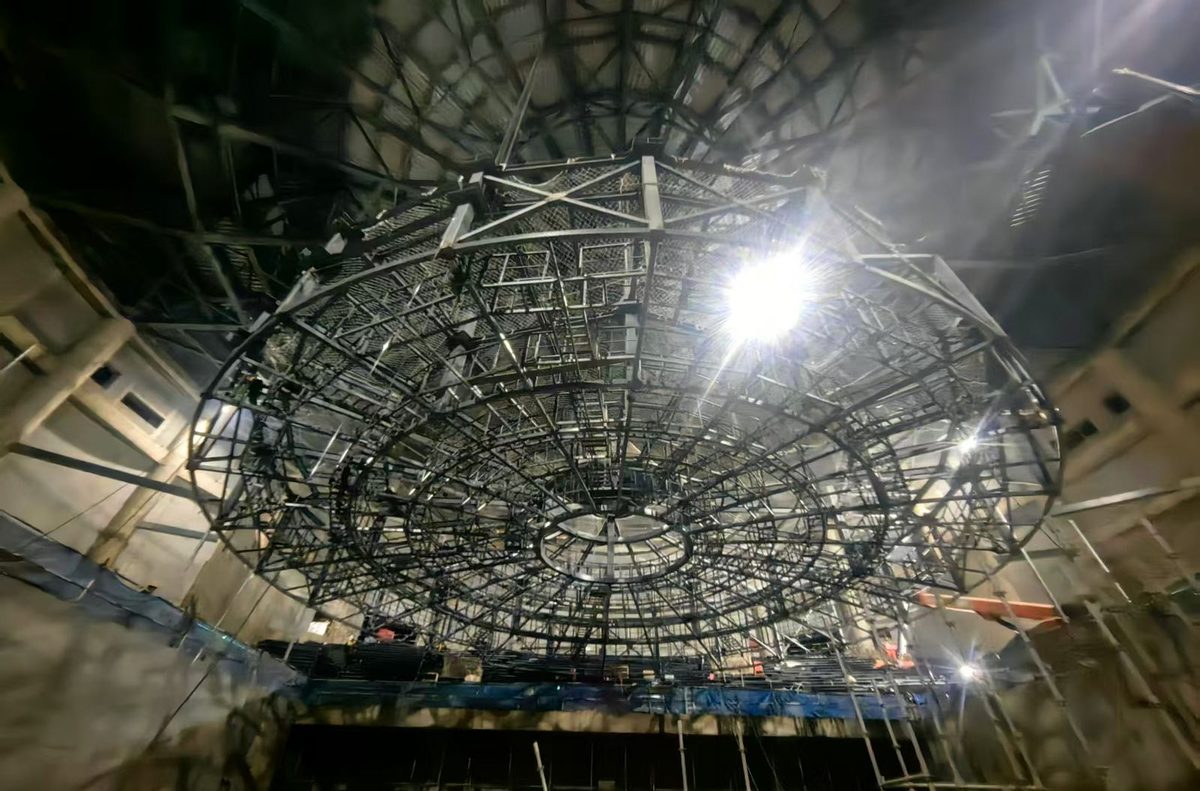
The lesson transfers down the range. The 20 m Changzhi dome, the 22 m and 28 m Huangshi domes and the compact Beijing pair all use the same approach: binning, pre-set, on-site measurement, per-module correction, content verification. Only the number of modules changes. The Kongtong 60 m case → · Changzhi 20 m case →
The scale effect is worth understanding even if your project is small. On a 5,300 m² sphere, one module is a rounding error in the image; on a 5 m dome it is a visible object. That makes small domes less forgiving per module — which is exactly why they receive the same calibration sequence rather than a shortcut. A compact dome that measures inside tolerance looks immaculate because the audience is close enough to check.
Ask a prospective supplier two questions: what uniformity and colour figures will you accept in writing? and who calibrates after a module swap? The answers tell you whether the dome will still look right in year five. Pitch → · Resolution → · Talk to the dome team →
Geometry. On a flat wall, every pixel is viewed at a similar angle, so a single factory profile can hold. On a sphere, the audience sees each module at a different angle, under different ambient reflection, at a different distance. Uniformity has to be achieved across a surface that is never viewed the same way twice — which is why the final correction happens in the room, not on a bench.
Brightness uniformity within 5% means the difference between the brightest and average module is small enough that the eye cannot pick out patches as the head turns. Colour deviation within 2ΔE means neighbouring modules sit inside the threshold where differences are essentially invisible to normal viewing. They are measurable targets, verified in the finished venue, not adjectives.
No — calibration corrects variation within the screen's capability, it does not create capability. That is why binning and consistency in the module supply chain matter before calibration ever starts: modules from mixed bins force large corrections, and large corrections cost brightness headroom and reduce gray depth. We calibrate to tighten a good screen, not to rescue a careless one.
The replacement module is corrected to the screen's calibration profile, not left at factory default. Because our domes are designed for front and rear module access, a swap is a one-technician job — but it should always finish with a calibration check, or the repaired area becomes the patch the audience notices next. We train operator teams on exactly this step at handover.
LED output degrades slowly and unevenly across modules, so a screen calibrated on day one can drift over years of daily operation. Periodic verification — measuring uniformity again and re-correcting if the numbers move — keeps the dome looking the way it did at handover. Long LED life beyond 100,000 hours helps, but it does not remove the need for scheduled checks.
Send your venue drawings, dome diameter and content plan — our engineers reply within one business day with a tailored configuration.
Get a Free Quote