Factory-direct LED Dome & Spherical Displays — Shenzhen, China
✉ enquiries@luminatii.com
☎ +86 177 0402 4640

Every dome buyer asks for "the best pitch". The honest answer is that pitch is a calculation, not a preference: it comes from how close the nearest audience member sits to a curved surface. Get that number right and P2 is generous; get it wrong and even P1.5 looks soft.
Pixel pitch — the centre-to-centre distance between LEDs — is usually quoted as a millimetre number, which makes it sound like an absolute quality grade. It is not. What the eye actually resolves is the angular size of a pixel at a given distance, and on a dome that distance changes with every square metre of screen.
Stand in the middle of a hemisphere and look up: the apex may be ten or fifteen metres away. Look at the horizon edge of the same screen: it is two or three metres from your face. Same screen, same pitch, radically different angular resolution. That is why dome pitch must be calculated from the nearest visible area at the closest audience position, and why a pitch that looks luxurious on a flat wall can look coarse in a dome — or the reverse.
Every pitch recommendation we make comes from the same three numbers, and we ask for all three before quoting:
From those we return a pitch, a total pixel canvas and a driver architecture — and we tell you where the saving is if you can move the seats back half a metre.
The most useful pitch table is not a specification sheet — it is a list of what exists. Here is the geometry-to-pitch mapping across our delivered dome range.
| Project | Diameter | Pitch | Why that pitch |
|---|---|---|---|
| Shenzhen flying theater | 7 m | P1.9 | Motion seats sit a few metres from the screen; the \"look down\" moment exposes any pixel structure |
| Beijing dome pair | 5 m & 8 m | P2 | Compact rooms, visitors stand 2–3 m from the surface |
| Changzhi dome | 20 m | P2 | Sound-transparent walk-in theater with a close front row |
| Huangshi park domes | 22 m & 28 m | P4 | Large seating bowls; nearest row is far enough that P4 resolves cleanly |
| Kongtong flagship | 60 m | Large-format | A 5,300 m² sphere at landmark scale — pitch chosen against the viewing deck geometry |
Read the table as a pattern rather than a rule: as diameter grows, the nearest-row distance usually grows with it, so the pitch can coarsen while the perceived image stays the same. That is why a 28 m dome at P4 looks sharper to its audience than an 8 m dome at P4 would — and why copying the pitch from a larger reference project is one of the most common (and expensive) mistakes in dome procurement. See the 22 m and 28 m reference →
Halving the pitch quadruples the number of pixels on the same surface area. That single relationship drives panel count, driver count, power, heat and weight — which is why pitch is the first commercial decision on a dome, not the last technical one.
| When you halve the pitch | What happens | Who pays for it |
|---|---|---|
| Pixel count | Roughly ×4 on the same area | Module and driver budget |
| Power draw | Rises with pixel count and driving load — our 1,200 nit screens run 150 W/m² at full-white peak | Electrical provision, cooling, operating cost |
| Heat load | More electronics per square metre, in a sealed sphere | HVAC design of the building |
| Service complexity | More modules per square metre to know and maintain | The operator, for the life of the venue |
This is not an argument against fine pitch — it is an argument for calculating it. On the Shenzhen 7 m flying theater, P1.9 was the right call because the format puts eyes 2–3 m from the screen and the illusion collapses without it. On a 28 m theme-park bowl, spending that money would buy nothing the audience can see; the same budget is better spent on brightness headroom, audio or the structure that keeps the sphere true. Why P1.9 at 7 m →
A pitch number on a quotation is a promise about pixel spacing. Sharpness on the screen is a promise about five systems agreeing — and pitch is only the first.
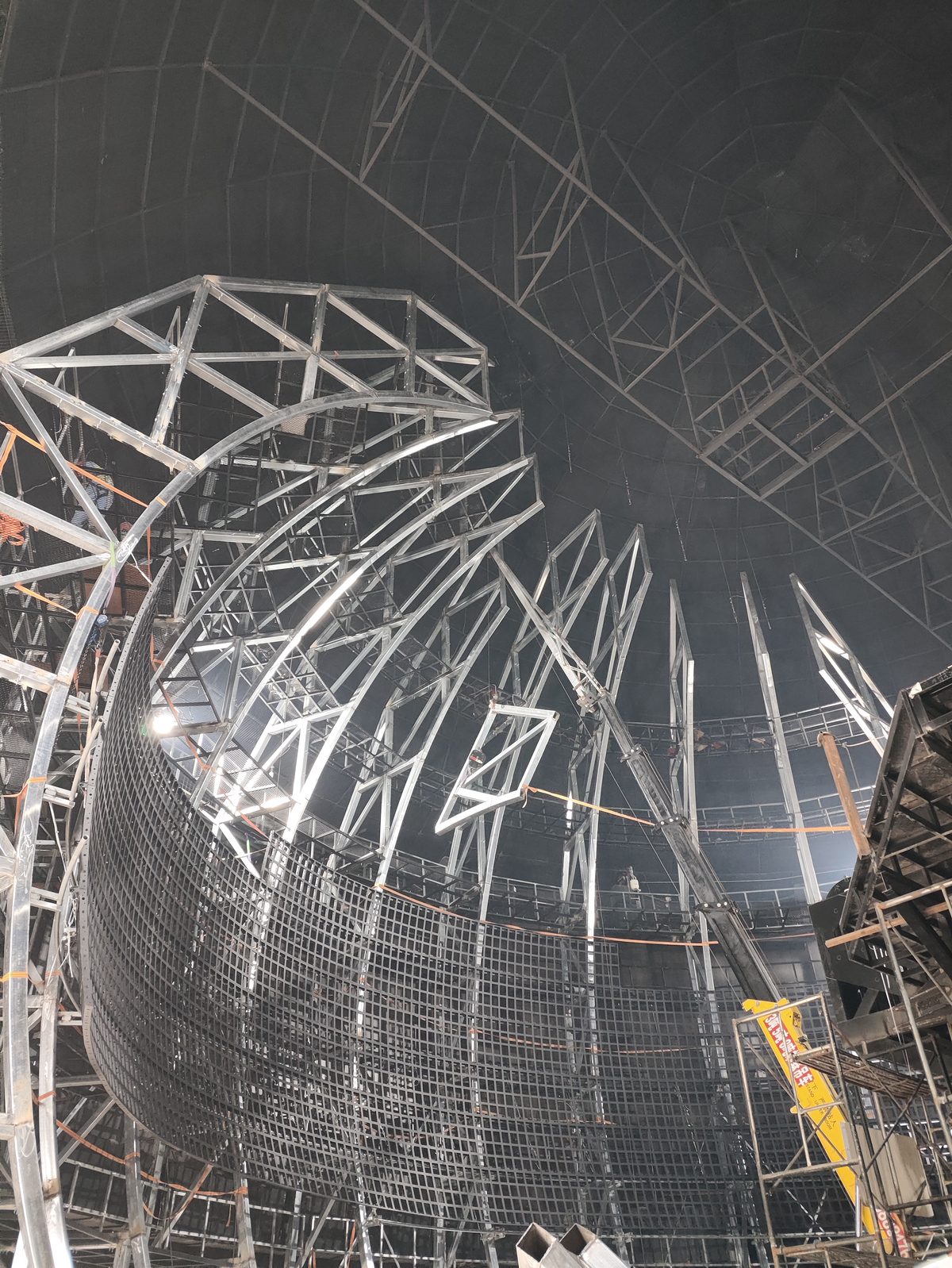
Flat panels bent onto a sphere produce seams at every row — and seams read as softness even when the pixels are tiny. Our modules are cut as triangles and trapezoids so the surface tiles true, with XY-adjustable connectors taking up structural tolerance on site.
Fine pitch means more data per square metre. Domes we deliver run high refresh (7,680 Hz) with 16-bit gray processing, so fast pans stay clean and dark gradients — the content class domes live on — stay free of banding.
Pixels that emit across most of their cell look sharper at the same pitch; wide dark gaps between LEDs read as a screen door. Narrow-bezel module design is part of how a dome holds up at close range.
A fisheye master rendered for 4K cannot fill an 8K canvas with real detail. Pitch, canvas and content resolution have to be specified together — which is why we ask what will play on the dome before we recommend a pitch.
The practical takeaway for buyers: ask each supplier to justify their pitch against your nearest seat distance, and ask what happens to the quote if that distance changes. A supplier who can answer both is calculating; one who cannot is copying. Next: dome resolution → · How our dome screens are built →
| Input | Why we need it |
|---|---|
| Room or building plan, with clear height | Sets the maximum diameter and the curvature your volume allows |
| Seating layout or standing position | Defines the nearest-row distance — the pitch driver |
| Intended content | Starfields and text-heavy content need more angular resolution than cinematic film |
| Target audience flow | Session length and throughput influence seat geometry, which feeds back into pitch |
With those four inputs we return a diameter, pitch, total canvas and driver architecture — plus a delivered reference at comparable geometry you can visit. Dome cinema planning → · Custom diameters → · Talk to the dome team →
Most of the domes we deliver land between P2 and P4, because that band matches the viewing distances of real buildings. Compact theaters at 5–8 m run P2 or finer; a 7 m flying theater runs P1.9; 22–28 m theme-park domes run P4. The pitch follows the room, which is why a supplier quoting a single "standard" pitch for every project is telling you they have not looked at your building.
You can, and you will pay for it twice: once in panel count and driver electronics, and again in power and heat. Pitch is the single biggest cost lever on a dome screen, so overspecifying is not caution — it is budget spent where the audience cannot see the difference. We would rather calculate the angular resolution properly and put the savings into structure, audio or content.
No, and this trips up experienced LED buyers. On a flat wall, viewing distance is roughly constant across the screen. On a dome, the audience sits inside the screen: pixels directly overhead are far away, pixels at the horizon are close. The worst case — the nearest visible area — sets the pitch, not the average.
Four things: module fill factor (how much of each pixel cell emits light), spherical module geometry (seams read as softness), driving quality — our domes run 7,680 Hz refresh with 16-bit gray — and the resolution of the content master. A fine-pitch screen fed an under-resolved fisheye master looks worse than a coarser screen fed a proper one.
Send us the seating layout or the room plan with the intended standing position, plus the dome diameter you are considering. We will return the pitch, the total pixel canvas and the driver architecture — with a delivered reference at comparable geometry attached.
Send your venue drawings, dome diameter and content plan — our engineers reply within one business day with a tailored configuration.
Get a Free Quote