Factory-direct LED Dome & Spherical Displays — Shenzhen, China
✉ enquiries@luminatii.com
☎ +86 177 0402 4640

A planetarium is the one place where black has to be black. Projection washes out the sky; an LED dome holds 10,000:1 contrast with brightness uniformity within 5% across the surface — so a star field reads as stars, not as a grey wall with dots.
Every planetarium promises the same thing: the sky as you cannot see it from a city. That promise is a contrast problem before it is a resolution problem — and contrast is exactly where projected domes struggle.
A projector throws light at the whole dome surface, including the parts that should be empty sky. The result is a dark grey field on which stars have to compete. As the lamp ages, that grey slowly rises and the show degrades without anyone noticing — until the day a new projector is installed and the difference is obvious.
An LED dome emits only where the image says there is light. With a 10,000:1 contrast ratio and brightness uniformity held within 5% across the surface, the star field stays even from the zenith to the horizon, and it still looks the same in year five as it did at first light.
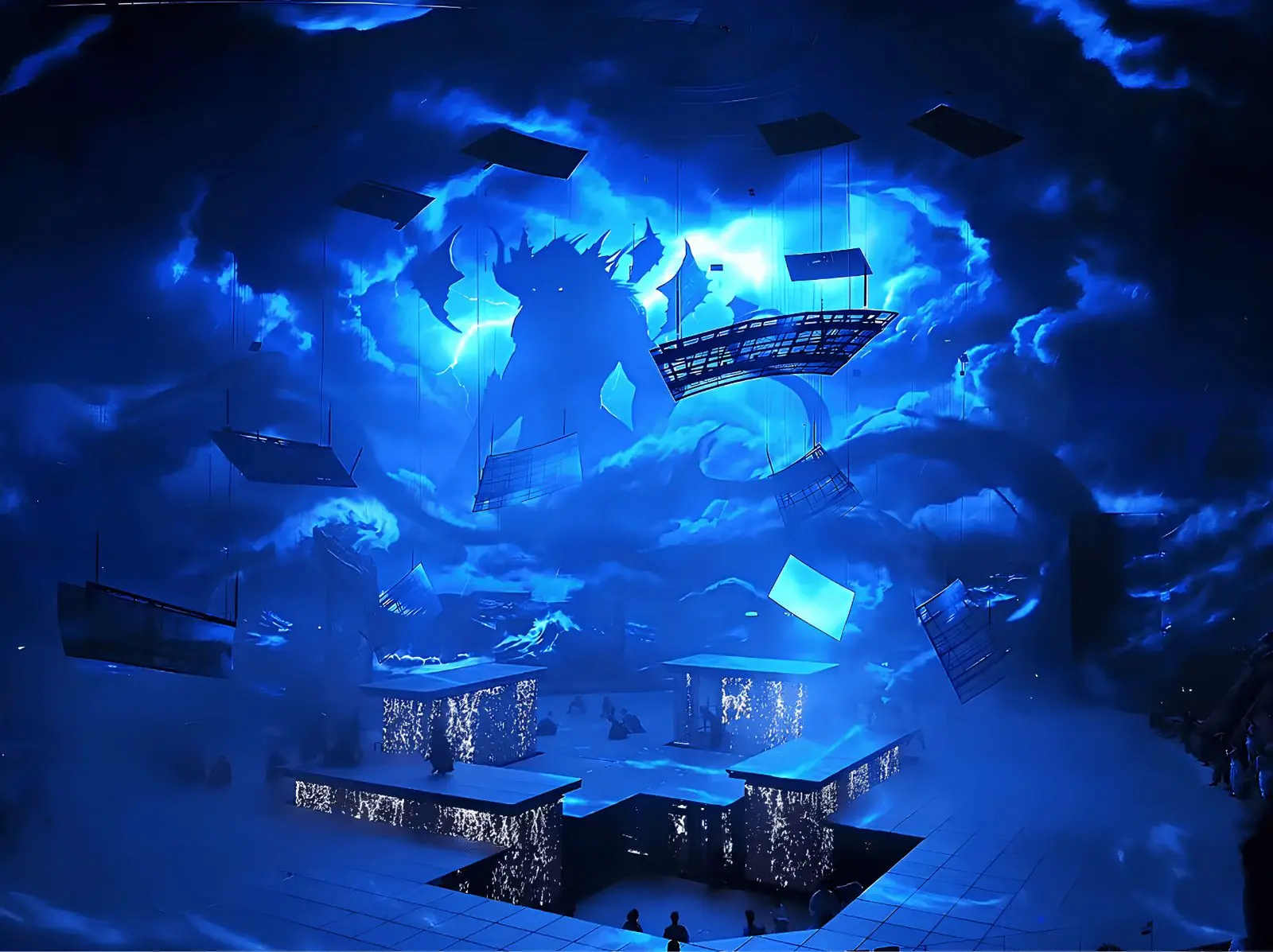
Both technologies build good planetariums. The right answer depends on diameter, show format and how the venue is operated for the next ten years — not on which one is newer.
| Criterion | Projected dome | LED dome |
|---|---|---|
| Black level | Grey field from ambient projector light | True black between pixels |
| Contrast | Limited by surface reflectance | 10,000 : 1 |
| Brightness over time | Falls as lamps age; re-lamping on a cycle | Stable; recalibrated, not replaced |
| Seams | Blending zones between projectors | Mechanical seams closed by panel geometry |
| Ambient light tolerance | Requires a dark room | Works with some ambient light — useful for daytime operation |
| Service | Lamp and filter changes, projector alignment | Module replacement from front or rear, single operator |
| Best fit | Very large domes on a tight capital budget | Small to large domes where contrast and uptime matter |
The honest summary: below roughly 20 m, an LED dome usually costs less to own over a decade and looks better on day one. Above that, the capital comparison needs a real project to judge. Read the full comparison of LED and projection domes →
A planetarium is the most demanding dome client because the audience knows what the sky looks like. Three details decide whether the illusion holds.
The celestial pole sits at the apex. If the panel geometry at the top is improvised, the stars converge into a visible rosette. Our pole caps are designed as their own pattern, and the mapping is commissioned so the pole lands exactly where the astronomy says it should.
The lower rows of a dome are viewed at the shallowest angle, where brightness falls off fastest on a cheap surface. Uniformity within 5% across the whole dome is what keeps the horizon as bright as the zenith.
Lecture theaters are raked. A tilted or truncated dome faces the audience instead of hovering above them, and it changes the panel layout from a pure hemisphere to a cut sphere — a geometry we model rather than approximate.
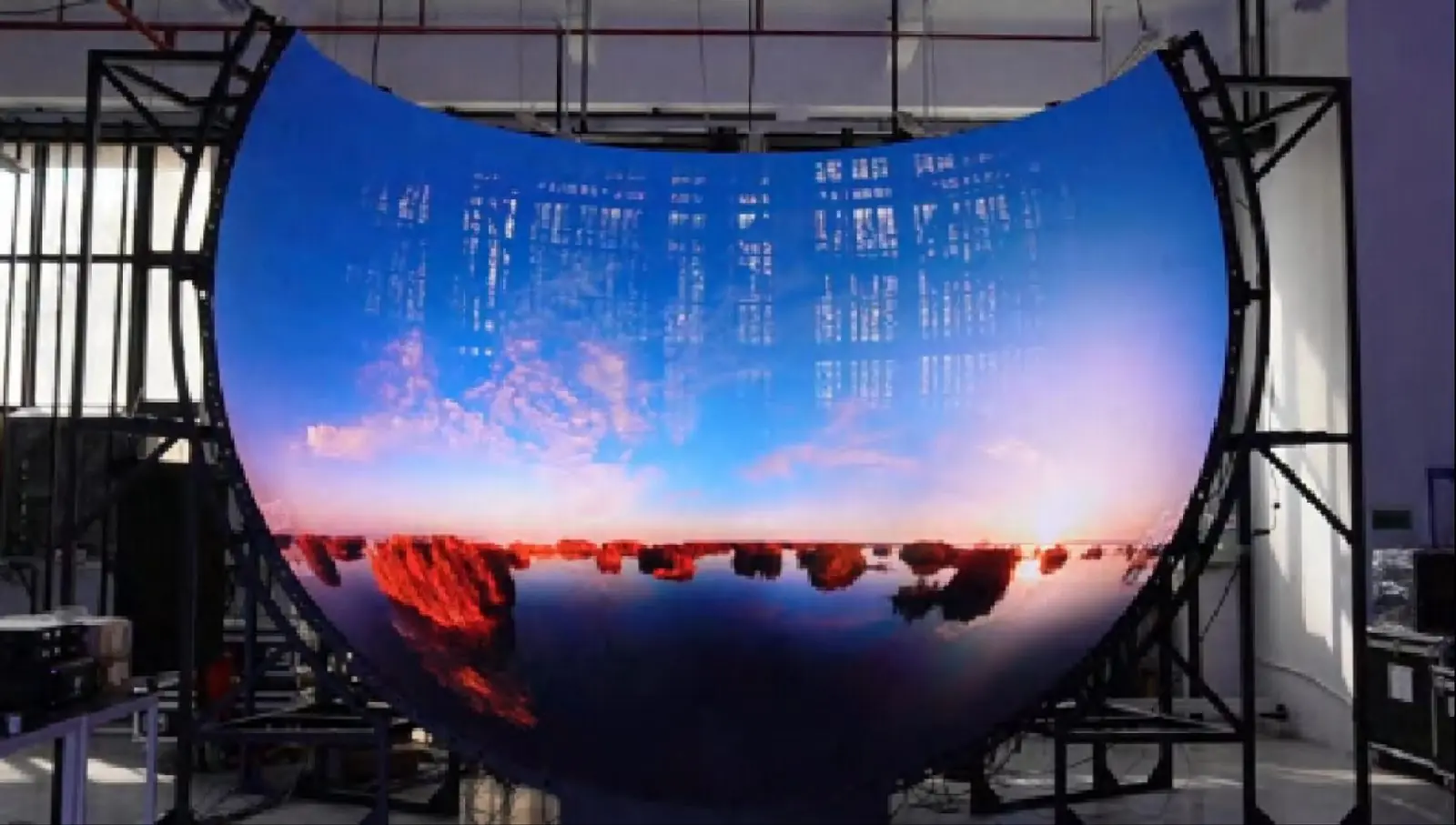
A 5 m or 8 m dome in a museum or school is a real planetarium, and it has the same optical requirements as a 20 m one — only the pitch and the seat count change. Our Beijing twin domes run P2 at 5 m and 8 m, which is fine enough that a child in the front row cannot see the pixel structure during a star show.
A dome receives a flat frame and has to display it on a sphere. Everything the audience sees at the edges of the image depends on how well that transformation is set up.
Fulldome content is authored as a fisheye or equirectangular master; real-time astronomy software renders its own projection. Either way, the signal has to be warped, edge-blended and mapped onto the physical panel layout — and the mapping has to be repeatable after a module replacement.
One detail that catches new planetarium operators: content frame rate. Astronomy renders at whatever rate the software produces, while the dome refreshes at 7,680 Hz. If the playback chain drops frames during a fast slew, the audience sees it as a stutter against a static star field — the movement is slow enough that any irregularity is obvious. We test the full chain with a moving star field before handover, not with a colour bar.
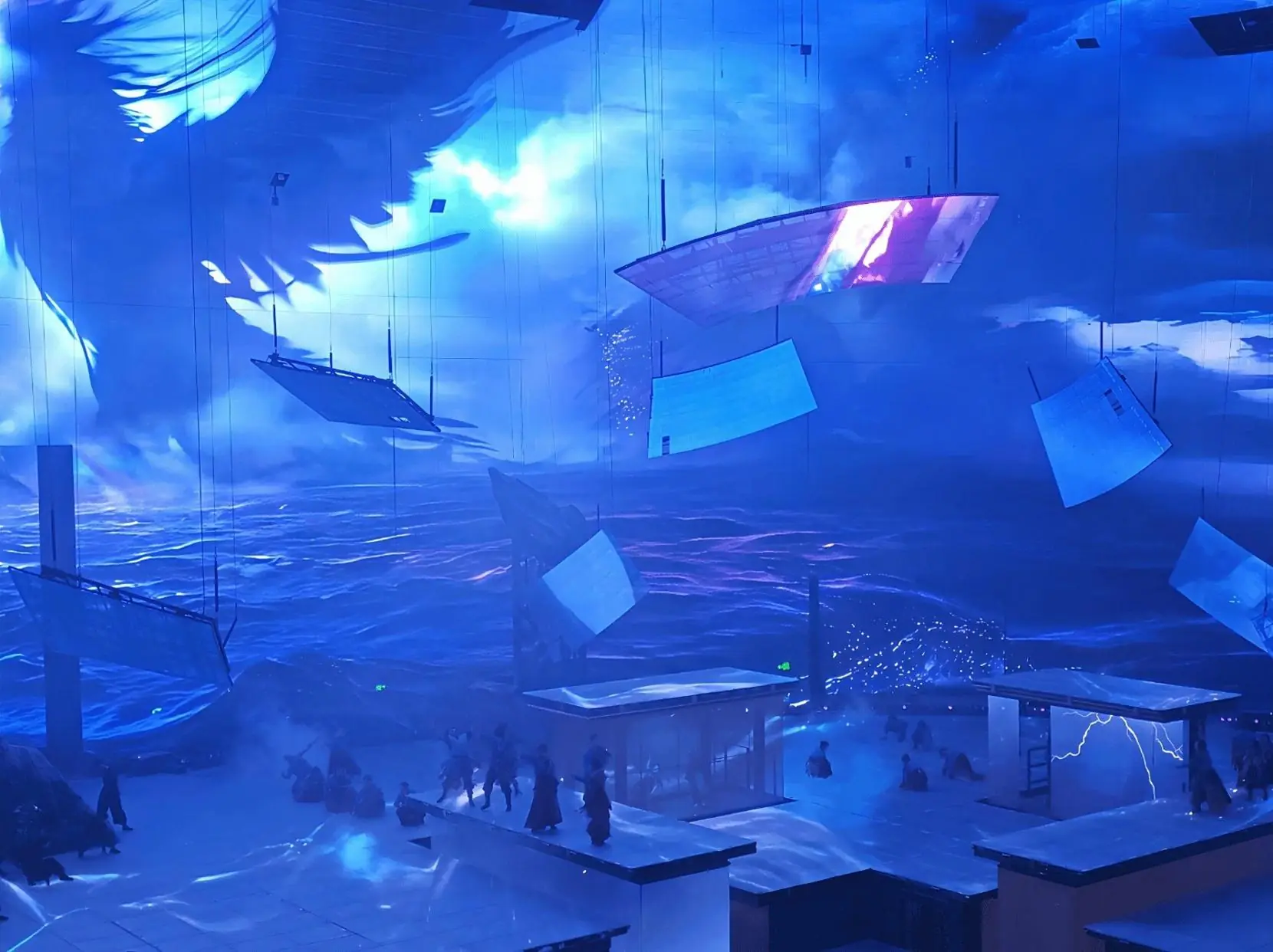
The Kongtong Island dome's first light was a star field — 5,300 m² of night sky, at 60 m diameter. It is the same engineering, at the largest scale we have built.
Five inputs are enough for a first configuration and a panel schedule. Everything else can follow.
| Input | Why it decides the design |
|---|---|
| Room dimensions and clear height | Sets the maximum diameter and whether the dome must be truncated or tilted |
| Seat count and layout | Defines the floor area, the nearest and furthest viewing distance, and the required pitch |
| Show format | Fulldome film, live astronomy, hybrid lecture — each has different resolution and brightness demands |
| Entry and stage openings | Portals cut into the shell change the panel layout and the structure around them |
| Operating pattern | Daily shows, school groups or evening-only use determine the access and cooling strategy |
Send the drawings and we will reply with a dome diameter, a pitch recommendation, a panel count and a first-light sequence — before any commercial discussion. Start with your drawings →
For black level, contrast and maintenance, yes. A projected image cannot produce true black because the dome surface is lit by the projector even where the frame is dark, and brightness falls off as lamps age. An LED dome emits its own light, so a dark sky stays dark, and the output is calibrated rather than degrading quietly. Projection still wins on initial cost for very large domes, which is why the decision should be made on the dome diameter and the show format.
Most planetarium and science-center domes sit between 10 m and 20 m. Below 10 m the seating becomes the constraint; above 20 m the structure and the content resolution become the drivers. We have delivered domes from 5 m to 60 m, so the diameter follows the room and the audience, not a product range.
Yes. The dome is a display surface — the playback system takes a warped and blended signal from your fulldome or real-time astronomy software. We commission the mapping so that the celestial pole lands correctly at the dome apex, which is the detail that decides whether a planetarium feels accurate.
With dedicated geometry, not by folding flat panels. The pole cap has its own pattern, each latitude band has its own trapezoid angle, and the panel connectors adjust in two axes so the seam is closed mechanically instead of being forced by the installer.
Our indoor dome platform runs 1,200 nit at the screen face and can be dimmed for dark-adapted audiences. A planetarium typically runs well below peak, but the headroom matters: running an LED dome at 30–40% of peak keeps the LEDs in a comfortable range and preserves the contrast the show was graded for.
Yes. Tilted domes, truncated domes and dome-plus-vertical-cylinder combinations are all buildable. A tilt is often the right answer in a lecture theater, where the audience is raked and the dome should face them rather than sit flat overhead.
Send your venue drawings, dome diameter and content plan — our engineers reply within one business day with a tailored configuration.
Get a Free Quote