Factory-direct LED Dome & Spherical Displays — Shenzhen, China
✉ enquiries@luminatii.com
☎ +86 177 0402 4640

An exhibition hall has seconds to stop a visitor, and a glowing sphere does it better than any wall: it is visible from every aisle, it photographs from every angle, and it turns a brand story or a science topic into an object people walk around. We build them — embedded, floor-standing and suspended — from 1 m booth pieces to 6 m hall centerpieces.
In a hall where every exhibitor bought the biggest flat screen, a sphere is the only shape that is not competing — it is simply different, and visitors drift toward it from every direction.
Flat screens organize a crowd into a semicircle. A sphere lets visitors gather all the way around, which shortens queues in busy halls and makes the exhibit feel open rather than gated. It also reads from upper levels — balconies, stairs and press positions all get a face of the image.

The mount decides the architecture. These are the three configurations we deliver most, each with its own structural and service logic.
| Format | Typical size | Best for | Key detail |
|---|---|---|---|
| Embedded hemisphere | 1–4 m | Walls, floors, portals and themed gateways | Structure flush with the architecture; viewing from one side |
| Floor-standing globe | 2–6 m | Centerpiece halls, lobbies, science exhibits | Concealed base, floor-loading check, walk-around viewing |
| Suspended sphere | 1–3 m | Atriums, booth centerpieces, retail displays | Structural anchors, safety clearance, service from below |
The embedded format is the most architectural — a half-sphere that rises from the floor or opens through a wall reads as scenery, not equipment. The 6 m Hezheng museum sphere in detail →
Exhibition spheres are not only permanent installs — we build and exhibit with them ourselves, which is how most partners first meet the product.
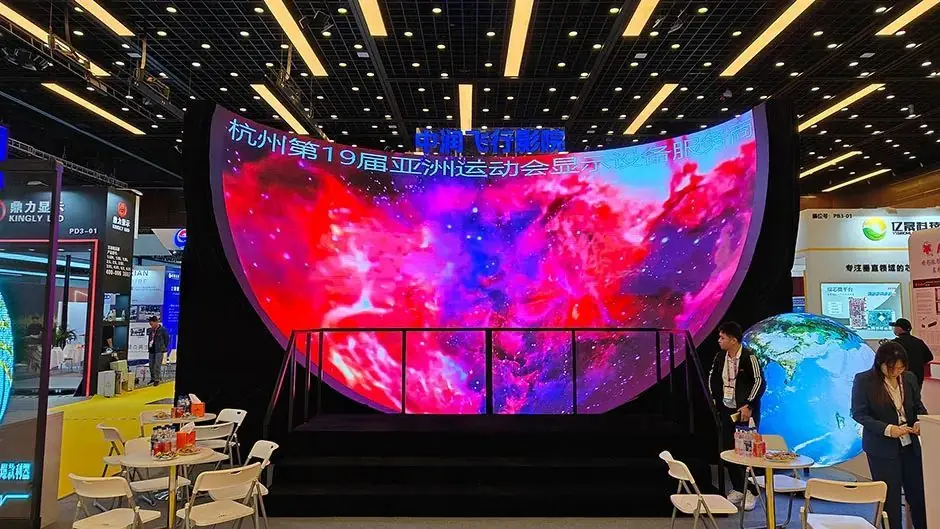
At the 2024 Beijing exhibition we ran a sphere as the centerpiece of our own stand — the fastest way to show buyers what their hall could look like. Trade-show builds taught us the logistics side of the product: segmented shells that assemble in hours, numbered panels, quick-connect cabling and stored mapping profiles that come back up without re-commissioning.
That same discipline goes into touring and rental builds — a sphere that your team can rebuild in a new hall with our remote support, not a permanent install pretending to be portable.
For agencies and stand builders, the practical benefit is speed on site: a booth sphere arrives pre-mapped, pre-numbered and pre-tested, so the screen is playing on the first build day instead of the last. We ship the structure model and a rigging plan with the quote, so your stand design and our sphere are one drawing from the start — and if the hall changes your plan, the diameter adjusts without restarting the engineering.
An exhibition sphere succeeds when it disappears into the design. Four details we settle with your contractor before fabrication.
We produce the structure model early enough for your exhibition contractor to build around it — the single biggest schedule saver on themed builds.
A sphere in a permanent hall plays thousands of hours a year to a returning audience. What plays on it is a rotation problem, not a production problem.
The practical structure for exhibition spheres: a core loop of your signature visuals, a seasonal layer that changes with the calendar, and short event segments for campaigns and school programs. Each segment runs one to three minutes, so a visitor who lingers sees variety and a visitor passing by still catches the signature moment.
Agencies produce in standard spherical formats; we commission the warping against the as-built panels so a new master plays correctly the day it arrives. Your operators swap segments from the playlist interface — no engineer required, no re-mapping, no downtime. For halls that host changing exhibitions, this is the difference between a screen that gets switched off after opening week and one that stays on the program all year: the content budget is measured in playlist edits, not production cycles.
Four inputs are enough for a first configuration and a structure concept.
| Input | What it decides |
|---|---|
| Hall dimensions and clear height | Maximum diameter and whether the sphere is floor, embedded or suspended |
| Closest viewing distance | Pixel pitch — P1.5-P2.5 for rail-distance viewing, up to P3 for large halls |
| Content plan | Resolution, brightness and the mapping approach for spherical masters |
| Permanent or touring | Fixed structure with concealed service, or segmented shell with road-case logistics |
Two budget notes that help planners. A sphere is priced mostly by diameter — the panel count grows with the square — so stepping down one meter of diameter often saves more than stepping down one grade of pitch. And lead time is driven by the structure, not the screen: panels ship in weeks, while the base or suspension steel is the item to start early, especially when it must coordinate with your hall's fit-out schedule.
Send the drawings or even a sketch of the hall. We will reply with a diameter, a pitch and a mounting concept before any commercial discussion. Spheres in retail atriums → · Start the conversation →
It depends on the hall and the dwell distance. A brand booth takes a 1-2 m sphere that reads across the aisle; a permanent exhibition hall or science center takes 3-6 m as a walk-around centerpiece — like the 6 m, 131 m² sphere we delivered for a museum in Hezheng. The rule we apply: the sphere's diameter should be at most one third of the hall's clear height, so the room keeps its proportions.
Yes — hemispheres and embedded spheres are a specialty. A half-sphere flush with a wall or floor turns the display into a doorway, a planet rising from the ground, or an observatory window. The structure, cable routes and service access are designed with your exhibition contractor before fabrication.
Not if the pitch matches the barrier line. Exhibition spheres are viewed from 1-3 m, so we normally specify P1.5-P2.5 for booth and corridor pieces and up to P3 for large hall spheres. The curved surface helps: the same sphere serves the visitor at the rail and the viewer across the hall.
Fast assembly, road-case logistics and repeatability. For touring spheres we design a segmented shell with numbered panels, quick-connect power and data, and a mapping profile that is stored and reloaded — so the sphere can be rebuilt in a new hall by your own team with our remote support.
In standard spherical projection formats — equirectangular or fisheye masters. We commission the warping against the as-built panel layout, so your agency works in normal production tools and the file simply plays. For brand builds we review the content storyboard against the sphere geometry before your agency starts animating.
Send your venue drawings, dome diameter and content plan — our engineers reply within one business day with a tailored configuration.
Get a Free Quote