Factory-direct LED Dome & Spherical Displays — Shenzhen, China
✉ enquiries@luminatii.com
☎ +86 177 0402 4640

Every museum wants one object visitors photograph before they read a single label. A spherical LED display is that object — a floating planet, a rotating globe, a data sculpture — and unlike a projection globe, it stays vivid under gallery lighting with no dark room required. Our Hezheng case below shows the real thing, at 6 m diameter and 131 square meters.
A flat screen in a gallery is furniture. A glowing sphere in the middle of a hall is architecture — and it solves three problems museums constantly fight.
First, it is a landmark: visitors orient themselves by it, meet at it, and photograph it — which means your museum appears in their feeds for free. Second, it is a storyteller: an earth, a moon, a planet or an abstract data world plays continuously, carrying science content with zero staff effort. Third, it is an anchor for the exhibition design around it — halls are planned around the sphere, which gives the whole gallery a logic.
In a natural-science museum in Hezheng, Gansu Province, we built a 6 m diameter spherical LED display as the centerpiece of the main exhibition hall — 131 square meters of P3 surface playing a living earth.
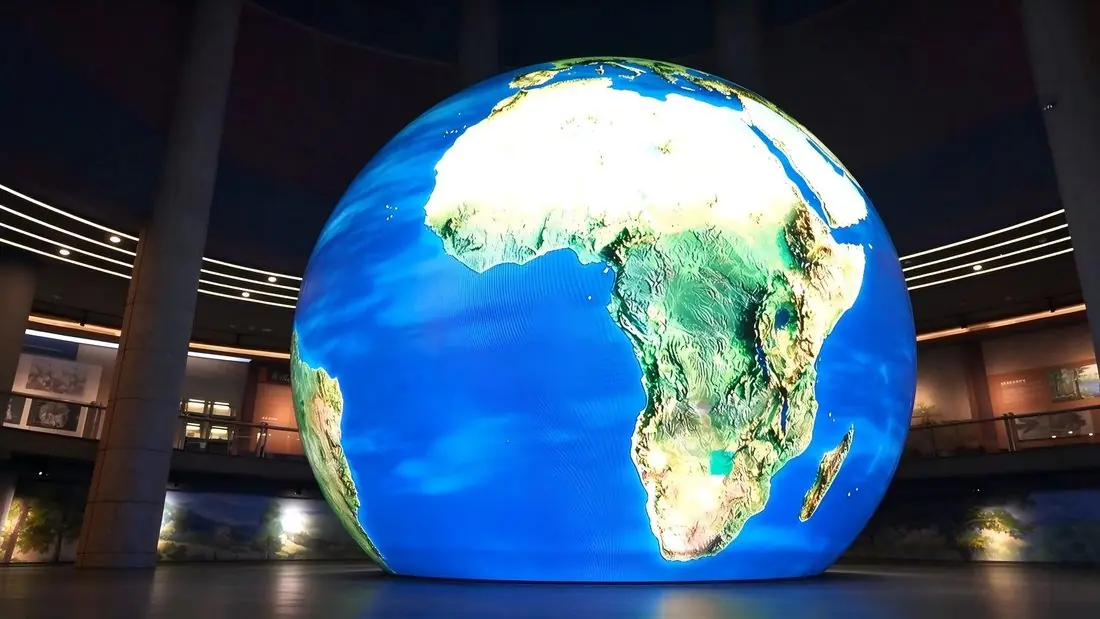
The sphere shows a rotating earth at P3 resolution — fine enough that visitors standing at the barrier read coastlines and mountain ranges rather than pixels. Its 131 m² of active display area is comparable to a 15 m × 9 m flat wall, but arranged so the content has no frame and no edges: the earth simply floats in the room.
The photograph above is from the delivered project: visitors circle the globe under a planetarium-style ceiling while the hall's exhibition walls continue behind it. This is what a working installation looks like — see it among our other delivered projects →
A museum sphere fails publicly if any one of four details is wrong. These are the items we settle before fabrication, not after installation.
Ground-supported spheres need a concealed base and a floor-loading check; suspended spheres need structural anchors designed for the exact weight. In Hezheng the sphere rests as a grounded globe within the scenic floor — the structure disappears into the landscape set.
P3 stays smooth from roughly 3 m out. If your barrier is closer, we step the pitch down; if the sphere is viewed across an atrium, a wider pitch saves budget. The curve helps you here — the same sphere serves both a close-up child and a distant balcony view.
Every sphere has poles where content would otherwise pinch. Our panel layout designs the polar zones as their own pattern, and the mapping is commissioned so a rotating earth shows clean, continuous motion at the poles instead of a squeezed smear.
A sphere in a permanent gallery must be serviceable without scaffolding the hall. Modules are replaced through the access scheme designed with the structure — a five-minute module swap, not a two-day closure.
The hardware is a one-time decision; the content is what keeps visitors coming back. Spheres accept any spherical-projection content, which means your existing science visuals may already be usable.
We commission the warping and mapping against the as-built panel layout, so content supplied in standard spherical formats simply plays. Your team gets a playlist interface, and we train the operator to swap segments without calling us.
A museum sphere usually shares a building with other contractors, a fixed opening date and a curator with opinions. The delivery sequence is designed for that reality.
We start with the hall drawings — clear height, floor loading, the barrier line and the exhibition design intent. From those we fix the diameter, the mounting concept and the pitch, and produce a structure model your exhibition contractor can build around. Fabrication runs in parallel with your hall fit-out, so the sphere arrives when the hall is ready for it, not before.
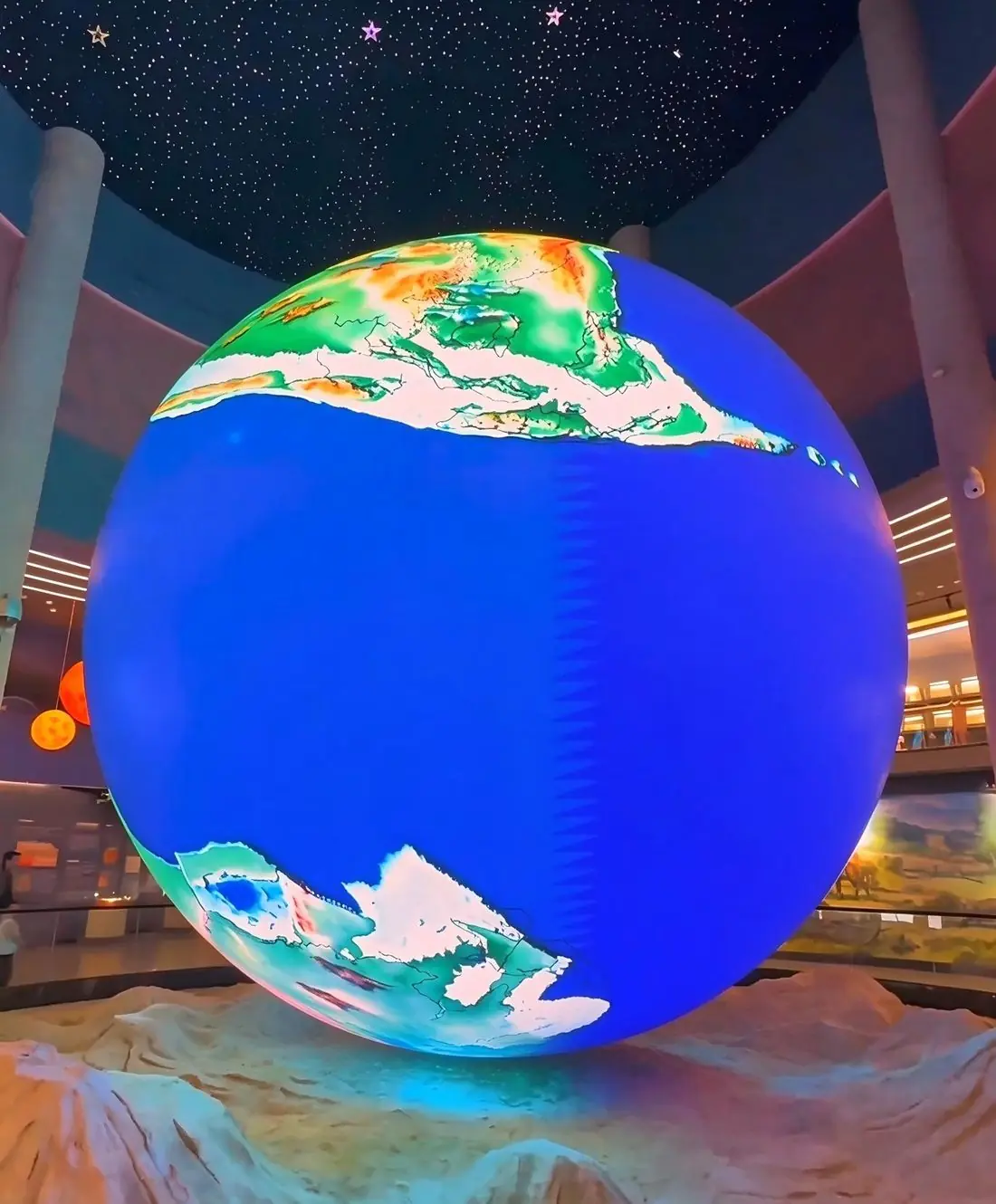
The Hezheng sphere followed exactly this sequence: structure coordinated with the scenic floor and star ceiling, first play in the hall under gallery lights, and handover to the museum's own operating team. How our sphere factory works → · The engineering behind large custom spherical screens →
A quick reference from delivered projects — indoor spheres sit at the smaller end of our range, outdoor landmarks at the top.
| Setting | Typical diameter | Pitch | Reference |
|---|---|---|---|
| Exhibit alcove / entrance | 1–2 m | P1.5–P2.5 | Close-viewing gallery piece |
| Museum centerpiece hall | 4–8 m | P2.5–P3 | Hezheng natural-science museum, 6 m / 131 m² / P3 |
| Science center atrium | 8–15 m | P3–P4 | Suspended or grounded globe with scenic surround |
| Outdoor city landmark | 15–26 m | P4–P7.8 | 26 m outdoor sphere in the Philippines |
Send us the hall drawings — clear height, floor loading and the barrier line — and we will reply with a diameter, a pitch and a structure concept before any commercial discussion. Spherical LED display product page → · Sphere screens for commercial atriums → · Outdoor LED spheres →
It follows from the hall, not from ambition. In a double-height atrium of 8-12 m clear height, a 4-6 m sphere sits naturally as a centerpiece; a small exhibit alcove takes 1-2 m. The Hezheng sphere is 6 m across in a large circular hall, which lets visitors circle it completely — that walk-around is a big part of why it works. We size the sphere against your ceiling, floor loading and viewing distances, and we have delivered everything from 2 m exhibit globes to a 26 m outdoor landmark.
That is what pixel pitch decides. The Hezheng sphere uses P3 — a 3 mm gap between pixels — which reads as a smooth image from about 3 m away. For hands-on viewing distances under 2 m we recommend finer pitches. Because the sphere surface is curved, viewing distance is measured from the closest point the public can reach, not from the center of the hall.
Anything authored for a sphere: rotating earth and climate data, planetary and geological content, brand or cultural artwork mapped in equirectangular projection. We handle the mapping so the content wraps without pinching at the poles. Most museums run a playlist of a few segments and update it for exhibitions and national holidays.
Yes — this is a standard engineering display, not a projector lamp waiting to die. Brightness is stable over years, modules are replaced from service access without dismantling the sphere, and there is no dark-room requirement, so the exhibit works with normal gallery lighting and daylight from windows.
That is where museum spheres get interesting. The Hezheng sphere sits in a scenic landscape floor with a star-field ceiling above it, so the globe reads as a planet inside a designed environment rather than a screen on a stand. We coordinate structure, floor treatment, access and controls with your exhibition contractor.
Send your venue drawings, dome diameter and content plan — our engineers reply within one business day with a tailored configuration.
Get a Free Quote