Factory-direct LED Dome & Spherical Displays — Shenzhen, China
✉ enquiries@luminatii.com
☎ +86 177 0402 4640

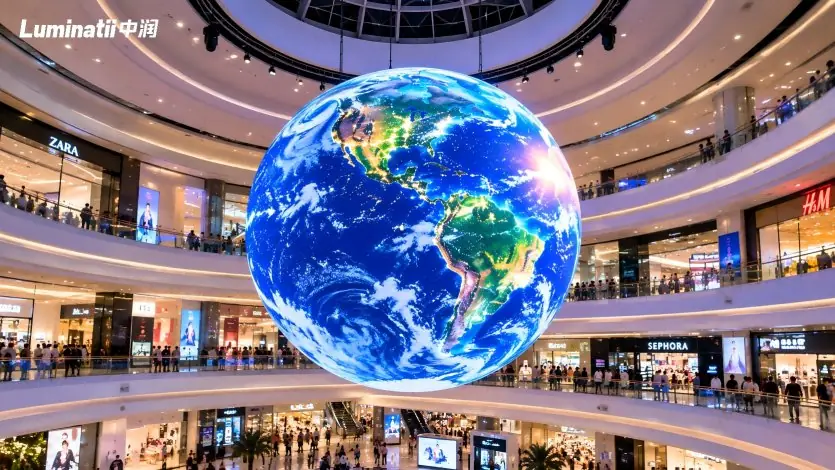
A mall atrium has one job: make people look up. A suspended LED sphere does that from every level at once — 360° visible, front-serviceable from a lift, and bright enough to hold its color against retail lighting.
A flat LED wall in a mall is seen from one direction, by people already walking towards it. A sphere in the atrium is seen from the ground floor, from the escalators, from the coffee shop on level three — and it gives people a reason to look up instead of at their phones.
Malls compete with online retail on experience. The atrium is the one space that cannot be replicated on a screen, and a suspended LED sphere turns that void into the building's focal point — visible from every circulation route and every level.
It also changes how the space is programmed. A sphere can run a brand launch in the morning, a seasonal campaign in the afternoon and a live event in the evening, without any physical change to the building.
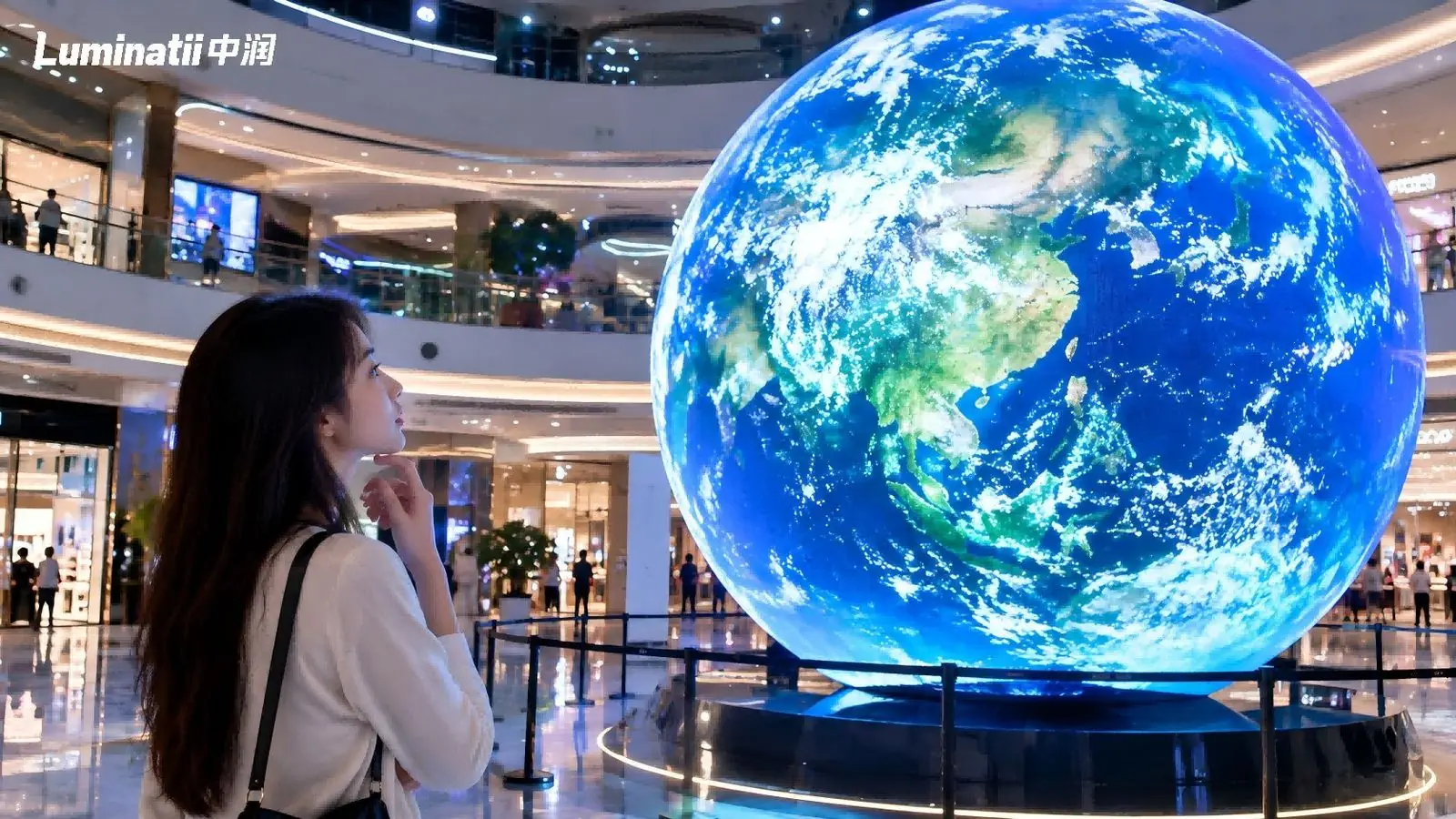
A mall is a public building with a fire strategy, a roof structure that was never designed for a display, and a maintenance team that has to reach the object without closing the atrium.
| Constraint | How we design for it |
|---|---|
| Roof structure | Suspension points located on primary structure, with the load calculated and shared with the base building engineer |
| Clearance | Sphere size and hanging height set against balustrade lines and the sight angle from the top floor |
| Service access | Front service with a single-operator module change; no scaffolding, no shell dismantling |
| Fire and egress | Low-voltage DC distribution to the panels, cable routing inside the cabinet, and materials selected for an occupied building |
| Noise | Fanless or low-noise power design where the sphere hangs above seating and dining areas |
| Visual finish | Seam geometry generated from the sphere model, so the silhouette is a circle from every level |
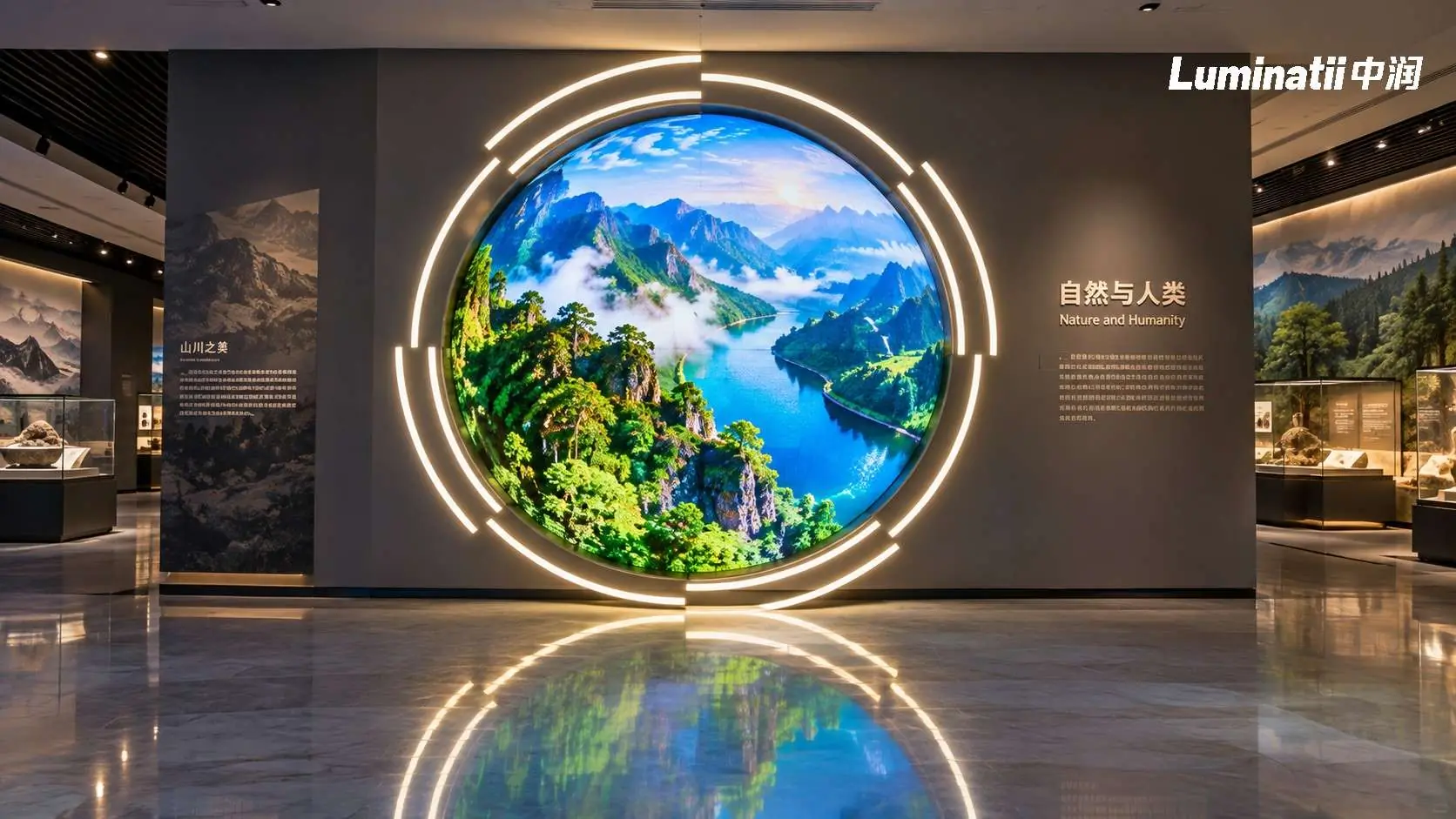
Some atriums are better served by a floor-standing sphere on a base, or by an embedded circular display set into a feature wall. The display technology is the same; the structure and the service strategy are completely different, and the right answer depends on the building.
We look at the atrium section drawing before recommending a format — a sphere that fits the render but not the roof is a problem you discover at installation.
Retail environments are unforgiving: bright ambient light, continuous operating hours, and an audience standing two metres away.
Visitors on the top floor are far away, but the people on the ground floor are close. Mall spheres are usually specified at P1.5 to P2.5 so the near view holds up.
Enough to compete with retail lighting and skylights, without turning the atrium into a light source that washes out the shopfronts around it.
Every visitor films the sphere. High refresh and 16-bit grayscale keep it flicker-free on camera, which matters when the content is designed to be shared.
| Parameter | Typical mall configuration |
|---|---|
| Diameter | 2 m – 5 m typical; up to 26 m delivered |
| Pixel pitch | P1.5 / P1.9 / P2 / P2.5 |
| Brightness | 1,200 nit at the screen face, dimmable |
| Contrast | 10,000 : 1 |
| Refresh | 7,680 Hz, 16-bit grayscale |
| Service | Front service, single operator, module-level replacement |
| Mounting | Suspended from primary structure, or floor-standing base |
| Control | Scheduled playlists, remote content updates, operator tablet |
The most common mistake in mall sphere content is treating it as a flat screen with curved edges. A sphere is read from all sides at once, and the top and bottom are seen foreshortened from every angle.
We commission the playback system with the as-built panel map, so content designed on a flat template maps correctly onto the sphere and stays correct after a module is replaced.
More questions about LED sphere installation and operation →
Retail projects rarely come with an empty shell. The atrium is trading, the escalators are running, and the installation has to happen without a hoarding across the shopfronts for three weeks.
Spheres are assembled and tested in the factory as bands, then shipped as a kit with a panel-by-panel layout drawing. On site, the suspension or base goes in first, the internal frame follows, and the bands close in sequence — work that can be done overnight, with the atrium handed back for trading each morning.
Because the sphere is pre-assembled in the factory, the site work is assembly rather than fabrication. That is the difference between a two-week closure and a series of night shifts.
The same display logic applies outside the building, where the sphere becomes a landmark for the whole development rather than a feature inside it.
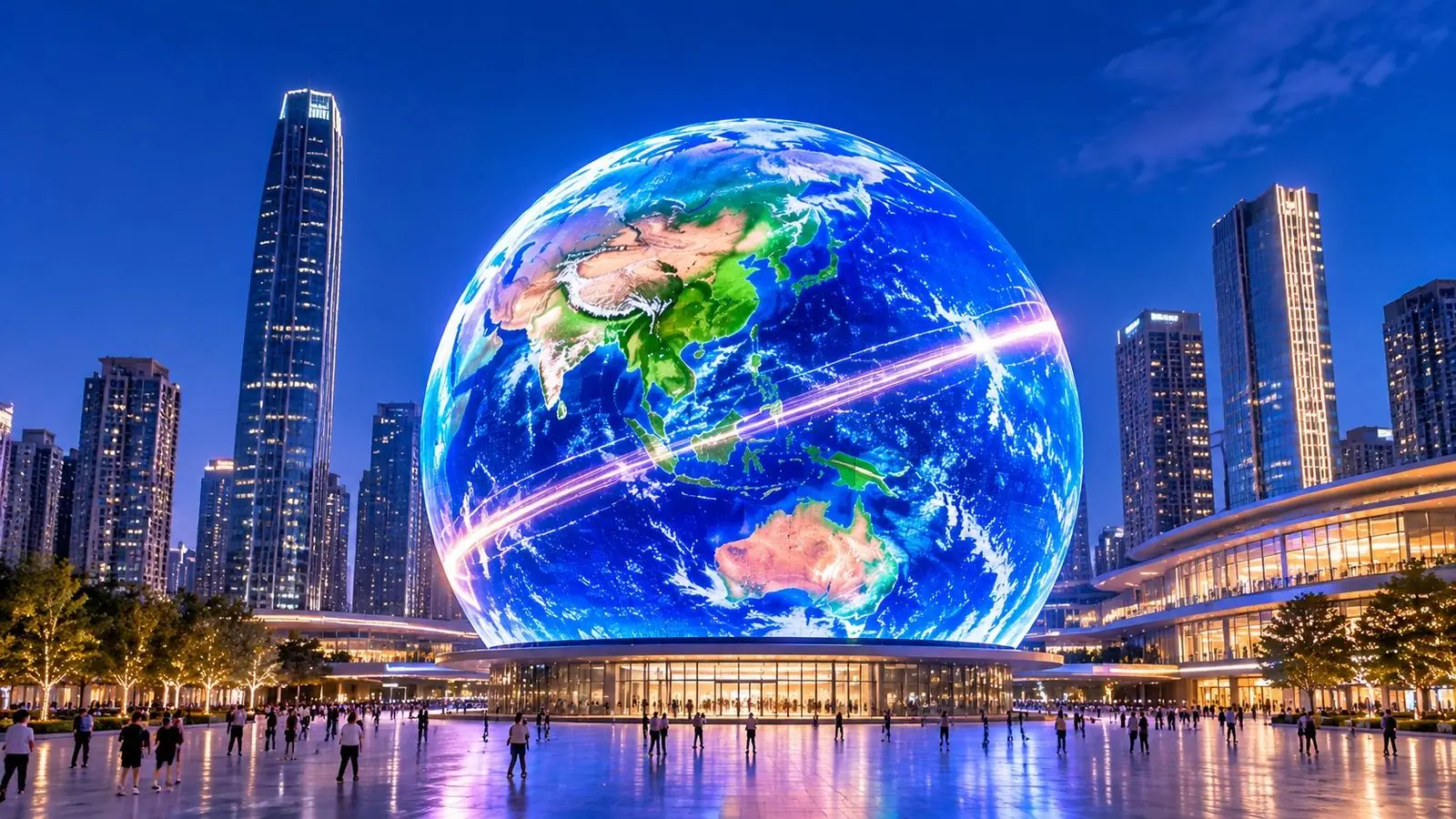
An outdoor sphere at a mall entrance or on a roof does a different job from an atrium globe: it works at 50 metres, in daylight, in rain, and it identifies the building from the road. That means IP65 sealing, higher brightness, wind-load calculation and a maintenance route that does not depend on closing the entrance.
We have delivered outdoor spheres up to 26 m in diameter — the same engineering at landmark scale.
Outdoor LED sphere engineering → · About our sphere manufacturing →
Most atrium installations land between 2 m and 5 m diameter, because the sphere has to clear the balustrades and the sight lines from the top floor. Larger spheres are possible — we have delivered up to 26 m — but in a mall the constraint is usually the roof structure and the clearance, not the display.
Yes, and the suspension has to be engineered with the sphere rather than added to it. The number and position of the suspension points, the stiffness of the internal frame and the panel gaps are one calculation; a sphere hung from four arbitrary anchors will show its seams within a year.
Front service. A technician reaches the modules from a scissor lift or a suspended platform, and each module is replaceable by one person using the large-buckle power boxes. We avoid designs that require dismantling the shell or scaffolding the atrium.
Yes. Mall lighting is bright but it is not direct sunlight, and an LED sphere at 1,200 nit with a 10,000:1 contrast ratio reads clearly from the top floor. Running below peak also keeps heat and power consumption down in an enclosed atrium.
Brand rotation, seasonal campaigns, launch events and interactive moments. Because the sphere is visible from every level, content should be designed for a 360° read — a flat poster layout wrapped around a sphere looks distorted from the sides.
That is usually the business case. The sphere becomes a bookable media surface with scheduled slots, which turns a decorative element into a revenue line for the mall operator.
Send your venue drawings, dome diameter and content plan — our engineers reply within one business day with a tailored configuration.
Get a Free Quote