Factory-direct LED Dome & Spherical Displays — Shenzhen, China
✉ enquiries@luminatii.com
☎ +86 177 0402 4640

Our largest delivered outdoor sphere: 26 m in diameter, a full external LED sphere standing on a coastal site in the Philippines, engineered for typhoon-class wind and salt air, and running nightly as a public landmark.
On a coastal site in the Philippines stands the largest outdoor sphere we have delivered: 26 m in diameter, a full external LED sphere whose display surface is the building's facade. It has no angles, no frame and no "off" view — every approach road and every window in the district sees a face of the image, and it runs nightly as a public landmark. From concept to first light, it was scheduled like the building it is.
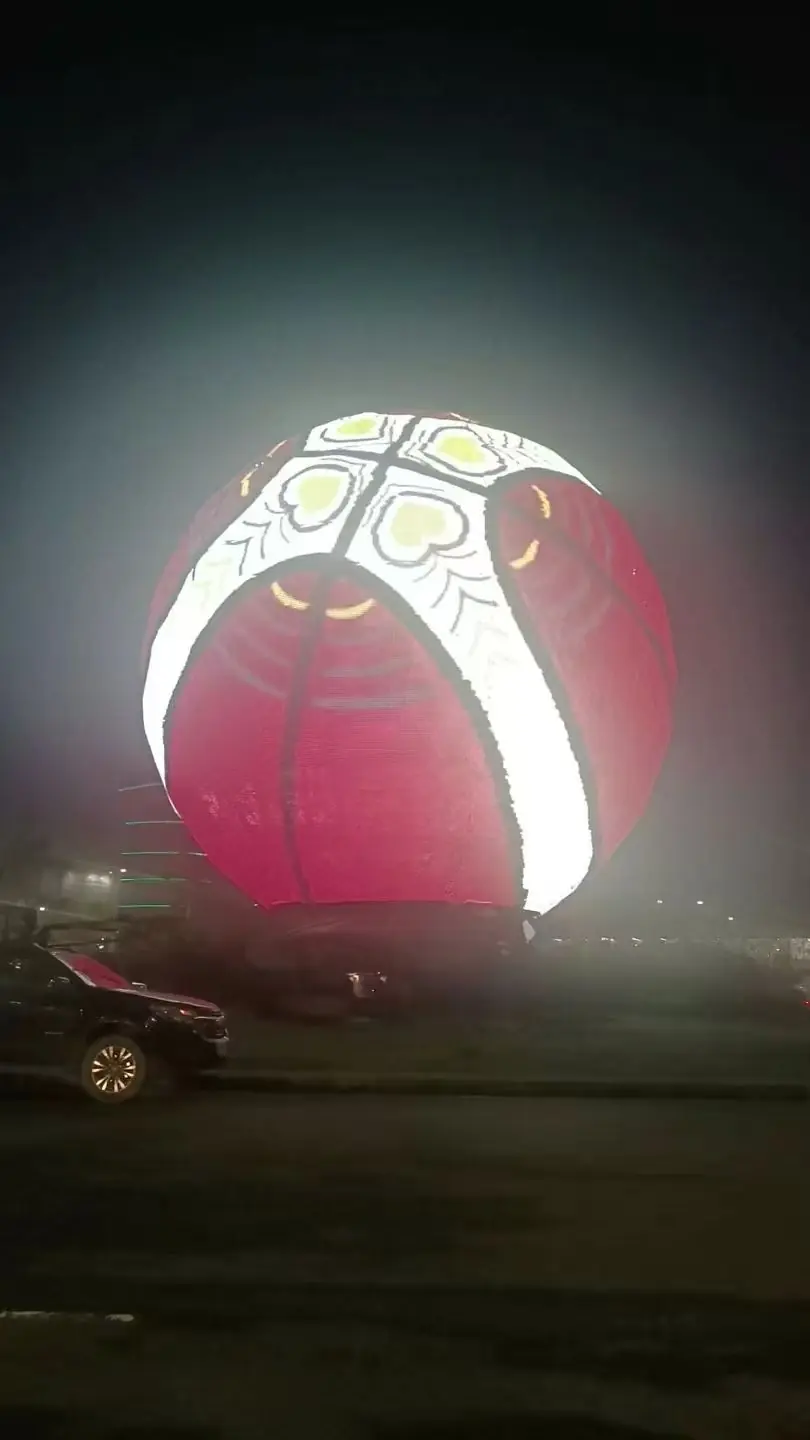
A 26 m external sphere is a building, not a screen. It has its own steel shell, its own weather envelope and its own access strategy — and it was engineered for one of the most demanding climates a display can face: tropical coastal, high humidity, salt air, typhoon-class wind.
A note on what we publish: the client's identity and the exact site stay confidential — the same courtesy your own project would receive. What we share within a serious inquiry is considerable: additional site photographs, the structural design approach, and direct conversation with the engineers who ran the installation. Landmark sphere engineering →
An outdoor sphere runs through every night of the year, in weather, at height. Four systems decide whether it still looks new in year five.
The shell is calculated against the site's design wind speed — typhoon-class for coastal Asia — with panel anchoring, ventilation pressure balance and seismic input in one structural model. The structure is engineered before the pixel pitch is chosen.
IP65-rated modules, drainage paths behind the screen, corrosion-protected steel and thermal design that vents heat without funneling rain inside. A landmark that dims every summer is one that was cooled as an afterthought.
Walkways inside the sphere put every module within reach — no scaffolding around a 26 m ball, no lane closures, no crane invoices. Failed modules are swapped in scheduled windows while the landmark stays lit.
Module health, power supplies and cabinet temperature report nightly to a dashboard. Failures are flagged before visitors notice them, and the repair is planned rather than emergency — the difference between a maintained landmark and a slowly dimming one.
The same four systems carry our outdoor sphere range at every size — 2 m to 26 m delivered, other diameters built to order. Outdoor sphere engineering in detail →
The visible result is one smooth glowing ball. The invisible sequence behind it is what buyers should actually evaluate.
The sphere divides into latitude bands of trapezoidal LED modules, each band's geometry calculated so seams align and imagery wraps without pinch. Panel count, structure loading and service layout all follow from this division — it is the first engineering decision, not the last.
The steel shell is designed against site wind, seismic and foundation data, and the panels mount to that structure through adjustable connectors that absorb real-world tolerance. On a 26 m ball, millimeters of steel movement are visible as image seams unless the connection design absorbs them.
Every sector runs on the factory test wall before packing — mapping, color and power all verified. Site assembly is then a reassembly of proven sectors rather than a first power-on in the air.
On site: sector assembly, full-surface calibration, content warping against the as-built geometry, then the nightly schedule — brightness tiers, signature content slots, monitoring integration — set with the operator before handover.
Buyers evaluating any large outdoor sphere — ours or a competitor's — should ask for exactly these four chapters: the geometry study, the structural calculation basis, the factory test evidence and the commissioning checklist. We hand all four over as standard documentation. Our sphere factory →
The Las Vegas Sphere put the format on every developer's agenda; this project proves the economics scale to the Asia-Pacific market. A spherical display earns attention no flat facade can match, for reasons that are geometric, not stylistic: it is a three-dimensional object in the skyline day and night, and it reads as architecture even between shows — which is why city planners and developers treat it as a building investment rather than an advertising expense.
| Revenue path | How the sphere earns |
|---|---|
| Advertising & brand takeovers | Full-surface brand nights command premium rates — a canvas flat screens cannot offer |
| Content licensing | Planetary, weather and countdown formats that only a sphere can play; the most-shared clips are spherical by nature |
| Destination value | The sphere becomes the address: events, tenancy and surrounding land value all rise with the landmark |
Operation is the quiet half of the investment: a nightly brightness schedule and content dayparting cut consumption sharply without losing the crowd, and we model the projected numbers with your diameter and playing hours before you commit.
Landmark spheres are decided on engineering trust as much as on price. The fastest way to start is with the site itself: a location plan, the design wind speed if you have it, and the farthest point the sphere should be recognized from. We will come back with a diameter, a structure concept and the full delivery schedule — structure, panels, installation and commissioning — so the opening date is planned, not hoped for.
Many landmark clients first judged us on a smaller sphere, then awarded the flagship. That path is open to you too. Landmark sphere sizing guide → · Our sphere factory → · All delivered projects →
The client's name, exact site and commercial terms are confidential — the same protection your own landmark project would receive. Within a serious inquiry we share much more: further site photography, the structural approach and a direct conversation with the engineers who delivered it.
This one was engineered to. The steel shell, panel anchoring and ventilation openings are calculated against the site's design wind speed; drainage paths and IP65-rated modules handle driving rain; corrosion treatment handles salt air. Structure is the project.
From inside. Service walkways are designed into the structure, so technicians reach any module without scaffolding or cranes, in scheduled windows, while the landmark stays lit. Remote monitoring flags failed modules and power supplies before visitors notice.
Power scales with brightness, diameter and playing hours — which makes the nightly schedule an economic lever. We provide a projected consumption model against your diameter and playing schedule before you commit.
The screen is not the long pole — the steel shell, foundations and approvals are. Panels manufacture in weeks; a 20 m-plus sphere is scheduled like a construction project, because that is what it is. The full schedule comes with the quotation.
Send your venue drawings, dome diameter and content plan — our engineers reply within one business day with a tailored configuration.
Get a Free Quote