Factory-direct LED Dome & Spherical Displays — Shenzhen, China
✉ enquiries@luminatii.com
☎ +86 177 0402 4640

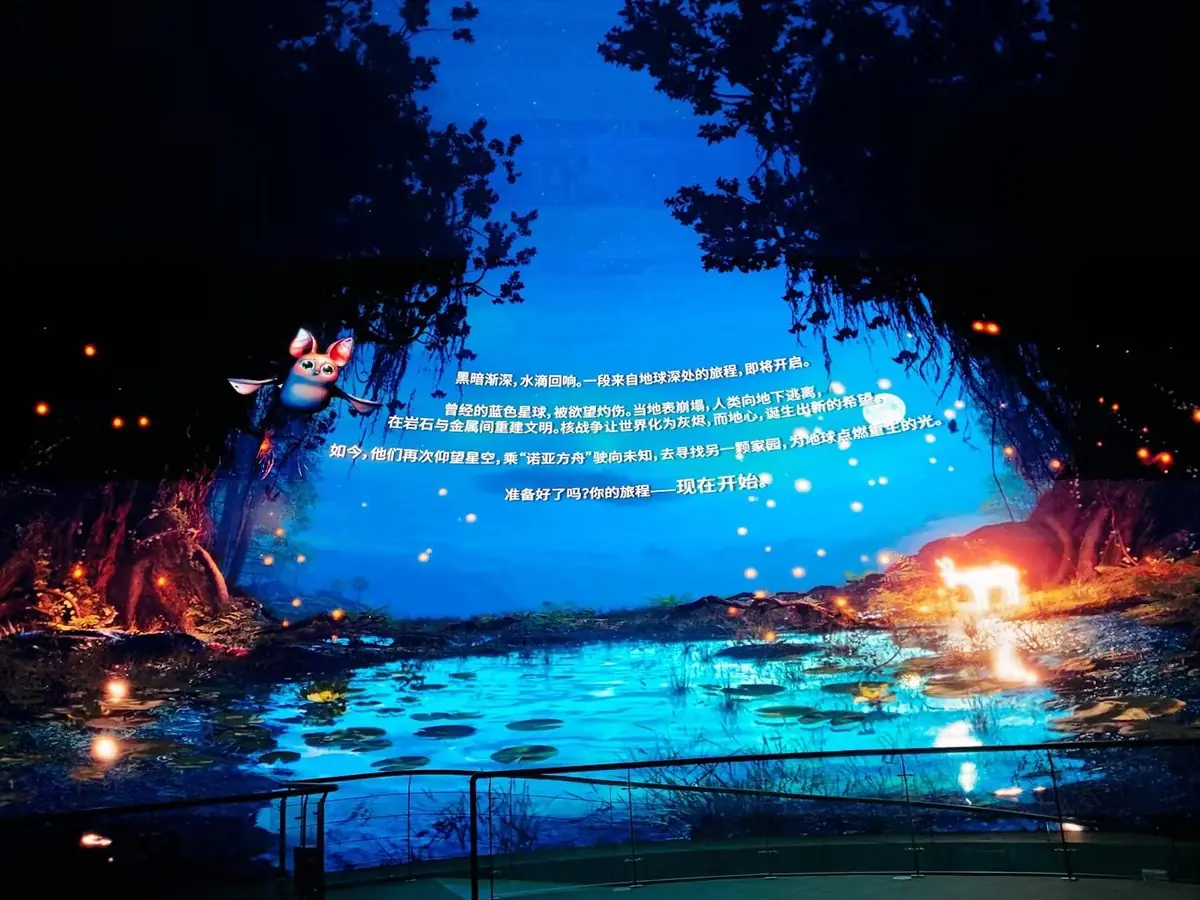
In Changzhi, Shanxi, a 20 m diameter LED dome plays cinema-grade content while the soundtrack comes from behind the screen — not from wall speakers fighting it. The screen is perforated, the audio sits directly behind it, and the audience hears the image instead of the room.
The venue in Changzhi, Shanxi is the format most buyers actually need: a 20 m diameter, acoustically transparent LED dome — one compact building, one seamless spherical screen, and the entire audio system mounted behind it. The perforated LED surface passes the soundtrack through with less than 5% transmission loss across speech and music bands, while keeping the image bright enough for daytime operation.
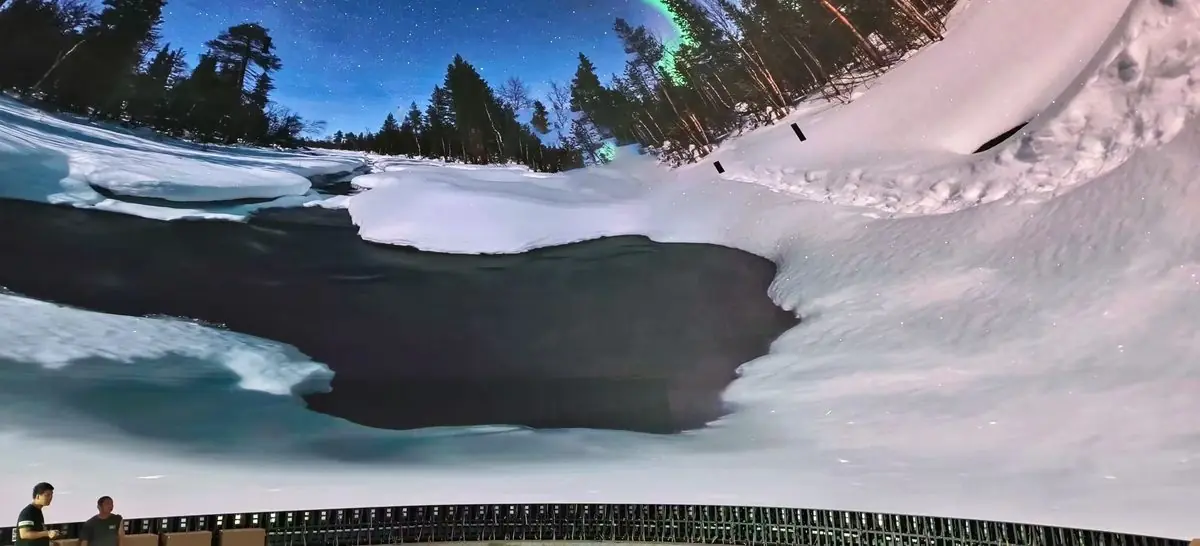
Ask visitors what they remember and they rarely mention pixels. They mention that the thunder came from above, that the narration moved with the character across the dome, that the snow scene felt cold. That is the sound-transparent design doing its work: the audio follows the image because it originates inside it.
A sound-transparent dome is a compromise engineered until it stops being one. Here is what the Changzhi build balances.
| Design problem | What we do about it | Result |
|---|---|---|
| Sound must pass through a solid screen | 50% perforation engineered into the module face | Transmission loss held under 5% in speech and music bands |
| Audio and picture must not drift apart | Audio system mounted directly behind the screen, system-level sync | < 0.02 s audio-to-image offset |
| A sphere is not flat | Triangular + trapezoidal modules, XY-adjustable connectors | Seamless spherical tiling with structural tolerance absorbed on site |
| Projection-grade dark scenes on LED | High-gray, high-refresh driving | Smooth gradients in starfields, snow and night content; 7,680 Hz refresh |
The last row matters more than most buyers expect. Dome content lives in darkness — stars, aurora, night skies. On a poorly driven LED screen those scenes band and smear, and the audience reads it instantly as "not cinema". The Changzhi screen carries that content class every day, which is why dark-scene handling is a question we ask about your content library before we quote pitch.
A 20 m sphere fills a building without filling a skyline. That is the quiet advantage of this diameter: it delivers true wrap-around immersion and a real full-dome image, inside a structure most venues can house — and it installs in a working building, not a stadium.

Three things every dome build shares, at any diameter. First, the structure carries tolerance, not the screen: the steel is surveyed, the module grid is computed from the real geometry, and XY-adjustable connectors let the crew close the last millimeters. Second, the audio design is part of the screen design — mounting points, cabinet depth and perforation are agreed before fabrication, because retrofitting sound into a finished dome is a project-killer. Third, the image is tuned to the room: brightness uniformity and color calibration are done in situ, target deviation within 5% brightness and 2ΔE across the sphere.
A fourth detail belongs in the audio conversation: serviceability behind the screen. Amplifiers and processors mounted directly behind a spherical screen have to be reached without pulling the LED surface forward, so rack positions, cable routing and access walkways are agreed during design, not improvised during commissioning. At Changzhi the audio chain sits in a service corridor behind the perforated surface — close enough to localize perfectly, accessible enough for the venue's own technicians to maintain. That is the difference between a sound-transparent dome that stays sound-transparent and one that quietly degrades into wall speakers after its first amplifier failure. How our turnkey delivery works →
The 20 m class is the workhorse of the dome economy, and Changzhi shows why.
Walk-in domes take whole audiences per session — no motion platform to cycle, no seats to re-dock. For venues selling spectacle rather than thrill, that means steady hourly throughput on content alone, and shorter queues than a ride of the same footprint.
The same screen that plays family films at noon plays a night show at eight. LED startup is instant — no projector warm-up — so turnaround between sessions is minutes. Sound-transparent audio makes the evening programming premium rather than recycled.
Front-and-rear maintenance access means a module can be swapped from either side without taking the screen down. The audio sitting behind the screen does not complicate that: the same access path serves both. Routine service stays inside the operator's own team.
This is also the format to study if you are comparing LED domes against projection domes. Projection needs darkness to compete; LED plays bright and dark content at any hour, and the perforated screen keeps the audio advantage a projection dome claims as its own. LED dome vs projection dome →
| Changzhi 20 m Dome | |
|---|---|
| Location | Changzhi, Shanxi, China |
| Format | Walk-in immersive dome theater |
| Diameter / Pitch | 20 m sound-transparent inner dome · P2 |
| Acoustic design | 50% perforation, audio behind screen, < 0.02 s sync |
| Image performance | 1,200 nit, 16-bit gray, 7,680 Hz refresh |
| Maintenance | Front and rear access, single-technician module swap |
Changzhi sits in the middle of our delivered dome range, which runs from 5 m compact theaters to the 60 m Kongtong flagship. The 60 m flagship case → · Dual-dome theme park case →
Diameter should follow from your audience flow and your building, not from a brochure. A quick orientation:
| Your situation | Suggested format | Reference |
|---|---|---|
| Compact building, first dome project | 7–10 m hemisphere | Shenzhen 7 m flying theater |
| Mid-size venue, group immersion | 14–22 m walk-in dome | This page; Guizhou 14 m; Huangshi 22 m |
| Thrill ride format | Flying theater + motion platform | Flying theater engineering → |
| Destination-scale spectacle | 30–60 m landmark sphere | Kongtong 60 m → |
Send us the building drawings and your target session length — we will return a diameter, pitch and audio architecture sized to the room, with a delivered reference attached. Talk to the dome team → · All projects →
In a dome, sound that arrives from the walls arrives late and from the wrong direction — the image is overhead and around you, the speakers are behind you. A perforated LED screen lets the audio system sit directly behind the image, so dialogue and effects originate where the story happens. The acoustic penalty is small and measurable; the sense of immersion it buys is not.
Visibly, no. The perforation is engineered into the module face, the driving electronics compensate for the open area, and at dome viewing distances the audience sees a continuous image. What they do notice is that the sound is anchored to the picture — which is the entire point.
The modules are cut in triangular and trapezoidal shapes so they tile a curved surface without seams, and every connection point adjusts in two directions (XY) so the crew can take up structural tolerance during installation. Front-and-rear access means a module can be serviced from either side without dismantling the screen.
Full-dome films, nature and space content, and show programming — the same 16-bit-high-gray pipeline our domes use for cinematic gradients. Snow, aurora and night-sky scenes are exactly the content class where cheap domes show banding; this screen does not.
Yes. Changzhi shows the format at its most practical: one compact building, one dome, sound-transparent audio, daily playback. If your venue is larger or wants motion platforms, the flying-theater page covers how the format scales.
Send your venue drawings, dome diameter and content plan — our engineers reply within one business day with a tailored configuration.
Get a Free Quote