Factory-direct LED Dome & Spherical Displays — Shenzhen, China
✉ enquiries@luminatii.com
☎ +86 177 0402 4640

A theme park attraction has one job: make guests queue for it twice. A dome does that better than almost any screen-based ride — total visual immersion, no motion sickness from 3D glasses, and a show that stays fresh because the content, not the hardware, carries the storyline. We know because we build them, including the two-dome complex at Huangshi described below.
A roller coaster thrills the body. A dome thrills the eye — and unlike a coaster, you can re-theme a dome every season without touching the hardware.
Rides depreciate toward boredom: the thousandth run of a coaster feels like the first. A dome inverts that. The screen, structure and sound system stay constant for a decade, while a content update — a new film, a seasonal overlay, an IP crossover — makes the same room feel like a new attraction. Parks use this to pull repeat visits between ride expansions.
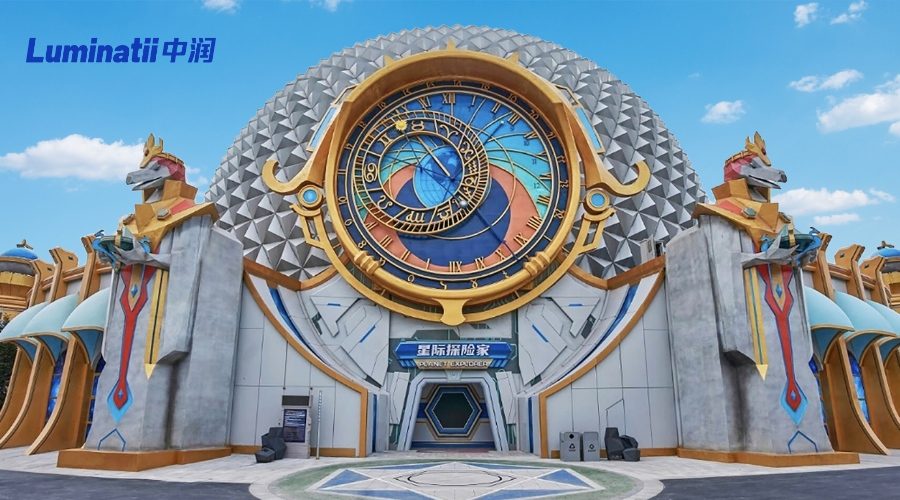
In Huangshi, Hubei, inside the Garden Expo Park on the shore of Daye Lake, we delivered a dual-dome complex for the Dinosaur Dream Factory zone — a full-sphere theater and a motion flying theater, both running daily since June 2024.
| Theater | The Land Sky Theater | Motion Flying Theater |
|---|---|---|
| Screen form | 28 m diameter full sphere, 720° with digital floor | 22 m diameter hemisphere |
| Display area | ≈ 2,400 m² | ≈ 630 m² |
| Pixel pitch | P4 custom-shaped full color | P4 custom-shaped full color |
| Experience | Standing/walking immersion with floor interaction | Seated motion flying platform |
| Role in the park | Signature walk-in attraction | Thrill-format headline ride |
| Status | Daily operation since June 2024 | Daily operation since June 2024 |
Two formats in one zone is deliberate: the full sphere absorbs families and casual visitors at high throughput, while the flying theater sells the premium thrill. Guests who queue for one buy the other — the pair raises per-capita spend without adding a square meter of land. How a 60 m dome became a tourism traffic engine →
A theme park dome is not a big TV bent into a curve. Three problems decide whether the attraction opens on schedule and stays open.
A 28 m sphere is assembled from thousands of custom-shaped modules over a steel shell. At Huangshi the installation demanded high positioning accuracy across wide irregular areas and a heavy steel-pipe scaffold — tolerances were held so the image seam stays invisible from the guest's closest viewing position.
Construction happened with the park environment around it. We designed self-created hanging ladders to replace full scaffolding in the riskiest zones, held full-coverage safety training, and finished with zero recordable incidents. Your park's insurance and operations team will care about this as much as the picture.
On the flying theater, platform motion, audio and image are locked within a fraction of a frame — 0.02 s audio-to-picture tolerance on our delivered flying theaters. Desynchronization is the difference between "amazing" and "makes me nauseous" in a motion format.
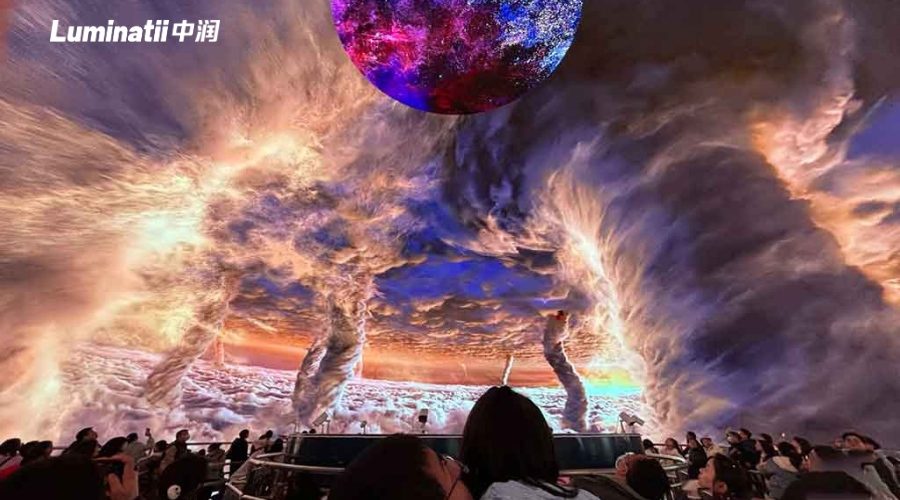
Park hours are brutal for a display: full brightness under mixed ambient light from morning to close, seven days a week. The Huangshi domes run calibrated brightness for daytime queues and a dimmed cinema mode for shows, with 16-bit grayscale so dark scenes stay smooth instead of banded. Thermal design keeps the screen stable through Hubei summers, and modules are serviced from access positions that do not interrupt the show schedule.
We have delivered domes from 5 m to 60 m diameter. The right format follows from your land, your audience and your ticket strategy — not from the biggest number.
| Format | Typical diameter | Guest experience | Best for |
|---|---|---|---|
| Full sphere 720° | 20–40 m | Walk-in immersion, floor interaction, huge throughput | Signature zone attraction |
| Flying theater | 15–25 m hemisphere | Seated motion ride with synchronized platform | Headline thrill attraction |
| Dome cinema | 12–30 m tilted shell | Seated fulldome film, high seating capacity | Family entertainment and IP shows |
| Compact dome | 5–10 m | Intimate group experience, fast turnaround | Kids' zones, museum wings, smaller parks |
Every format above has a delivered reference in our project list — we will show you the closest match to your site during the first call. For feasibility checks, a full-sphere 360° walk-in theater typically needs a main auditorium of roughly 1,100 m² and 33 m of clear height for about 160 guests per show and a 6-minute film — a bigger building than most owners expect, and the single most common planning surprise. How we configure custom domes → · Flying theater LED domes in detail →
The screen is delivered once; the operation runs every day. Park operators who plan these three routines from day one get the payback their business case promised.
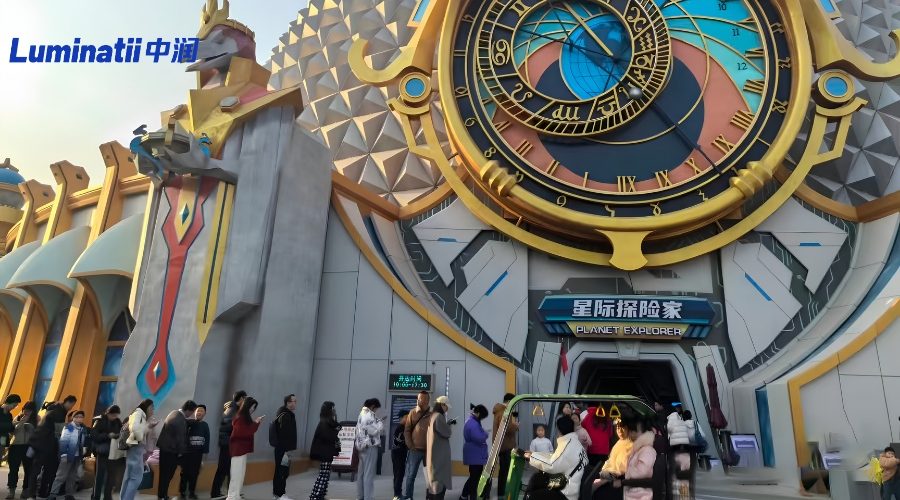
Queue design, pre-show space and load/unload choreography decide your real capacity more than the dome diameter does. At Huangshi the queue builds early and stays orderly because the show cycle is predictable — guests can see the next entry point from the line. We model your peak-day target into the diameter and seat count, so the screen never becomes the bottleneck.
Evening operation deserves its own plan: a second brightness profile, a different show list and staff briefing notes. Parks that run a distinct evening format routinely lift per-guest spend without new hardware.
LED domes age by brightness, not by sudden failure. Modules are swapped in blocks during scheduled maintenance windows — usually overnight or on low-attendance weekdays — and the attraction stays open while individual sections are serviced. This is the quiet advantage over projection: no lamps to re-lamp on a cycle, no alignment drift to re-converge, and picture quality that is calibrated back to spec rather than replaced.
At handover we train the operator team on the daily checklist, the module-swap procedure and the show-control interface, so the attraction runs on your staff from opening day.
Five inputs are enough for a first configuration, a throughput estimate and an installation schedule aligned with your park calendar.
| Input | What it decides |
|---|---|
| Available space and clear height | Maximum dome diameter, full sphere vs hemisphere vs tilted shell |
| Peak-day target throughput | Seat count, show cycle length, and the pitch guests actually need |
| Ride format | Walk-in sphere, motion flying theater or dome cinema — each has different structure and AV design |
| Theme and content plan | Resolution, brightness and show-control interfaces, plus seasonal re-theming needs |
| Site conditions | Outdoor exposure, park operating calendar, crane access and installation windows |
Send us the site drawings and your peak-day target. We will reply with a dome diameter, a throughput model, a panel schedule and an installation plan — before any commercial discussion. Start the conversation →
The screen itself is the main load. A 28 m dome draws roughly the power of a mid-size ride, and unlike a ride it has no high-wear mechanical consumables in daily operation. LED screens age by brightness, not by failure: modules that dim are swapped in blocks during scheduled maintenance windows, and the show stays open while individual sections are serviced. The honest cost drivers are staffing, content refresh and air conditioning, not the display.
A 28 m dome typically seats 200 to 300 guests per show with a cycle time of 12 to 20 minutes including load and unload, which works out to roughly 600 to 1,200 guests per hour for the theater alone. The exact number depends on your pre-show and transition design more than on the screen. We size the dome diameter to your peak-day target throughput — that calculation is part of the first proposal.
Yes — that is the flying theater format, and it is the most common theme park configuration we deliver. The screen and the motion platform are engineered together so the image, the platform motion and the audio stay synchronized within a fraction of a frame. See our flying theater page for the integration details.
The Huangshi two-dome complex was delivered inside an operating park environment with zero recordable safety incidents, using self-designed hanging ladders and full scaffolding discipline. A typical 20-30 m dome runs on a similar schedule to our other delivered projects: steel structure first, then panels and commissioning. The precise timeline is confirmed against your park calendar before we sign.
A signature film for the main show, shorter seasonal or IP-based segments for re-theming, and ideally a day-parting plan: family content in the morning, thriller or premium content in the evening. The dome plays standard fulldome masters; we handle warping, mapping and show control integration so your content supplier works in ordinary production tools.
Send your venue drawings, dome diameter and content plan — our engineers reply within one business day with a tailored configuration.
Get a Free Quote