Factory-direct LED Dome & Spherical Displays — Shenzhen, China
✉ enquiries@luminatii.com
☎ +86 177 0402 4640

You cannot tile a sphere with squares. Every dome screen that looks truly seamless is built from modules cut as triangles and trapezoids, with independently adjustable angles and connectors that move in two directions. This is the least visible and most consequential hardware decision in a dome.
This is the single most important sentence in dome hardware: a sphere curves in two axes at once. A flat panel can be given a single bend, which handles one axis. Place it on a sphere and its corners lift away from the surface — leaving a gap, a step, or a panel that has to be forced into place and stays stressed for its service life. Multiply that by thousands of modules and the result is a dome that reads as a mosaic.
The industry answer is geometry rather than force: modules are cut as triangles and trapezoids, shapes that tile a sphere without leaving crescents or requiring deformation. Trapezoids handle the bands where circumference changes with height; triangles resolve the transitions and the pole region. Together they let the grid follow the curvature continuously — the foundation of a seamless image. The complete dome screen system →
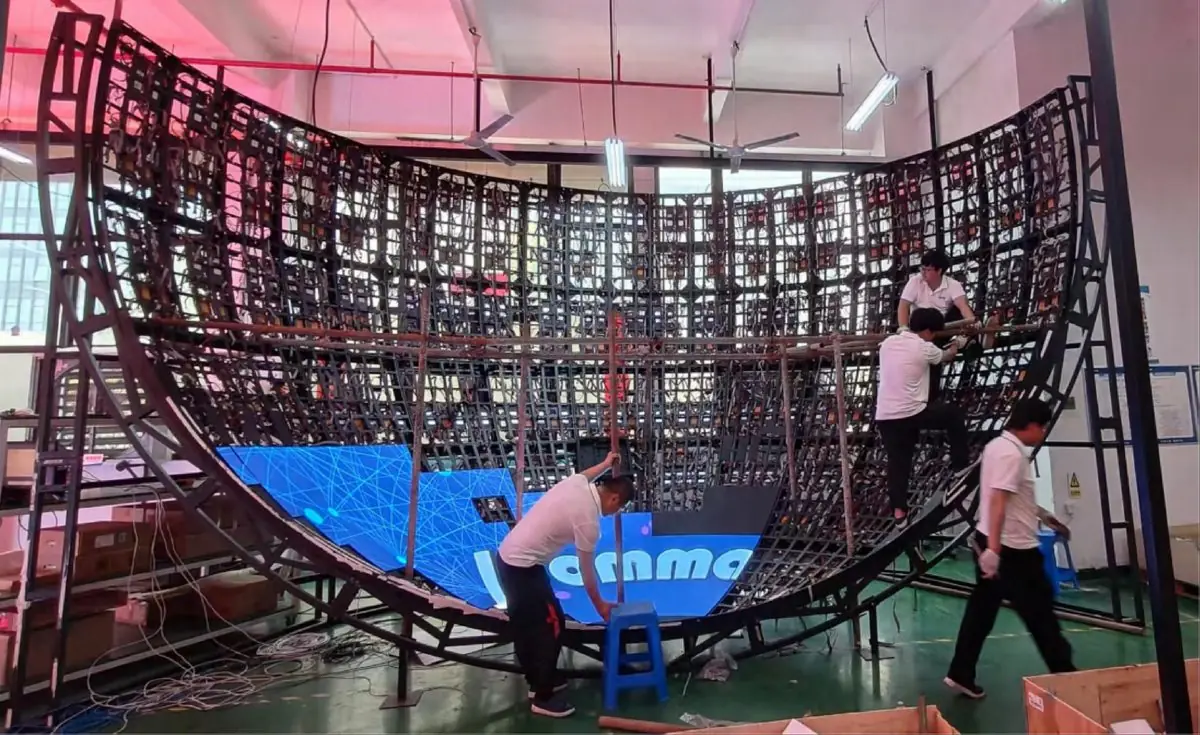
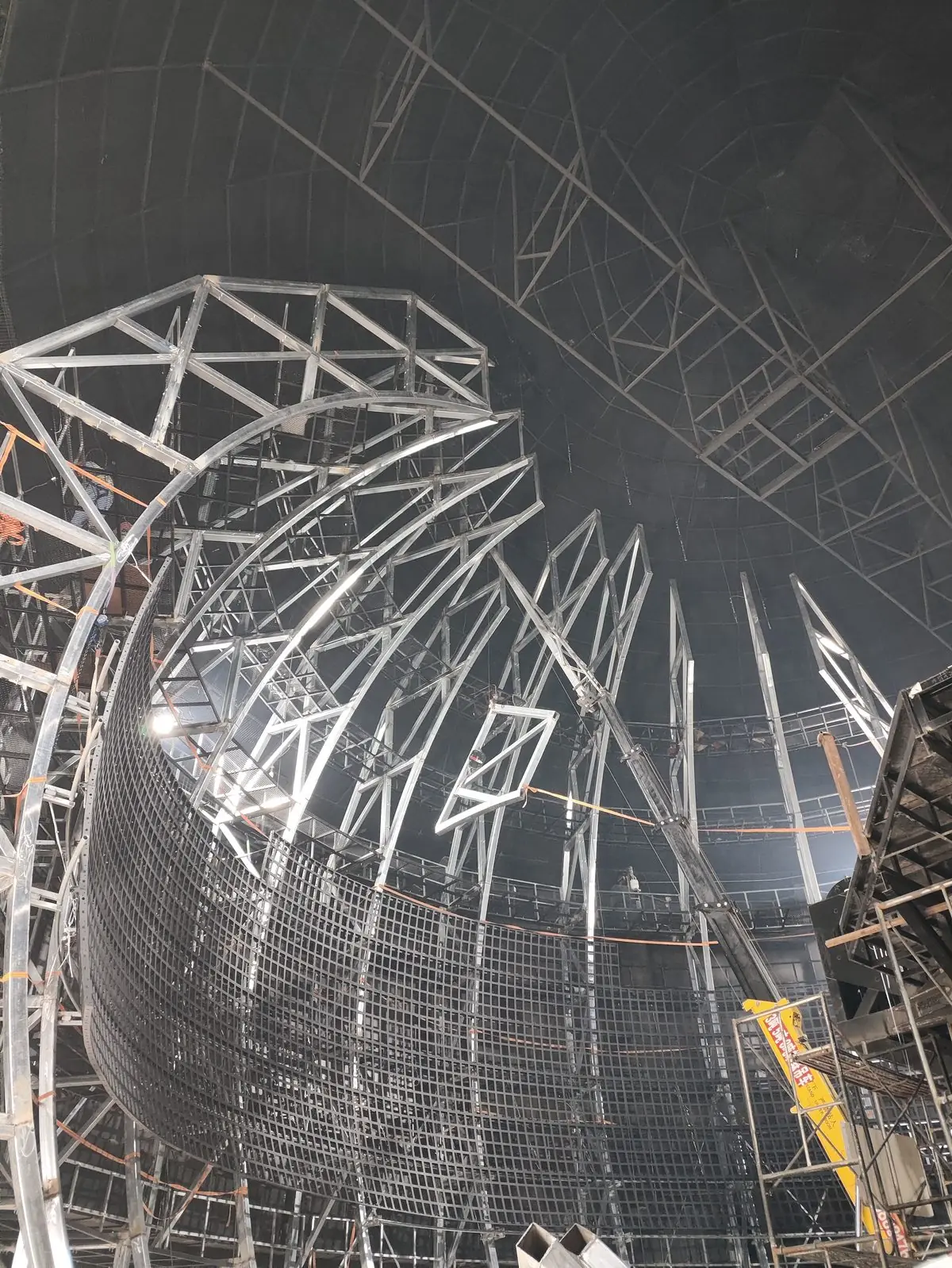
Four details turn the right shape into the right surface. First, independent angle adjustment: each module is oriented to the local surface normal, so the face of every unit is perpendicular to the sphere at its own position rather than to an average plane. Second, XY-adjustable connectors: every connection point moves in two directions, letting the crew close structural tolerance on site instead of accepting it permanently. Third, narrow bezels: less non-emitting border per module means a higher fill factor and less screen-door effect at close viewing distance. Fourth, edge continuity: module edges are designed to meet their neighbours precisely, so the grid disappears into a continuous surface.
These are the details a buyer cannot see on a specification sheet and can absolutely see on a finished dome. Two suppliers can both quote "P2.5 LED dome" and deliver visibly different products, because pitch says nothing about geometry, fill factor or adjustment range. What pitch does and does not tell you →
| Symptom the audience sees | Geometric cause | Why calibration cannot fix it |
|---|---|---|
| Visible grid lines across the dome | Flat or single-curve panels meeting the sphere only at their centre | Calibration corrects brightness and colour, not surface position |
| Soft, faceted appearance | Modules oriented to an average plane rather than the local normal | Focus and seam geometry are physical, not electronic |
| Brightness bands sweeping with viewing angle | Angular misalignment between neighbouring modules | Uniformity measured head-on can pass while off-axis still varies |
| Screen-door effect at close range | Wide bezels and low fill factor | Pitch reduction is the only remedy — an expensive one after installation |
| Local distortion in content | Irregular module sizes or spacing breaking the geometric mapping | Content mapping assumes a true sphere; the hardware must deliver one |
The commercial lesson is straightforward: when comparing dome suppliers, ask what module shapes they use and how much adjustment exists at each connection. A supplier using only rectangular panels is not offering a cheaper dome — they are offering a different, and visibly inferior, product at a similar price. How the structure supports the geometry →
Installation follows the geometry, not the other way around. The crew works in bands from the base upward, setting a surveyed reference ring first, then closing each band against the one below it. Trapezoidal modules fill the band; triangular modules resolve the transitions and the pole. Because every connection adjusts in two directions and every module's angle is independently set, each band is brought true before the next begins — errors are absorbed locally instead of accumulating at the top of the sphere.
That sequence has a quality-control consequence worth asking about in procurement: the sphere can be measured band by band during installation, not only at the end. A crew that checks each ring against the surveyed reference catches drift while it is still adjustable; a crew that assembles everything and measures once discovers drift when the only remaining remedy is re-shimming thousands of connectors. The difference shows up in the delivery schedule as much as in the image.
Finally, the module system has to survive being serviced. Because each module's geometry is fixed by its connectors rather than by hand-fitted shims, a replacement returns to the same plane as its neighbours — the surface does not degrade every time somebody opens the screen. That is the quiet long-term value of good module geometry: it makes the tenth year look like the first. The structure beneath the grid →
The module system does not change with diameter — only the count, the pitch and the structure do. That consistency is why a compact dome and a flagship sphere can share a supply chain and a quality standard.
| Project | Diameter | What the geometry had to solve |
|---|---|---|
| Beijing 5 m & 8 m | 5–8 m | Small radius: modules must follow tight curvature with no visible faceting at 2–3 m viewing |
| Shenzhen 7 m | 7 m | P1.9 pitch on a curved surface — seams would be exposed at close seating |
| Changzhi 20 m | 20 m | Sound-transparent perforation plus spherical tiling in one module |
| Kongtong 60 m | 60 m | Thousands of modules, 5,300 m², geometry accuracy maintained across the whole sphere |
Ask us for module drawings and a sample section for your diameter — the geometry is the part of a dome that is decided long before the first show. Custom dome geometry → · Module service design → · Talk to the dome team →
One last comparison worth making during supplier evaluation: ask to see the rear of a module, not just the front. The rear reveals the enclosure design, the cabling route and the connector quality — the parts that decide service life. A dome that looks flawless from the audience side and chaotic from behind is a dome that will be expensive to own.
Front-facing photographs sell domes; the back of a module explains them.
Geometry. A flat panel touches a sphere at one point or one line; the rest of the panel sits away from the surface, or deforms the surface to meet it. On a large dome, that shows up as visible joints at every row and a faceted rather than spherical appearance. Bending a panel helps along one axis only — a sphere curves in two. Triangular and trapezoidal modules are cut so their edges follow the actual sphere.
They tile different regions of the sphere. Trapezoidal modules work naturally in bands around the dome, where the circumference changes with height; triangular modules resolve the transitions and the pole region, where a trapezoid would leave gaps or crescents. Using both lets the grid follow the curvature continuously instead of approximating it.
Each module's mounting angle is set independently, so the face of every module can be oriented to the true local surface normal rather than to an average plane. Combined with XY-adjustable connectors — which take up structural tolerance in two directions — the crew can achieve a continuous surface even when the building is not mathematically perfect.
Heavily, and in ways buyers do not expect. Seams read as softness; gaps reduce fill factor and create a visible screen-door effect at close range; misaligned angles produce brightness variation across the viewing angle. A fine pitch on poor module geometry looks worse than a coarser pitch on good geometry — which is why we treat this as a quality issue, not a manufacturing detail.
Yes. Individual modules can be replaced from the front or the rear, and because the drive design is parallel, a failed module does not affect its neighbours. After replacement the module is calibrated to the screen's profile — geometry is fixed by the connector design, so a swap restores the surface without re-shimming the sphere.
Send your venue drawings, dome diameter and content plan — our engineers reply within one business day with a tailored configuration.
Get a Free Quote