Factory-direct LED Dome & Spherical Displays — Shenzhen, China
✉ enquiries@luminatii.com
☎ +86 177 0402 4640

In a 3D render, a curved LED wall and an LED dome look like the same idea at different scales. In a finished room, they are different products. The wall curves toward the audience and stops; the dome surrounds them and closes overhead. That difference decides where your visitors look, whether the illusion holds at the edges, how sound behaves, and what the structure and budget look like. Here is the comparison done honestly — including the cases where the wall is genuinely the right answer.
A curved LED wall bends the picture toward the audience. An LED dome places the audience inside the picture. Everything else — structure, sound, seating, cost — follows from that one distinction, and most disappointments in immersive projects trace back to choosing the format before defining the experience.
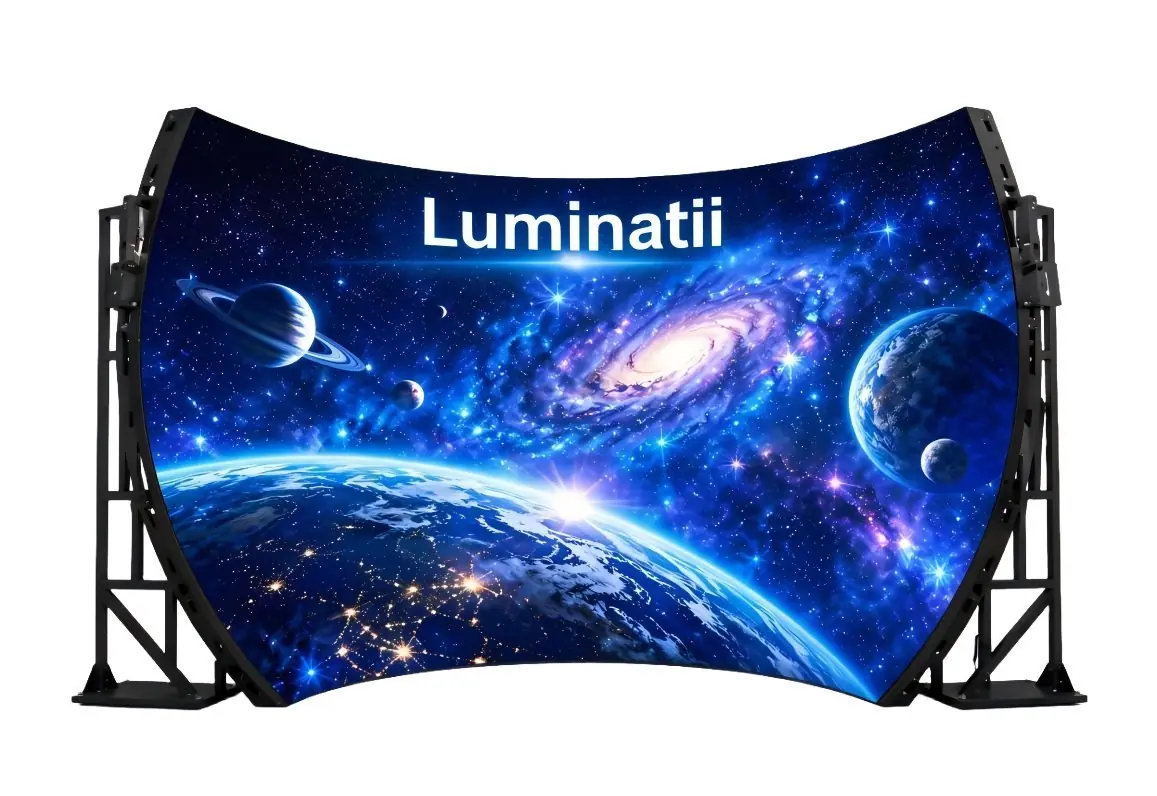
Immersion is not resolution — it is whether the edges of your visual field agree with the story. The comparison below is what determines whether a visitor forgets the room.
| Factor | Curved LED wall | LED dome |
|---|---|---|
| Field coverage | Frontal arc; edges and ceiling stay in the real world | Closes overhead; head turns stay inside the image |
| Viewing posture | Facing the screen; looking away breaks immersion | Reclined or free; movement is part of the experience |
| Edge seams | Vertical edges meet architecture — visible junction points | No frame; geometry continuous across the surface |
| Sound | Speakers visible or wall-mounted beside the screen | Audio from behind a sound-transparent screen; image and source coincide |
| Structure | Simpler frames; integrates into existing architecture | Engineered steel with loads calculated for the site |
| Project scale | Generally smaller, faster installs | Larger project; destination-attraction economics |
One nuance buyers miss: on a dome, the sound advantage is not a separate feature — it is engineered into the screen. Our sound-transparent domes run 50% open perforation with less than 5% acoustic loss, so speakers live behind the image. On a wall, the equivalent is speakers beside the picture, which the ear can locate and the brain notices. A sound-transparent dome in service →
Both formats demand real curved-geometry engineering; they differ in how much, and where. This matters when you compare quotes, because curvature done cheaply is the defect that appears in year one and never leaves.
The practical takeaway: ask any supplier — for either format — how curvature is achieved and what the screen weighs per square metre. Those two answers separate engineered products from assembled ones.
The screen is only part of the system. How the room seats its audience and moves its sound changes which format delivers the experience the brief promised.
Buyers comparing the two formats on brightness and pitch tables routinely miss both of these — and both are far harder to fix after opening than any screen parameter. Decide the room, then decide the screen.
And a note on flexibility, because it tips several real projects: a wall reconfigures. Panels extend, aspect ratios change, the surface migrates to a new wall next season. A dome is committed architecture — it shapes the room, and the room shapes every future use of it. Venues that re-theme often lean wall for that reason alone; destinations building a permanent signature attraction lean dome because permanence is the point.
Neither format wins in the abstract. Match the format to the brief with this table — and note that several rows are about the business, not the screen.
| Your brief says | Lean toward | Why |
|---|---|---|
| "A stunning backdrop / centerpiece" | Curved wall | Frontal impact is the goal; dome adds cost for coverage you don't need |
| "A ticketed immersive attraction" | Dome | Peripheral closure and sound-from-image drive repeat visits and premium pricing |
| "Inside an existing building, fast" | Curved wall | Structure and access far simpler; sphere needs geometry planning |
| "Planetarium / flying theater / dome cinema" | Dome | These formats are defined by surround vision; a wall contradicts the brief |
| "Phase two might go immersive" | Dome (or reserved geometry) | Walls don't convert to domes; plan the room once |
We build both — the same module technology, calibration discipline and service design run through our walls, spheres and domes — so this comparison is engineering, not salesmanship. Tell us the brief and we will tell you honestly which format it wants, including when the answer is "the wall." LED domes → · Turnkey dome delivery → · Delivered projects →
When the experience is frontal by design. Stage backdrops, exhibition features, broadcast sets and retail statements often want a powerful curved surface that the audience faces — not an environment that wraps them. A curved wall also integrates more easily into existing architecture, installs faster, and can sit within structures that were never designed for a sphere. If your brief says "impressive screen" rather than "immersive space," the wall deserves a serious look.
Peripheral vision. Human field of view is roughly horizontal-panoramic and extends well above eye level, so a wall — even a strongly curved one — leaves the edges and ceiling of the visual field in the real room. The moment a viewer turns their head, the illusion ends. A dome closes the visual field overhead, so head movement stays inside the image. That is the whole reason planetariums are domes, and it cannot be rendered away.
Both are seamless if built correctly — the difference is where the geometry gets hard. A wall has two problem zones: its vertical edges, where panels meet architecture, and any tight horizontal curve. A sphere demands true curved geometry everywhere, which is why it needs triangular and trapezoidal modules with individually adjustable angles rather than bent flat cabinets. Done properly, neither shows seams; done cheaply, the dome shows them less because the eye forgives curvature more than edges.
A curved wall is generally the smaller project: less area, simpler structure, faster installation. The dome's additional cost buys a different category of experience — full immersion, sound from behind the screen, and a venue people travel to rather than walk past. The honest comparison is not screen-versus-screen but brief-versus-brief: what is the room for? We quote both formats when the brief is genuinely open.
Rarely, and it is worth knowing before you build. The wall's structure, seating geometry and sightline design all assume a frontal experience; converting to a dome means re-planning the room, not adding panels. Venues that expect to deepen immersion over time should plan for a dome — or at least reserve the geometry for one — from the start.
Send your venue drawings, dome diameter and content plan — our engineers reply within one business day with a tailored configuration.
Get a Free Quote