Factory-direct LED Dome & Spherical Displays — Shenzhen, China
✉ enquiries@luminatii.com
☎ +86 177 0402 4640

A flat video wall and an LED sphere can stand in the same atrium, at a similar budget, doing completely different work. The wall broadcasts; the sphere gathers. The wall shows content; the sphere becomes content — the object people photograph, circle and return to. This page compares them honestly across visibility, content behavior, engineering and cost, because the right answer depends on whether you are buying a screen or a landmark.
The comparison that matters is not screen-versus-screen — it is job-versus-job. A video wall is the right answer when the content is the point. A sphere is the right answer when the object is the point. Get the job wrong and no amount of pixels fixes it.
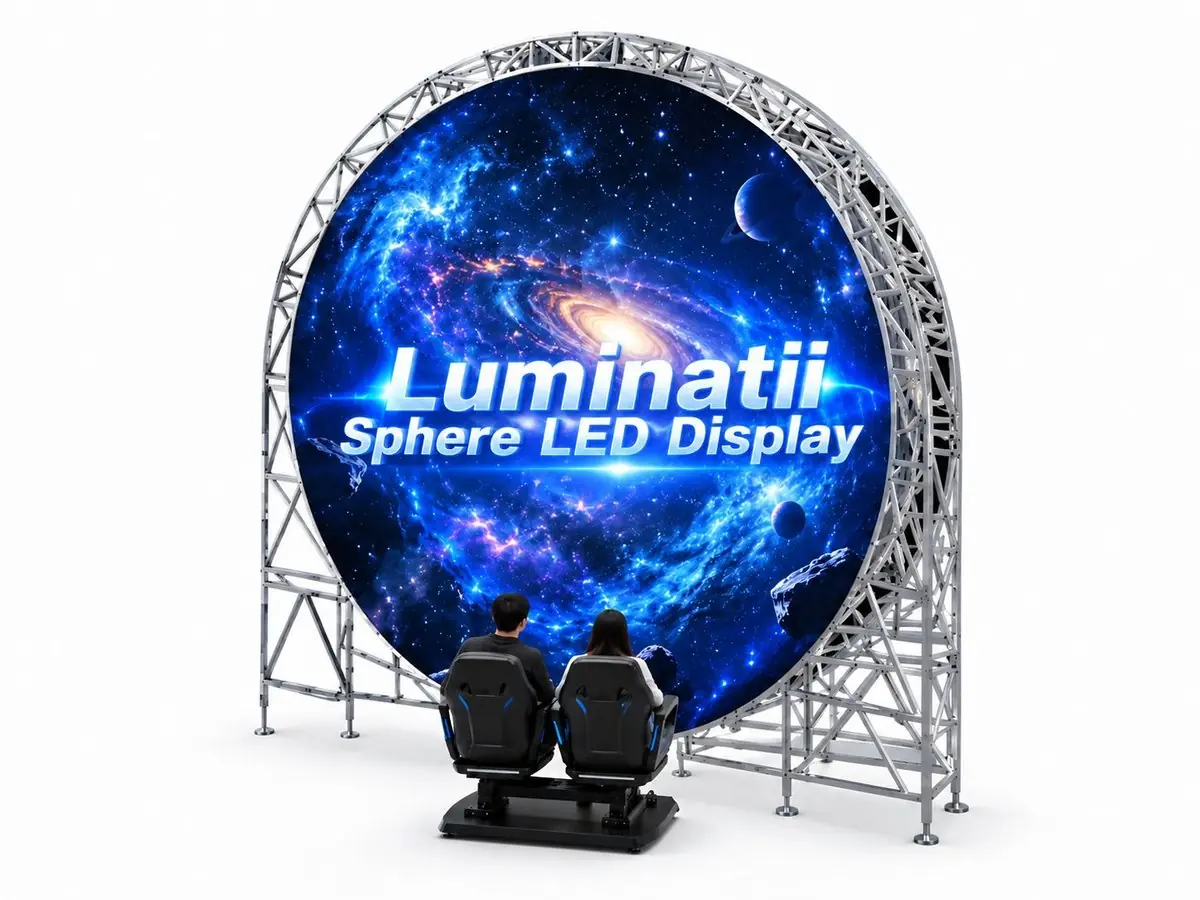
Same room, same budget bracket, different physics. Where each format genuinely wins — and loses.
| Factor | Flat video wall | LED sphere |
|---|---|---|
| Content fit | Perfect for rectangular composition — video, data, text | Content must be authored for spherical mapping; text panels awkward |
| Visibility | Frontal; sides and rear are dead zones | 360° visible; no back of the screen |
| Silhouette value | None — a surface, not an object | Strong — photographs as a landmark object |
| Structure | Simple mounting; conventional loads | Internal frame, custom geometry, engineered per project |
| Floor plan | Wall-hung; zero footprint | Occupies floor or hangs from structure — a planning decision |
| Maintenance | Conventional flat access | Front-and-rear access engineered for curvature; single-person module swaps |
Notice the two rows buyers forget until it is too late: floor plan and maintenance. A sphere takes space and needs an access plan — both are cheap to design in and expensive to retrofit. How service access is engineered →
Placement deserves its own paragraph, because it decides half the sphere's value. A sphere placed where circulation bends around it — lobby centers, atrium voids, entrance thresholds — gets seen from the moving angles that make it an object. A sphere pushed against a wall becomes an expensive hemisphere, and a video wall would have done the job better. Plan the walking routes before the footprint: the sphere earns its premium from being surrounded, not admired from one spot.
The most expensive misconception in this category is that a sphere is a video wall wrapped around a form. It is a different construction problem, and the difference shows up in the render, on site and in year five.
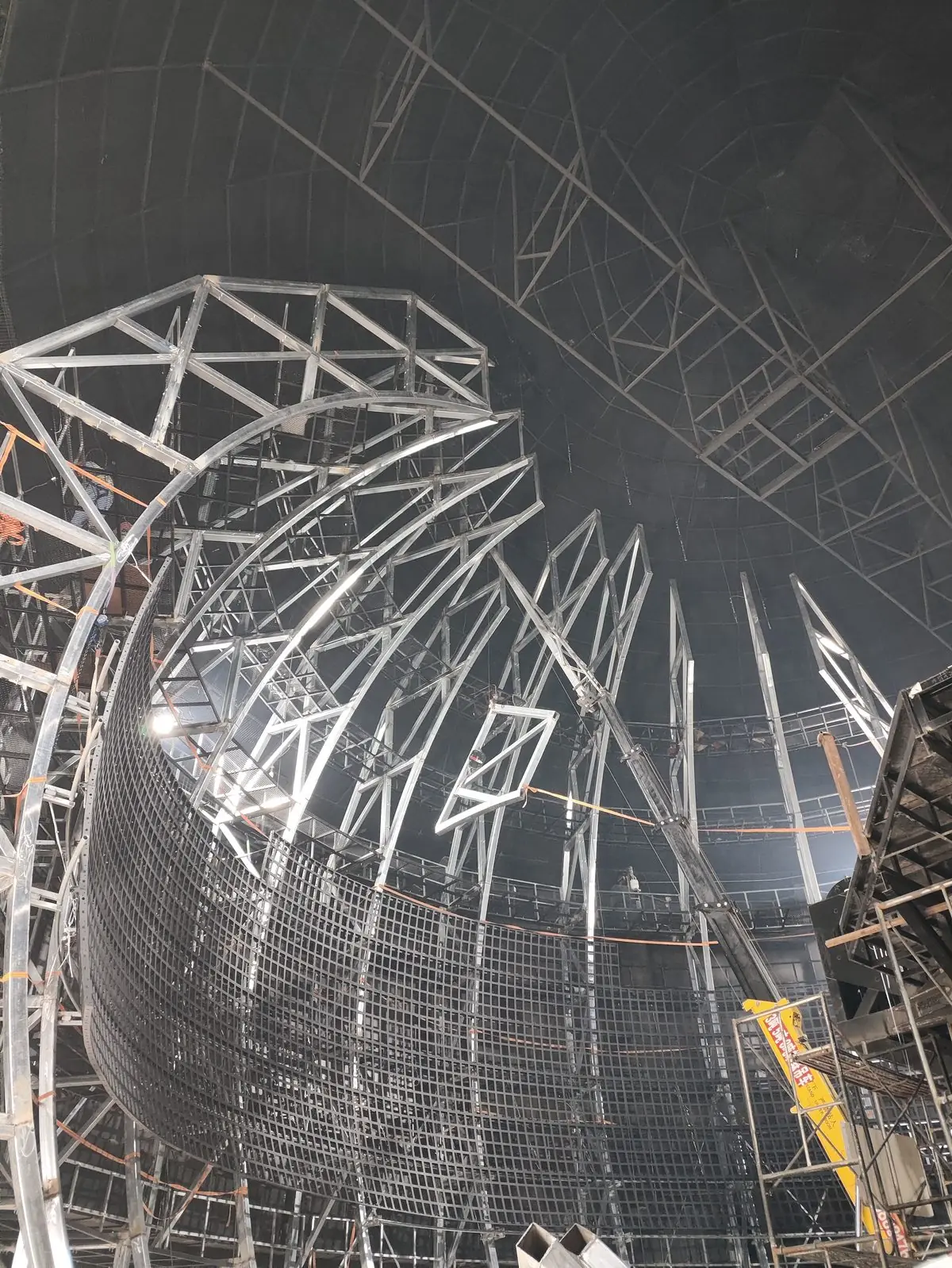
Ask any supplier how their sphere modules achieve curvature and how uniformity is verified. Vague answers here predict vague screens.
Hardware comparisons stop at the screen edge. But the formats diverge most in how content behaves on them — and content is what your visitors actually experience every day.
A practical middle path many venues take: the sphere plays ambient identity content that changes slowly and deliberately, while flat screens elsewhere in the venue handle fast-changing information. The two formats coexist because they do different jobs — which is the whole argument of this page.
A decision table, built from delivered projects rather than from brochures.
| Your brief says | Lean toward | Why |
|---|---|---|
| "Show schedules, promos, data" | Video wall | Rectangular content at lowest cost per square metre |
| "An object the lobby is remembered by" | Sphere | Silhouette and 360° presence — a wall can't be an object |
| "Science museum / earth display" | Sphere | The planet is the content; the shape is the message |
| "Control room / broadcast set" | Video wall | Composed information, fixed sightlines, serviceability |
| "Social-media-driven retail flagships" | Sphere | Visitors photograph objects, not surfaces |
We build both — spheres from 2 m to 26 m and large-format walls — so this page is selection advice, not a sales pitch. Tell us the job and we will recommend the honest format, including when that means selling you the wall. The sphere product → · Museum spheres → · Delivered projects →
No, and the difference is engineering, not geometry. A sphere needs custom-shaped modules — triangles and trapezoids with independently adjustable angles — because bent flat cabinets create visible facets and stressed pixels. The internal structure, module layout and cable routing are all designed around curvature. Our spheres use the same approach from 2 m gallery globes to the 26 m coastal landmark: computed geometry, XY-adjustable connectors and calibration performed on the finished sphere, not a flat bench.
When the job is information or impact at scale. Departure boards, wayfinding, data dashboards, retail promotions, control rooms and stage backdrops are all jobs where a rectangle is the correct shape — content is composed for rectangles, and the wall delivers it at the lowest cost per square metre. If nobody needs to walk around your screen, you probably don't need a sphere.
Because a sphere is an object, and objects get photographed. A video wall is background; visitors pose in front of it but the picture is of them. A sphere has a silhouette — people circle it, film it from every side and the footage reads as "that place with the glowing globe." Venues buy spheres partly for this effect: the display doubles as the location's identity. It is also why sphere content works differently — the best-performing content treats the sphere as a character, not as a big TV.
Per square metre, yes; per outcome, it depends. A sphere's surface area is smaller than most walls, but its structure, custom modules and installation are more complex. The fair comparison is against the job: if the job is "give the lobby a signature object that visitors photograph," the sphere usually wins because a wall cannot do that job at any price. If the job is "show the schedule," a wall wins because a sphere is an expensive way to show a schedule.
Mostly yes, with one caveat: mapping. Content for a sphere is projected onto curved geometry, so playback systems handle spherical mapping and the content itself is authored with the wrap in mind. We provide the mapping pipeline and verify playback on the finished sphere at handover; venues typically run everyday content (brand, news, ambient visuals) through the same CMS they already use.
Send your venue drawings, dome diameter and content plan — our engineers reply within one business day with a tailored configuration.
Get a Free Quote