Factory-direct LED Dome & Spherical Displays — Shenzhen, China
✉ enquiries@luminatii.com
☎ +86 177 0402 4640

A 7 m diameter dome in Shenzhen proves that flying theaters do not need airport hangars. P1.9 fine pitch, rows of motion seats facing a spherical screen, picture and platform in sync — the flight format compressed into a footprint most venues can actually house.
In Shenzhen we delivered a 7 m diameter flying-theater dome, P1.9 — the compact end of the ride format. Motion seats face a spherical LED screen that wraps the audience's field of view; the platform banks and pitches with the film; the audio moves with the picture. Everything that makes a flying theater sell tickets survives the compression to 7 m. What disappears is the building problem: no 25 m clear height, no dedicated structure, no months of civil work.
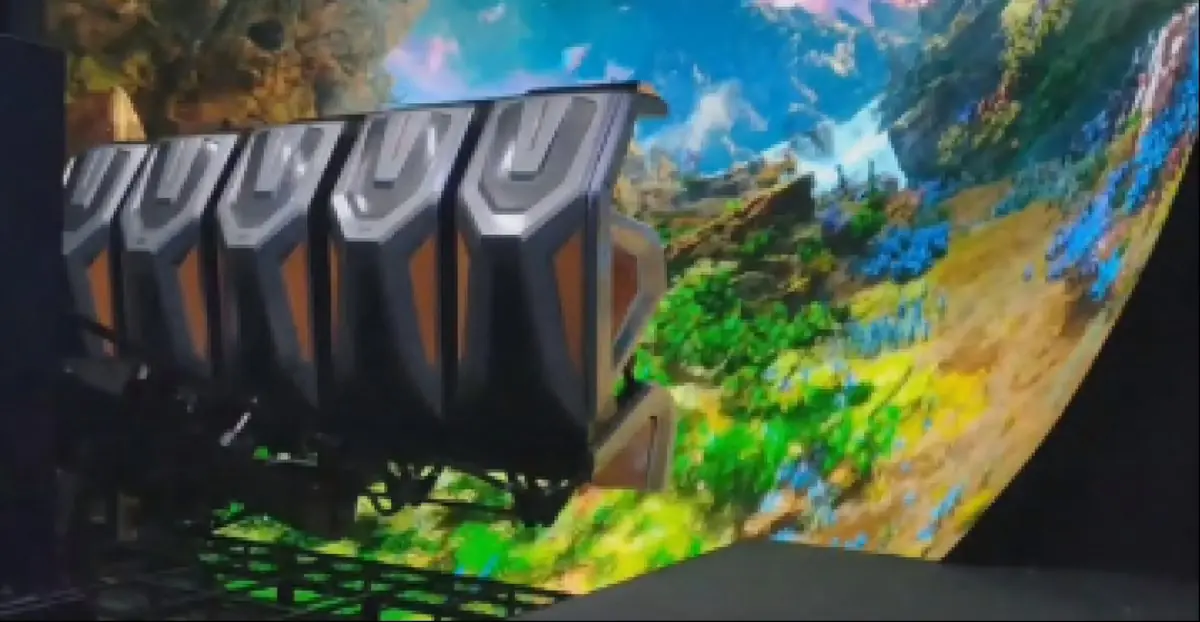
Look at how close the seating sits to the screen — and how much of the audience's field of view the image occupies from there. That geometry is the entire trick of the compact flying theater: the dome does not need to be huge, it needs to be close. Proximity does the wrapping; the pitch makes it photographic.
The Shenzhen dome runs P1.9 — our finest spherical pitch — and the pairing of pitch to format is not an aesthetic choice. It is the load-bearing decision of the whole design.
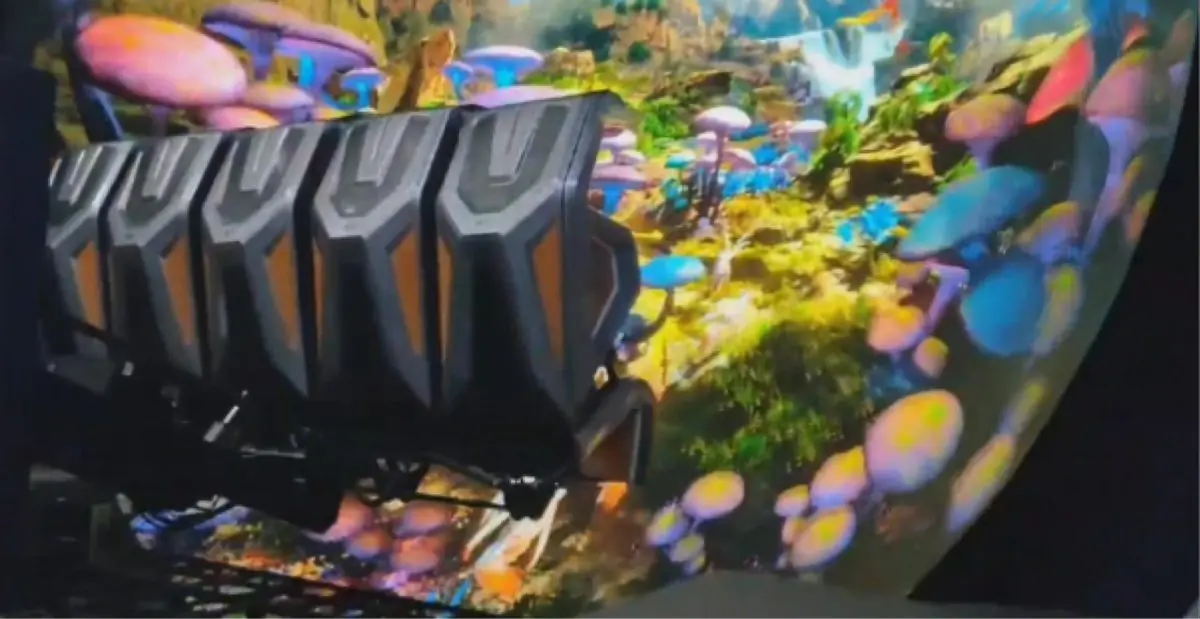
A flying theater asks its audience to believe their own eyes are reporting altitude. The moment of maximum risk is the moment the film looks down: the ground fills the screen two or three meters from the viewer's face, and any visible pixel structure snaps the brain back to a room with chairs in it.
At P1.9, the pixel field holds up at that distance — color gradients stay photographic, fast pans stay smooth under high-refresh driving, and dark scenes stay free of banding. The audience's eyes stay in the film. That is the whole product.
This is also where spherical module geometry earns its keep. Fine pitch on a curve is unforgiving: flat panels bent onto a sphere show seams precisely where the audience is looking, and there is no distance to hide them at 7 m. Triangular and trapezoidal modules with XY-adjustable connectors tile the surface without those seams — the same construction we use from 5 m to 60 m, just with finer pitch under closer eyes. Flying theater engineering →
A flying theater lives or dies by synchronization. In Shenzhen, the three systems were engineered as one package, and that integration is what the audience actually buys.
| Cue | What the audience perceives | Engineering requirement |
|---|---|---|
| The bank | The horizon tilts, the seat leans, the sound sweeps with the turn | Image, platform and audio cues land as one event |
| The drop | The ground rushes up, the seat falls, the engine sound swells | Latency budget designed across all three systems at once |
| The calm | Level flight, ambient audio, horizon steady | High-refresh driving keeps pans smooth; sync holds in the quiet moments too |
When screen, motion and audio come from separate vendors, these cues are negotiated after installation — and the audience feels the negotiation. When they come from one engineering pipeline, commissioning is a calibration session instead. The compact format makes this discipline even more valuable: at 7 m, every seat is close enough to notice everything, and there is nowhere for a sync error to hide.
The Shenzhen dome exists because operators kept asking the same question: we love the flying-theater numbers, but we don't have a 20 m building — what can we actually do?
Shopping malls, family entertainment centers and tourist venues already have the room this format needs. No new structure, no crane over the roof, no season of civil work — the dome and its platform install inside a working building, and the venue starts selling rides instead of renting out a corner.
Small capacity is a feature when each seat is the product: motion-seat rides command per-ride pricing far above passive cinema, and short films keep the throughput honest. The compact theater sells the same thrill as its larger siblings, priced per seat, in a footprint the landlord already pays for.
LED startup is instant and content changes are file uploads — a new film relaunches the attraction without touching hardware. Operators schedule a film library across dayparts and seasons, which keeps repeat visitors returning to a ride whose seats never moved.
And the format connects upward: several operators run the compact dome as their first ride product, then scale to a 22 m flying theater or a dual-dome park as the numbers mature. The 7 m screen's construction — modules, driving, maintenance design — carries directly into the larger builds. The 22 m format at Chengdu Happy Valley →
| Shenzhen 7 m Flying Theater | |
|---|---|
| Location | Shenzhen, Guangdong, China |
| Format | Flying theater — dome screen + motion seats |
| Diameter / Pitch | 7 m spherical LED dome · P1.9 |
| Image performance | 1,200 nit, 16-bit gray, high-refresh driving |
| Integration | Picture, motion platform and show audio, one package |
| Maintenance | Front and rear access, single-technician module swap |
Position in the range: the 7 m dome is the smallest ride format we deliver, in a lineup that runs to the 60 m Kongtong flagship. Every diameter between them has a delivered reference behind it. Huangshi dual domes → · Changzhi 20 m sound-transparent dome →
Two inputs decide it: the room's clear height and your target hourly throughput. From those we size the dome, the seating rows and the platform specification — and answer honestly whether 7 m is the right diameter or whether your volume supports the next size up.
| If your goal is… | Look at | Reference |
|---|---|---|
| Premium ride in a compact footprint | 7 m flying theater, P1.9 | This page — Shenzhen |
| Full-scale flying theater operation | 22 m dome + motion platform | Chengdu Happy Valley 22 m → |
| Group spectacle without ride hardware | 14–20 m walk-in dome | Changzhi 20 m → |
| Immersive room on a small budget | 5–8 m sound-transparent dome | Beijing 5 m & 8 m pair → |
Send us the room drawings and your throughput target — we will come back with diameter, pitch, seating and platform specification, sized to the space, with a delivered reference attached. Flying theater engineering → · All projects → · Talk to the dome team →
Yes — because flight is created by the relationship between the image and the seats, not by the diameter. The screen wraps around the field of view from the seating position, the platform banks and pitches with the film, and the audio moves with the picture. Those three cues together read as flight at 7 m just as they do at 22 m; the small format simply trades scale for accessibility.
Motion seats sit close to the screen — a few meters, not a few tens. At that distance, a coarser pitch would show pixel structure and break the flight illusion at its most vulnerable moment: when the audience is looking down at the 'ground'. P1.9 keeps the image photographic from the nearest row.
That depends on your room, your throughput target and the platform specification — we size the seating layout from your building rather than quoting a fixed number. What we can say is that the 7 m format turns a compact footprint into ticketed ride revenue, which is exactly why operators choose it for spaces that could never house a 20 m theater.
Yes — same spherical triangular and trapezoidal module system, same high-gray high-refresh driving, same front-and-rear maintenance design. The 7 m dome is the format compressed, not simplified; even the fine pitch is only possible because the spherical module geometry supports it.
The format scales upward: 14 m and 20 m walk-in domes for group immersion, 22 m flying theaters for full-scale ride operations, and up to the 60 m Kongtong flagship. The useful question is which format your audience flow supports — we help you answer that from your building drawings.
Send your venue drawings, dome diameter and content plan — our engineers reply within one business day with a tailored configuration.
Get a Free Quote