Factory-direct LED Dome & Spherical Displays — Shenzhen, China
✉ enquiries@luminatii.com
☎ +86 177 0402 4640

A spherical LED display is one of the most quoted screens on the internet and one of the least honestly priced. Catalog numbers ignore the variables that decide the real budget: diameter, pixel pitch, installation height, environment and whether the sphere is a decorative globe or a 26 m coastal landmark. This page shows what a sphere screen budget is actually made of, which variables move each part, and what to send us so the quote you receive is buildable rather than indicative.
Search "LED sphere screen price" and you will find confident numbers attached to no specification at all. Here is the honest version: we have delivered spheres from 2 m to 26 m in diameter — gallery globes, museum earth displays, mall centerpieces and a 26 m outdoor landmark on a tropical coast — and no two of them were priced the same way, because no two were the same project. Diameter changes the surface area, pitch changes the LED count, and everything else — structure, environment, installation height, access — changes the engineering around the screen. A price list would be fiction; a structured quotation is not.
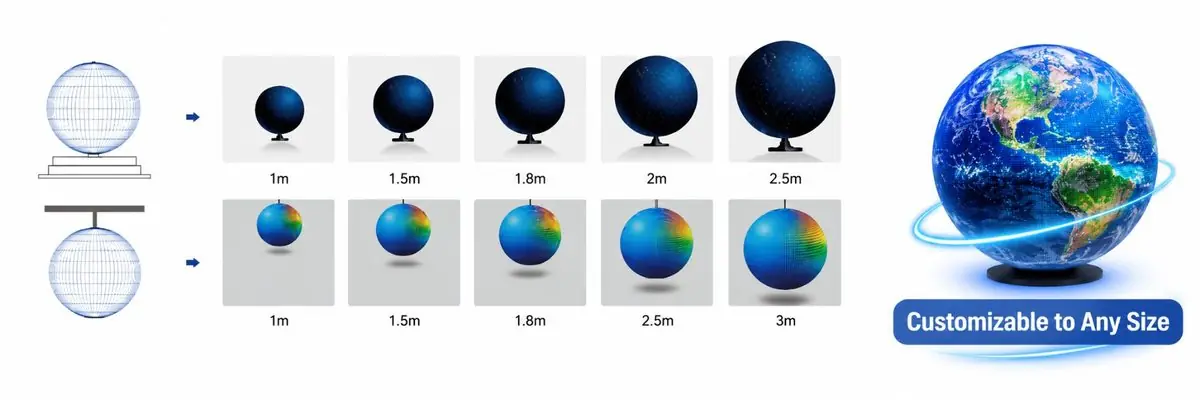
Every sphere quotation we issue decomposes into the same components. Knowing what each one covers — and what moves it — is the fastest way to become a buyer no one can confuse.
| Component | What it covers | What moves it |
|---|---|---|
| Screen system | Custom-shaped modules, power, receiving cards, control system, cabling | Pitch, surface area, custom module ratio, brightness specification |
| Internal structure | The frame inside the sphere that carries modules and services | Diameter, mounting method, wind loads outdoors, access requirements |
| Environmental engineering | IP65 sealing, salt-fog protection, thermal design, corrosion-resistant finishes | Outdoor exposure, coastal air, dust, temperature range |
| Installation | Engineering plan, lifting, site crew or supervision, high-access work | Height, crane access, whether the sphere is assembled on site or lifted complete |
| Integration & content | Playback, mapping onto the sphere geometry, show control | What content system the venue owns; spherical mapping is not flat-wall playback |
| Calibration & support | On-site uniformity and color verification, training, spares, warranty | Target uniformity (we hold ≤5% brightness deviation, ≤2ΔE) and service philosophy |
Two patterns repeat across our delivered projects. First, structure and installation weigh heavier than buyers expect — a suspended sphere in a finished atrium is an access problem before it is a screen problem. Second, environmental engineering is where outdoor budgets quietly diverge: the difference between an IP65 screen and an IP65 screen with specified salt-fog protection is invisible on day one and decisive in year three. How we engineer outdoor protection →
Sphere budgets are decided in specification far more than in negotiation. The levers below are the ones that actually move the number.
And the cuts to avoid: skipping calibration, dropping spares, accepting "outdoor-grade" without a stated protection class. These savings resurface as visible seams, drift and year-two corrosion — the most expensive defects to fix once the sphere is hanging. Outdoor spheres as a product →
The difference between an estimate and a quotation is information. This is what turns "how much is a sphere?" into a buildable number.
| Information | Why we need it | If you don't have it |
|---|---|---|
| Diameter (or the space it must fit) | Surface area, module layout and structure all follow | Send the atrium or site dimensions; we will propose |
| Nearest viewing distance | Decides pitch and resolution targets | Photos of the space help |
| Indoor / semi-outdoor / outdoor | Sealing, materials and thermal design follow | Describe the venue; we will classify it |
| Mounting intention | Floor, suspended or architectural — different structures | We will propose options with trade-offs |
| Content direction | Earth displays, brand visuals and landmarks map differently | A mood description is enough to start |
| Scope and timeline | Screen-only or full package; target date | We will quote both |
Send what you have and we will return a structured quotation with every component itemized and every assumption visible — so the first conversation is about design, not about decoding a number. Request a sphere quotation →
Real delivered projects show how differently the same product line spends money — and why each allocation was right for its brief.
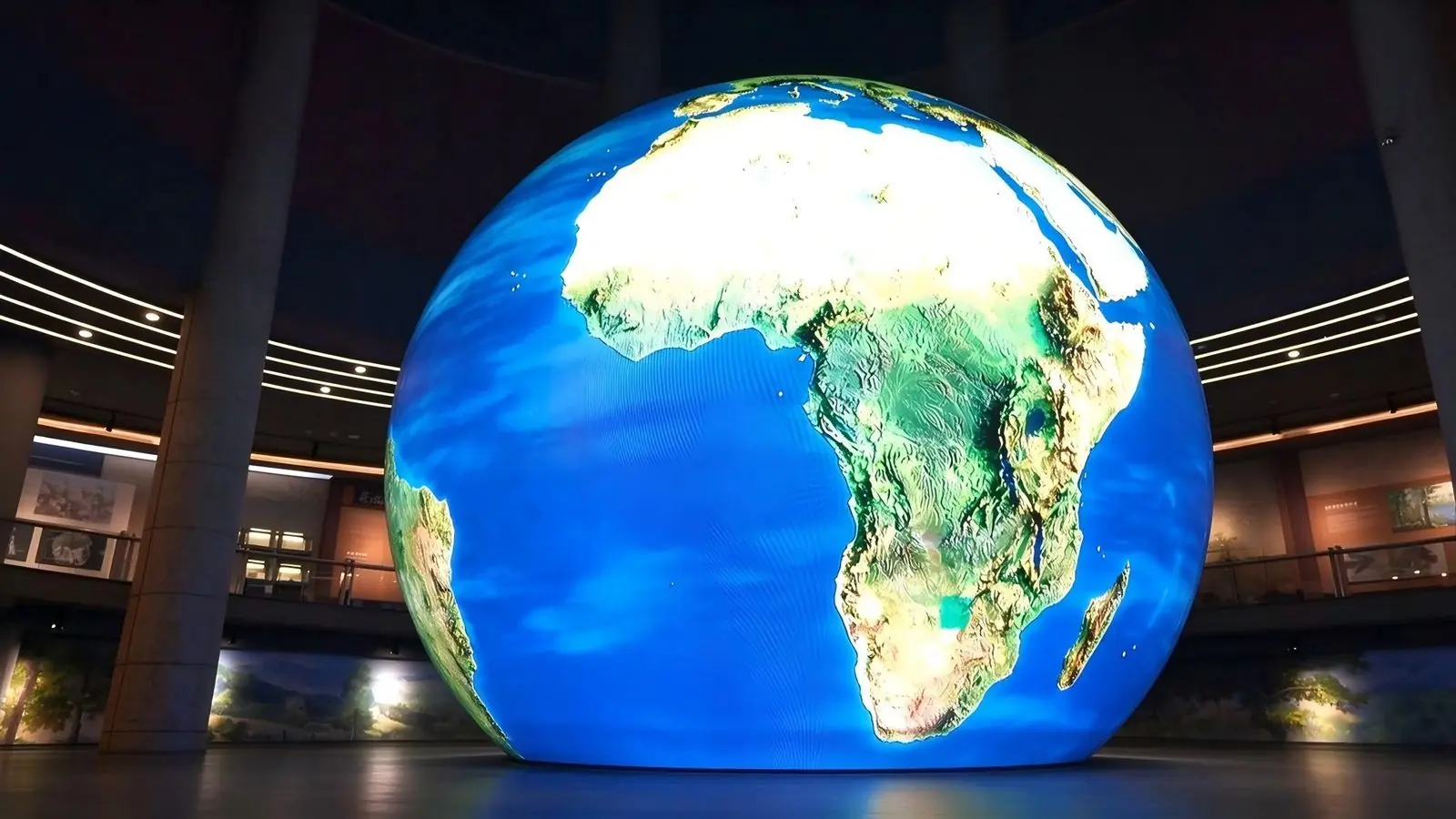
Same product line, three different centers of gravity. This is why we do not publish one number for "a sphere" — and why the buyers who get the best results are the ones who tell us the brief instead of asking for a rate card.
Tell us your diameter, your venue and your content idea — we will show you where the budget should go and what it should buy. How we build spheres → · Museum spheres → · The 26 m coastal reference →
A 6 m indoor display sphere — like the 6 m, P3, 131 m² natural-science museum sphere we delivered in Hezheng, Gansu — is a very different project from an outdoor sphere of the same diameter, and even indoor spheres vary with viewing distance, resolution targets and whether visitors walk around the sphere or view it from a fixed point. Rather than a diameter-based number that would be wrong for half the projects of that size, we quote against your geometry, viewing distance and content. The quote lists every component so you can see what you are paying for.
Because a sphere's cost is dominated by things a flat rate cannot see: the proportion of custom-shaped modules, the internal structure that carries the screen, whether the surface is fully or partially visible, installation height, and the environment it must survive. A cheap per-square-metre figure usually prices only the LED surface and leaves structure, engineering and commissioning to be discovered later. We prefer to state the whole system's cost and each component's share explicitly.
It carries additional engineering rather than just a bigger sticker: IP65 sealing with salt-fog protection for coastal sites, wind-load calculation for the actual location, corrosion-resistant materials and finishes, and access design for maintenance at height. How much this adds depends entirely on the site — a sheltered urban plaza and a coastal landmark are different projects. We itemize the outdoor-specific engineering separately so you can see exactly what protection is costing.
Yes. If you have your own fabricator or integrator, we supply the screen system with full interface drawings — module layout, weights, power and data routing — and your team builds the rest. The quote then covers the screen, control system, calibration guidance and spares, with the interface points stated in writing so nothing falls between contracts. Many museum and exhibition buyers choose this route.
Normalize first: same diameter, same pitch, same environment class, same scope. Then check four things — is the internal structure included, is on-site calibration and uniformity verification included, are spares and service terms stated, and does the supplier state screen weight per square metre? A quote that is silent on structure and commissioning is not cheaper; it is incomplete. We itemize all of it, which is exactly why our totals can be compared honestly.
Send your venue drawings, dome diameter and content plan — our engineers reply within one business day with a tailored configuration.
Get a Free Quote