Factory-direct LED Dome & Spherical Displays — Shenzhen, China
✉ enquiries@luminatii.com
☎ +86 177 0402 4640

A dome is installed twice: once in the factory, where the geometry is proven, and once on site, where the building decides whether the plan survives. This page is the sequence we actually run, and the site conditions that have to be true before a crew arrives.
Most site problems are design problems that were postponed. The survey, the interface drawings and the erection sequence decide whether the crew has a smooth month or a difficult one.
An LED dome installation begins with measurements, not with a shipping date. We need the clear height to the underside of the roof, the column grid, the floor loading capacity, the door and lift dimensions, and the route a steel segment will travel from the truck to the room.
From those numbers we produce the interface drawing: where the base ring lands, where the structure ties into the building, where the power and signal cabinets sit, and how a technician reaches the top band in service. Everything after that is execution.
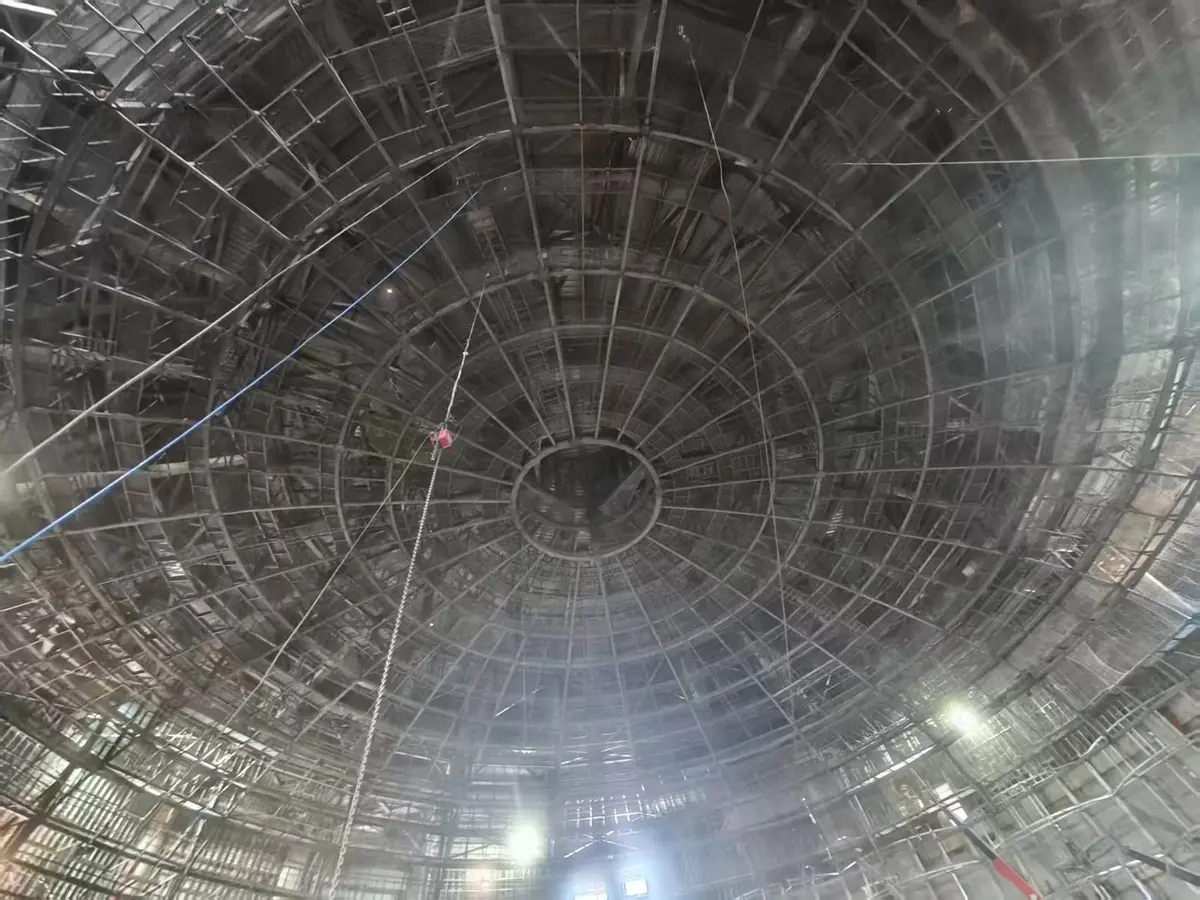
The order below is the one we use on large domes. Changing the order is possible; changing it late is expensive.
| Step | Work | Who is on site |
|---|---|---|
| 01 | Setting out and base preparation | Surveyor, civil contractor, our engineer |
| 02 | Anchor and base ring installation | Civil crew under our supervision |
| 03 | Steel shell erection, ring by ring | Steel crew, our site supervisor, lifting contractor |
| 04 | Structure survey and tolerance report | Our engineer — this gates the screen start |
| 05 | Walkways, catwalks and service access | Steel crew |
| 06 | Module and cabinet installation, band by band | Our installation team plus trained local crew |
| 07 | Power, signal and playback commissioning | Our engineers |
| 08 | Calibration, first light, acceptance and training | Our engineers, client operators |
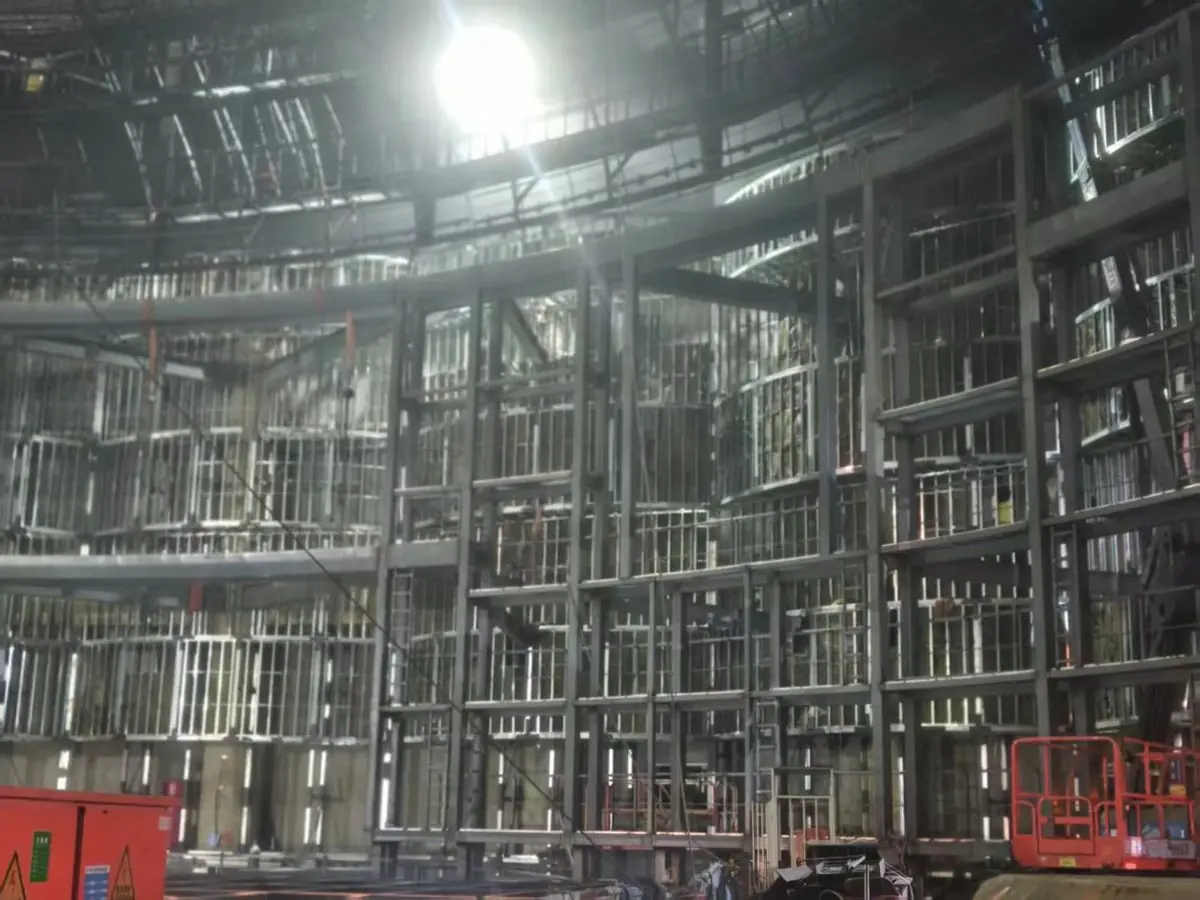
Between the steel going up and the first module going in, we measure the shell and issue a tolerance report. The connectors on our modules are XY two-way adjustable, which absorbs a real amount of accumulated tolerance — but not an unlimited amount. If the shell is outside tolerance, it is corrected before 5,300 m² of screen is hanging from it.
On the Kongtong Island project this discipline is what made a 60 m sphere close without visible seams, and it is the reason the same team can install a 5 m exhibit dome and a 60 m landmark with the same method.
The checklist we issue before mobilization. If an item is not ready, the crew waits — and waiting is the most expensive thing on a dome project.
| Requirement | What we need |
|---|---|
| Clear height | The height assumed in the design, measured and confirmed, with no unplanned services crossing the dome volume |
| Floor and base | Prepared base or slab at the specified level, with anchor positions accessible |
| Power | Supply capacity matching the display load — 150 W/m² at full white peak — with earthing and protection in place |
| Lifting | Crane, hoist or gantry rated for the largest steel segment, with a documented lift plan |
| Access | A route for modules and cabinets, plus working-at-height access for the installation team |
| Storage | Dry, secure space for modules and electronics before installation |
| Environment | Dust and humidity control during module installation, and protection of installed bands |
For a sphere, the same list applies with two additions: the suspension or base structure has to be certified for the sphere's dead load and wind case, and the content must be mapped in spherical coordinates before first light. Custom sphere installation scope →
A dome that is only assembled on site is a dome whose problems are discovered on site. We assemble and light the bands in the factory first.
Each latitude band is assembled on the factory floor to confirm the module geometry, the taper toward the pole and the seam closure before crating.
Bands are lit with test patterns to check for dead pixels, color consistency and driver addressing. Faults are fixed where a replacement module is a walk away.
Every module is labeled with its position, and the crates are packed in the order the site will need them. Installation follows the packing plan, not a search through boxes.
Brightness uniformity, chroma and seam continuity are set during commissioning and verified at acceptance. The target figures on our projects are a brightness uniformity deviation within 5% and a chroma deviation within 2ΔE, at 16-bit grayscale processing and 7,680 Hz refresh.
On an acoustically transparent dome the calibration also has to account for the perforation: a 50% open area with under 5% sound transmission loss means the image is seen through the same surface the audio passes through, and the mapping has to be aligned with the audio position behind it.
LED dome calibration and mapping → · Service access and maintenance →
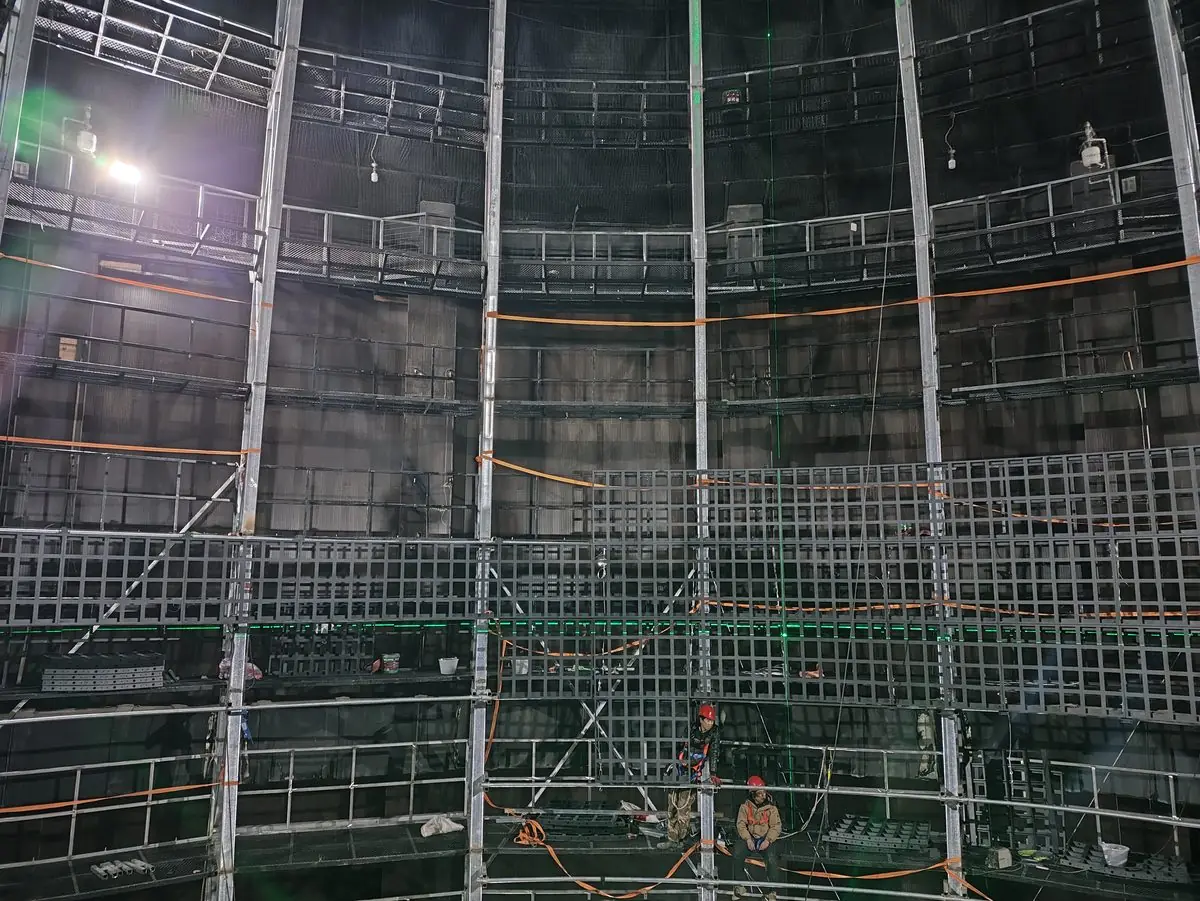
Most of our domes are installed outside China. The method is the same; the labor split is not.
A project engineer leads from our side and a site supervisor stays on location through the critical phases: setting out, structure alignment, the first band, module installation start, calibration and handover. Local labor handles scaffolding, rigging support and general works under that supervision.
The screen, the structure interface and the calibration stay with our team, because those three decide whether the surface closes. Civil works, scaffolding and lifting are usually better sourced locally, and we plan them with the client's contractor before mobilization.
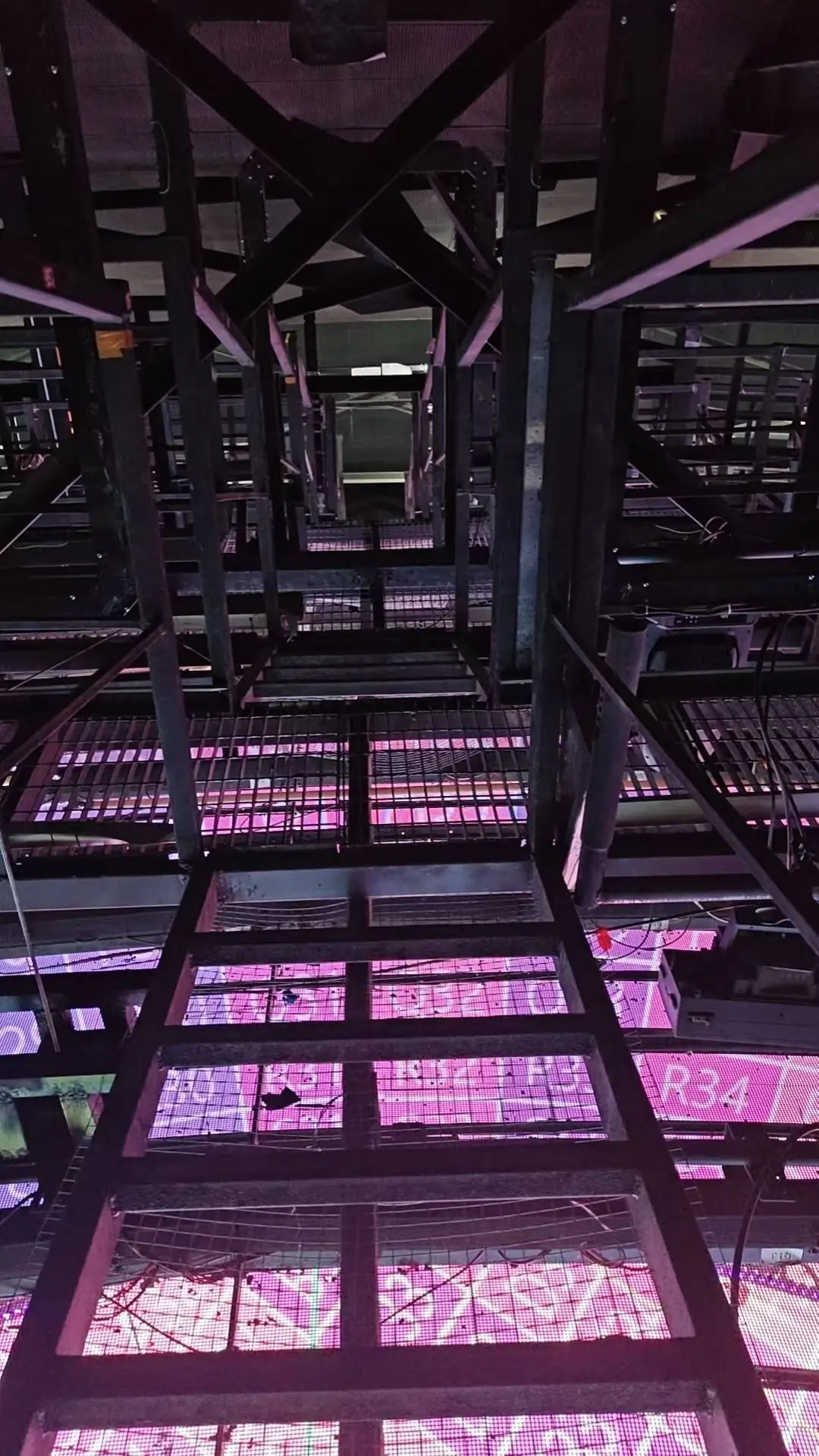
A dome is accepted on measurements, not on impressions. These are the checks that close a project.
Acceptance is also where the operator training is signed off. A dome that is technically perfect but whose staff cannot start a show is not handed over in a usable state.
Talk to an installation engineer → · See delivered projects → · LED dome screen platform →

It depends almost entirely on the structure, not the screen. The 60 m Kongtong Island dome was completed in around 180 days from design to handover, including a steel shell, 8 lifting and openable screens, 6 mechanical doors and 10 lifting floor panels. A small exhibit dome in an existing room is measured in weeks, not months.
Yes. Our engineers supervise erection and commissioning on site, and we work alongside the client's local contractor for civil works, scaffolding and lifting. The display, the structure interface and the calibration stay with our team, because those three determine whether the dome closes without seams.
A level or properly prepared base, the clear height the design assumes, a power supply sized to the display load, a lifting plan for the largest steel segment, a secure storage area and a route for modules to reach the dome. We issue a site readiness checklist before mobilization so nothing is discovered on arrival.
Yes. Bands are pre-assembled and lit in the factory to verify geometry, module mapping and driver addressing before shipment. Factory pre-assembly is what makes a curved surface predictable on site — problems are found where they are cheap to fix.
Acceptance covers brightness uniformity within 5%, chroma deviation within 2ΔE, seam continuity across every band, refresh at 7,680 Hz, grayscale at 16-bit, the full content playback path, and a documented module-by-module address map. All of it is recorded and handed over with the training file.
Yes, with a phasing plan. Museums, malls and parks rarely close for a dome. We sequence the work around opening hours, isolate dust and noise, and plan the heavy lifts for closed periods.
One project engineer leads from our side, with a site supervisor on location for the critical phases: structure alignment, first band, module installation start, calibration and handover. Local labor handles scaffolding, rigging support and general works under our supervision.
Send your venue drawings, dome diameter and content plan — our engineers reply within one business day with a tailored configuration.
Get a Free Quote