Factory-direct LED Dome & Spherical Displays — Shenzhen, China
✉ enquiries@luminatii.com
☎ +86 177 0402 4640

A sphere is the least forgiving shape in LED. Every module sits at a different angle, every band has a different circumference, and nothing can be hidden behind a bezel. We build them to the diameter your room, structure and content actually need — spheres delivered from 2 m to 26 m, and beyond that range we engineer a new one.
Flat screens absorb a bad measurement with a trim piece. A sphere cannot. The diameter, the band count and the module geometry are locked before the first cabinet is cut, which is why every sphere we build starts with a model, not a quote.
Buyers usually start with diameter, and diameter is indeed the first number. But on a sphere the diameter immediately sets everything else: the number of latitude bands, the circumference of each band, the module count at the equator versus the pole, and the pixel density where the surface curves away from the viewer.
That is why we ask for three things before discussing price. Where will people stand or sit? What is the mounting structure — hung from a roof, standing on a base, or embedded in a wall? And what content will run — a planet earth, a brand animation, or live data? Those three answers decide the geometry, and the geometry decides the cost.
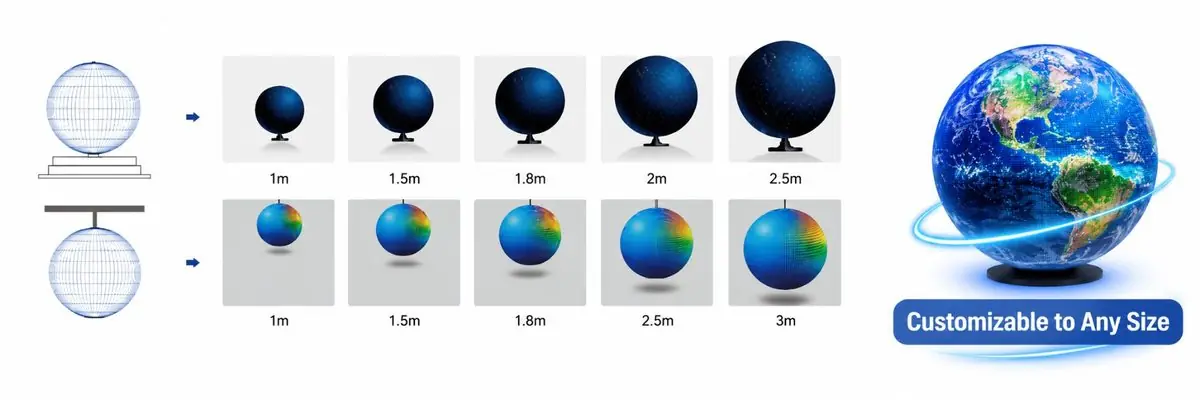
Three inputs, in this order: viewing distance, mounting height, and the content resolution you want at that distance.
Pixel pitch is chosen from the closest viewer who matters. A mall sphere seen from 3 m needs a finer pitch than a landmark sphere seen from 60 m across a plaza — and the finer pitch changes the module count and the budget far more than diameter does.
A hung sphere at 8 m centre height is read from below, so the underside carries the content and the top wastes pixels. We shift the pixel budget to the visible zone instead of distributing it evenly.
Wind load for outdoor spheres, the load path for a suspended sphere, and the route a technician takes to reach the top band five years later. All three are designed with the shell, not after it.
Textbook geometry gives the surface area of a sphere as 4πr². In practice the number that matters on site is the shipping diameter of the largest ring and the door width it has to pass through. We design spheres to be assembled in place from segmented rings, so the on-site limit is the door, not the final diameter.
This is also why a 26 m outdoor sphere is not simply a scaled 6 m museum globe. The structure moves from a fabricated frame to an engineered space frame, the wind load becomes the governing case, and the maintenance strategy changes from front access on a ladder to a designed walkway or lifting system.
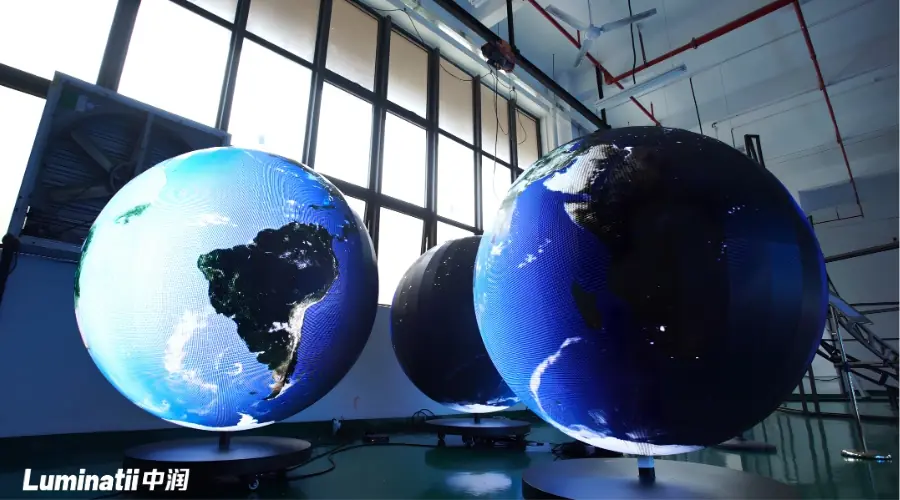
An indoor globe and an outdoor landmark can look identical in a render. Under the surface they share almost nothing.
| Decision | Indoor sphere | Outdoor sphere |
|---|---|---|
| Ingress protection | Standard cabinet sealing | IP65, including humidity, dust and salt-spray resistance |
| Brightness | 1,200 nit is more than enough under museum lighting | 1,200 nit minimum, because daylight and facade lighting both compete |
| Governing load | Dead load and mounting points | Wind load, plus seismic case where required, calculated per project location |
| Structure | Light internal frame, hung or floor-standing | Engineered space frame with base or roof connection, corrosion protection |
| Service access | Front access from a platform or lift | Designed walkway, catwalk or lifting system inside the shell |
| Content | Interactive, exhibit-driven, often close viewing | Landmark animation, brand loops, event content, long viewing distance |
Both share the same display platform: 1,200 nit, 10,000:1 contrast, NTSC 90%+ color gamut, ≤5% brightness uniformity deviation, ≤2ΔE chroma deviation, 16-bit grayscale processing and 7,680 Hz refresh. Power runs at 150 W/m² at full white peak, and LED lifetime is over 100,000 hours.
Water is the first problem and heat is the second. A sealed outdoor sphere breathes with temperature, so the cabinet design has to manage condensation without letting moisture into the module. Salt spray adds a corrosion case that changes the fasteners, the frame coating and the connector plating.
The third problem is content brightness management. A landmark sphere runs all evening at high brightness, then has to survive a summer facade at noon. We set the display to a scheduled brightness profile rather than running it flat out, which protects both the LEDs and the driver electronics.
A rectangular module cannot tile a sphere. Ours are cut as trapezoids and triangles, and each module can be adjusted in angle so the surface closes without visible seams.
On a flat wall, gaps are absorbed by the cabinet frame. On a sphere, every latitude band has a different circumference, so the module width has to taper as it approaches the pole. If the taper is wrong, the seam opens; if the module cannot tilt, the surface facets.
Our modules are built with an XY two-way adjustable connector, which lets the installer correct the accumulated tolerance of the structure and close the surface precisely. The result is a continuous image across 360° rather than a faceted ball with visible bands.
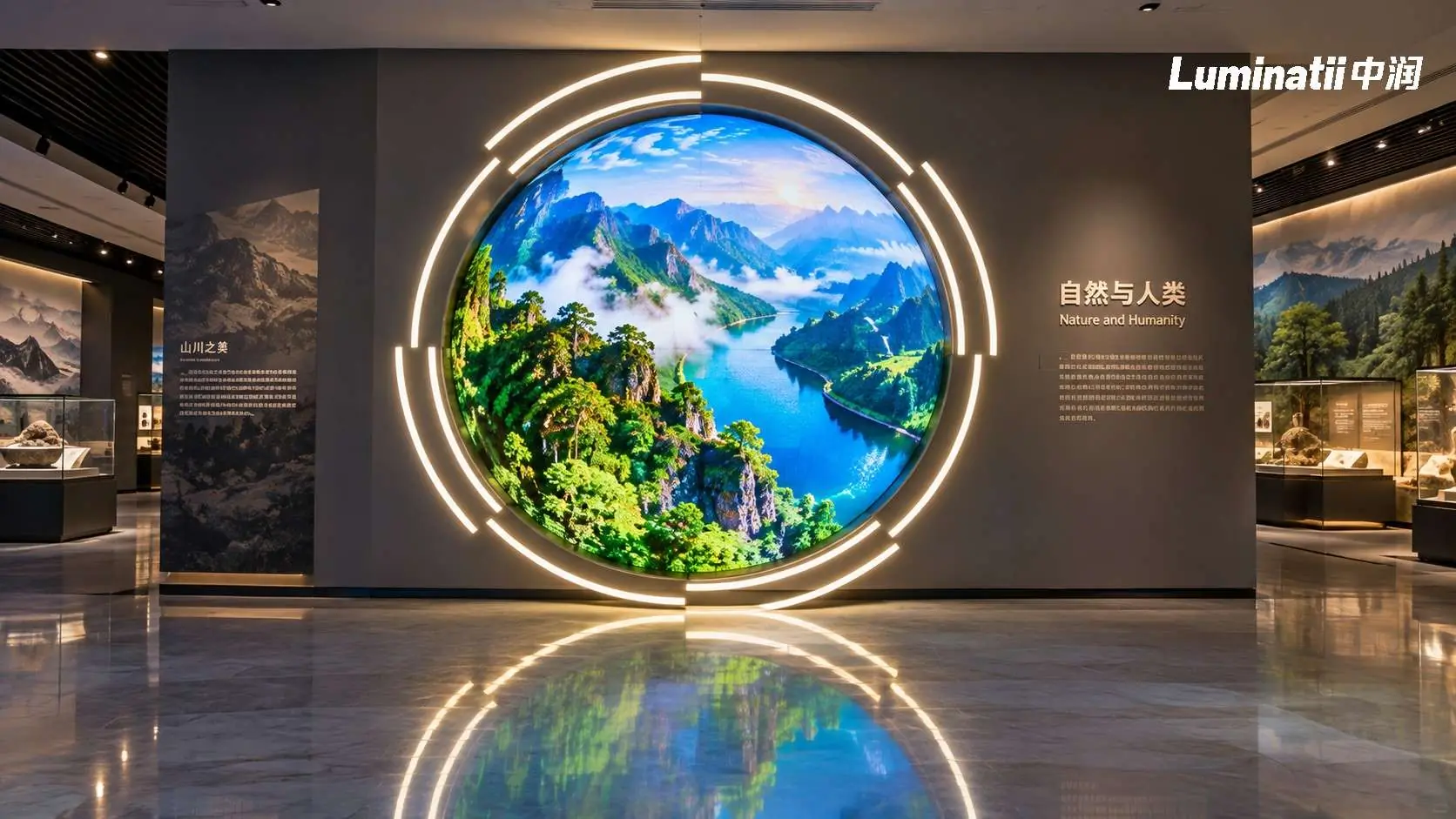
The mounting type is usually decided by architecture, not by the screen. We design the interface to whatever the building can give us.
| Mounting | Typical venue | Engineering note |
|---|---|---|
| Suspended | Mall atriums, hotel lobbies, airports | Roof connection, load spreading and a designed lowering or walkway strategy for service |
| Floor-standing | Museums, exhibition halls, showrooms | Base ring and internal frame, with a level floor and a defined viewer approach distance |
| Embedded | Walls, columns, floors, feature ceilings | Partial sphere geometry, with the cut line integrated into the architecture |
| Column-mounted | Public spaces, transport hubs | Ring clamp around the column, access from a mobile platform |
A shopping mall LED sphere is normally suspended and seen from below, so the content is authored for an upward view. A museum sphere is usually floor-standing with viewers walking a full circle, which means the content has to read from every angle without a preferred front.
Two references at opposite ends of the range, both fully custom.
| Project | Specification | What made it custom |
|---|---|---|
| Natural-science museum — Hezheng, Gansu | 6 m diameter, 131 m² display area, indoor floor-standing | Close viewing distance, earth-globe content, integration with a star-field ceiling |
| Coastal landmark — Philippines | 26 m full outdoor sphere, IP65 | Full outer sphere, salt-spray climate, wind load, night landmark operation |
Every sphere is quoted from a 3D model and a panel schedule, so you can see the band layout and the module count before you commit. See the 26 m sphere case → · See the 6 m museum globe →
One supplier, one tolerance chain, and one party responsible for the seam between steel and screen.
A sphere is not a product you buy and hang. It is a structure, a display and a content system that have to agree with each other, which is why we keep all three in one scope.
LED sphere screen technical platform → · Send your project drawings →
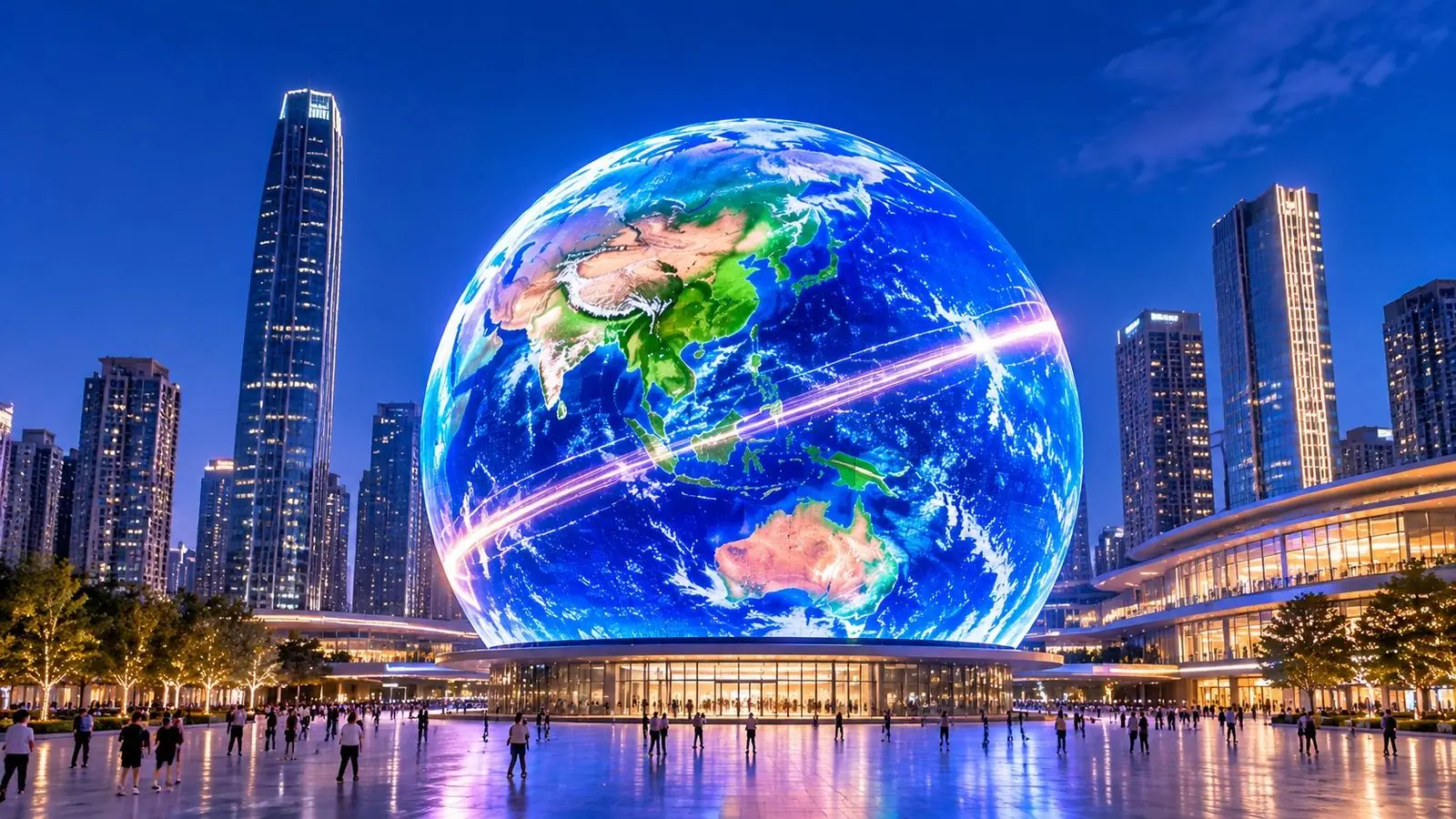
Every sphere is a one-off, so the adjectives are less informative than the three numbers behind them: diameter, mounting and viewing distance.
A customized LED sphere display usually means a configuration change — pitch, brightness, base finish, playback. A bespoke LED sphere display or a made-to-order LED sphere means the sphere is generated from a diameter that no catalogue carries. A tailor-made LED sphere system puts the structure, the suspension or base, the service access and the content pipeline in one scope.
We build the third. The diameter is the input: spheres delivered to date run 2 m to 26 m, and any diameter is built to order because the surface is produced from tapered modules on a structure we design, not assembled from stock cabinets. This is custom LED screen design and manufacturing in the literal sense — the design and the manufacturing sit in the same company — which is what customized LED display solutions promise and rarely deliver.
Before quoting we need the diameter, the mounting condition and the closest viewing distance. Those three decide the pitch, the structure and the maintenance plan, in that order.
Sphere types and mounting options → · Trapezoidal and triangular modules → · What drives sphere cost →
Yes. 26 m is the largest sphere we have delivered, not a limit. Each sphere is engineered from its own structural calculation, so a larger diameter is a new design rather than a catalogue item. Send the site drawings and we will tell you what the structure and access route need to look like.
We have delivered down to 2 m in diameter, which is the scale of a reception globe or a museum exhibit piece. Below that size the module count per band becomes the constraint rather than the structure, so the pitch has to be very fine to keep the sphere readable.
Yes. Hemispheres, three-quarter spheres, embedded spheres that emerge from a wall or floor, and sphere-plus-cylinder forms are all buildable. The panel geometry is generated from the surface, so a truncated or embedded form is a modelling exercise, not a new production line.
Content is mapped in a spherical coordinate system rather than a flat frame, so there is no single seam and no pole distortion. We supply the mapping and playback configuration with the screen, and we can work from your existing 360° masters or produce the mapping from flat footage.
Yes. Modules are front and rear serviceable, and on a hung sphere the front access route is usually the only practical one. A single technician can replace a module from the front without dismantling the shell.
Send your venue drawings, dome diameter and content plan — our engineers reply within one business day with a tailored configuration.
Get a Free Quote