Factory-direct LED Dome & Spherical Displays — Shenzhen, China
✉ enquiries@luminatii.com
☎ +86 177 0402 4640

A sphere is the only LED display with no natural front. That single fact decides the structure, the installation method and how the content is mapped — and it splits the product into six configurations buyers keep asking for by different names.
An LED spherical display, an LED ball screen, an LED video sphere and a spherical LED video wall are four names for one product family. What separates them is not the technology but the market that named them.
The advertising and events market says LED ball screen, LED video ball or LED ball display. The architectural market says LED display sphere, LED spherical display or LED spherical screen. The AV market says spherical LED video wall, because it is specifying a video surface that happens to be round. Museums and science centers say digital sphere display when the globe is a data visualization, and immersive sphere display when the visitor stands inside it.
All of them are built the same way: tapered LED modules on a spherical structure, mapped in spherical coordinates, with no preferred viewing side. That last property is what makes a sphere different from every flat or curved screen — there is no "front", so there is no back-of-house side to hide the access, the cabling or the structure.
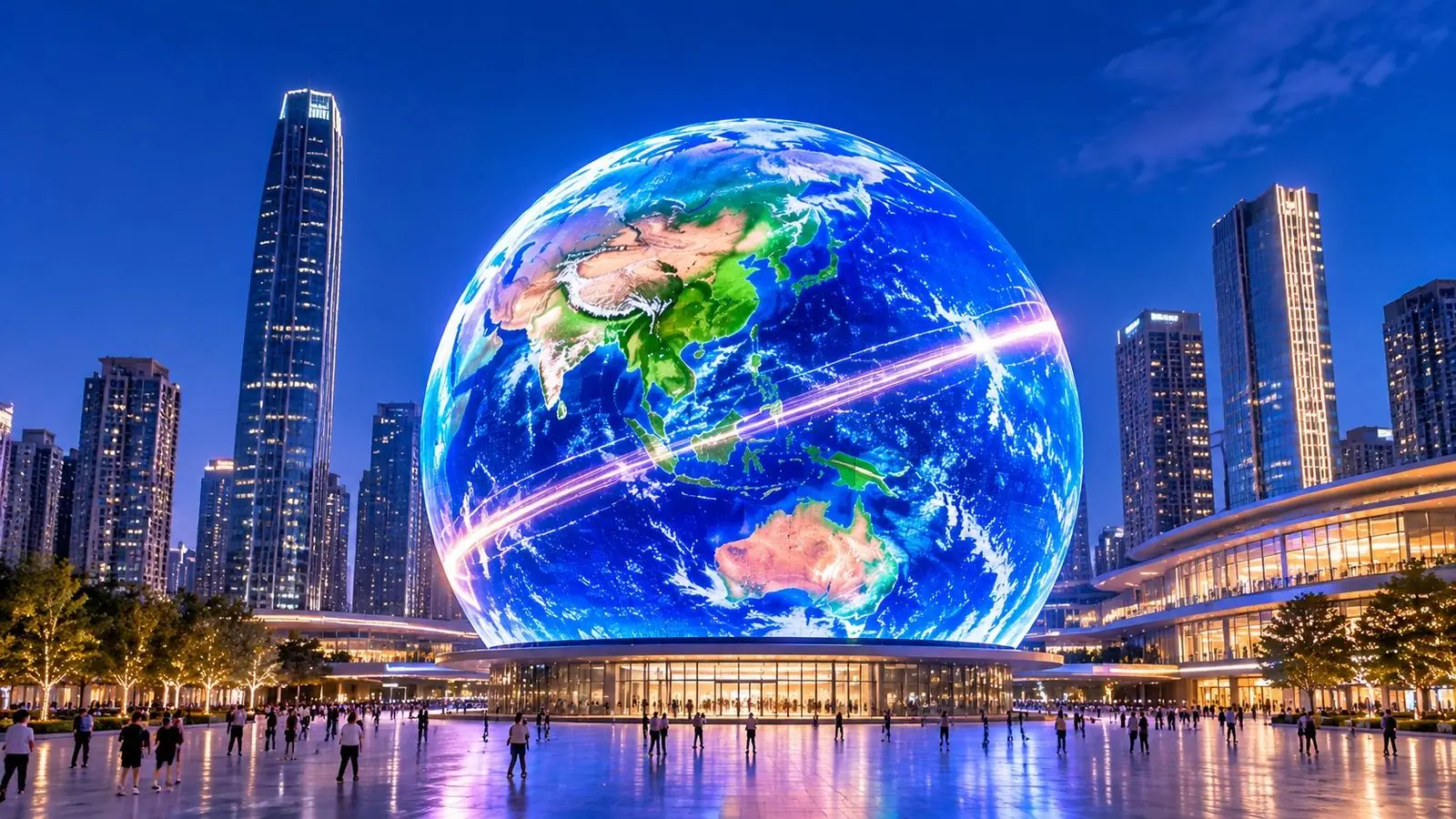
Six configurations that cover almost every brief we receive. The mounting column is the one that decides the engineering cost.
| Type | Coverage | Typical use | Mounting |
|---|---|---|---|
| Full exterior sphere | 360°, complete globe | Outdoor advertising, city landmark | Pedestal, buried base or structural tower |
| Full interior sphere | 360°, viewed from inside | Immersive exhibit volumes, dome-in-dome | Ring structure with floor opening |
| Hanging sphere | 360° or upper cap | Mall atria, exhibition halls, airports | Suspended from roof structure |
| Pedestal sphere | Full globe above a base | Museum globes, showroom centerpieces | Self-supporting base or column |
| Embedded sphere | Partial, set into a surface | Architectural features, walls and floors | Recessed into building fabric |
| Curved sphere segment | Less than 360°, one face | Stage backdrops, feature walls | Frame or wall-mounted |
Diameter drives structure, transport and installation far more than the screen does. How a custom sphere is engineered →
"360 degree LED sphere" is a coverage claim, not a product class. Here is how coverage actually changes the build.
At the equator a sphere's surface is generous: modules can be large and still follow the curve. At the poles the circumference collapses toward a point, so module width has to shrink band by band, and the final cap is a small cluster of triangular pieces. A sphere that looks simple in a rendering is a tapered tooling problem in the factory. A 3D LED sphere display follows the same logic and adds a stereo pipeline on top: the same refresh headroom and left/right eye-sync discipline as a 3D dome, with content authored on the sphere rather than converted.
Our answer is the same one we use on domes: triangular and trapezoidal modules with independently adjustable angles, joined by XY two-way adjustable connectors that absorb structural tolerance in two directions. The 6 m globe at the natural-science museum in Hezheng, Gansu is a 131 m² build, and it uses that geometry at a modest scale; a 26 m outdoor sphere uses exactly the same logic with different logistics.
A curved LED sphere screen — a partial sphere segment — is not a cut-down ball. It is a surface with a designed edge, which means the edge has to be finished, the structure has to carry the cut, and the viewing angle is fixed by the installation instead of by the visitor walking around it.
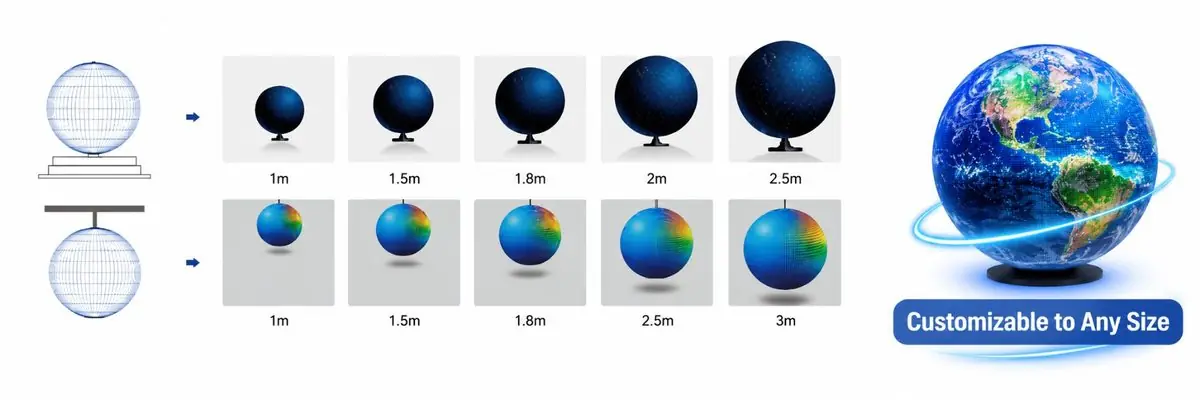
A large LED sphere display — roughly 10 m and above — stops being a screen project and becomes a structure, transport and maintenance project with a screen attached.
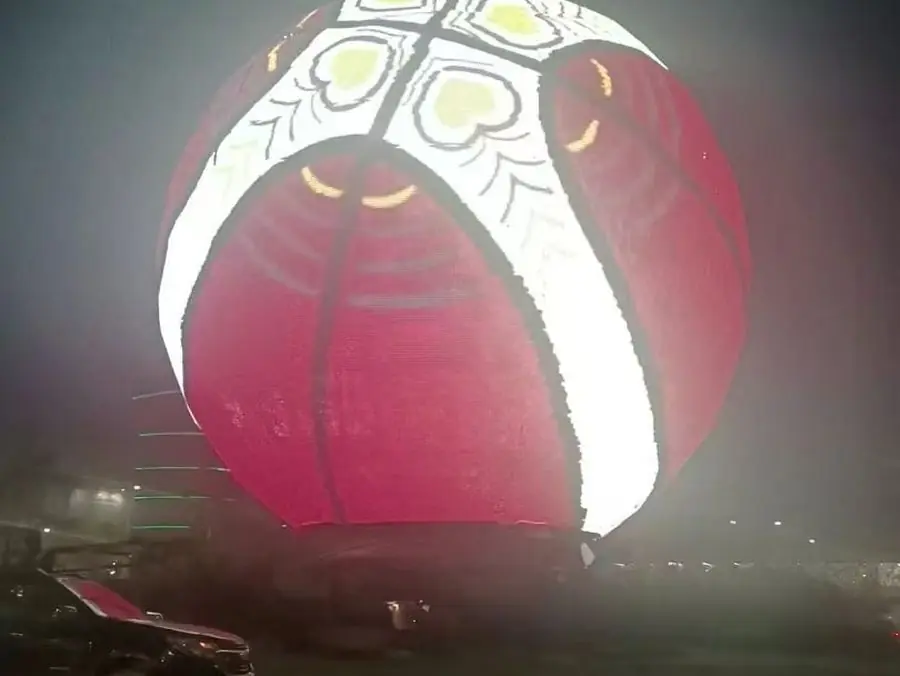
Spheres delivered to date run 2 m to 26 m. The 26 m outdoor sphere in the Philippines sits on a coastal site, which means IP65 modules, salt-spray and humidity protection, and a structure detailed for wind rather than for weight alone. 26 m is our largest reference, not a ceiling: any diameter is built to order, because the surface is engineered to the project geometry rather than assembled from a fixed catalogue.
A giant LED sphere screen is usually an LED landmark sphere before it is a display, so the failure mode to design out is not dead pixels: it is a service visit that needs a crane.
Landmark sphere engineering → · Outdoor LED sphere display →
Two briefs that sound alike and are specified differently: one is sold to advertisers, the other is sold to a city or a developer.
Content rotates, so the screen has to be bright enough for daylight, sealed against weather, and manageable by someone who is not an AV technician. Remote playback and a scheduling layer matter more than pixel pitch.
The sphere is architecture. Structural expression, night-time appearance, service access that does not show, and a content identity that reads from 200 m away come before resolution.
An indoor LED sphere display — a museum or showroom globe — lives under a roof, so weight, ceiling load and quiet operation lead. Interactive content — touch, gesture or sensor-driven — is common, and the screen becomes part of the exhibit script.
For daylight advertising, brightness and power are the same conversation: the screen is specified in nits, and the power system is specified in watts per square meter at full white. What drives sphere cost →
Five questions, in this order. The answer to the first one removes most of the options.
Bespoke is the norm rather than the exception at this scale: most spheres we build are customized to a diameter, a ceiling height or a structural grid that already exists. Spheres delivered from 2 m to 26 m; any diameter is built to order. And every LED sphere installation project runs the same sequence — survey, structure, bands, calibration — with our engineers on site through the critical phases.
Send a site plan for a sphere review → · Building a dome instead? Dome types →
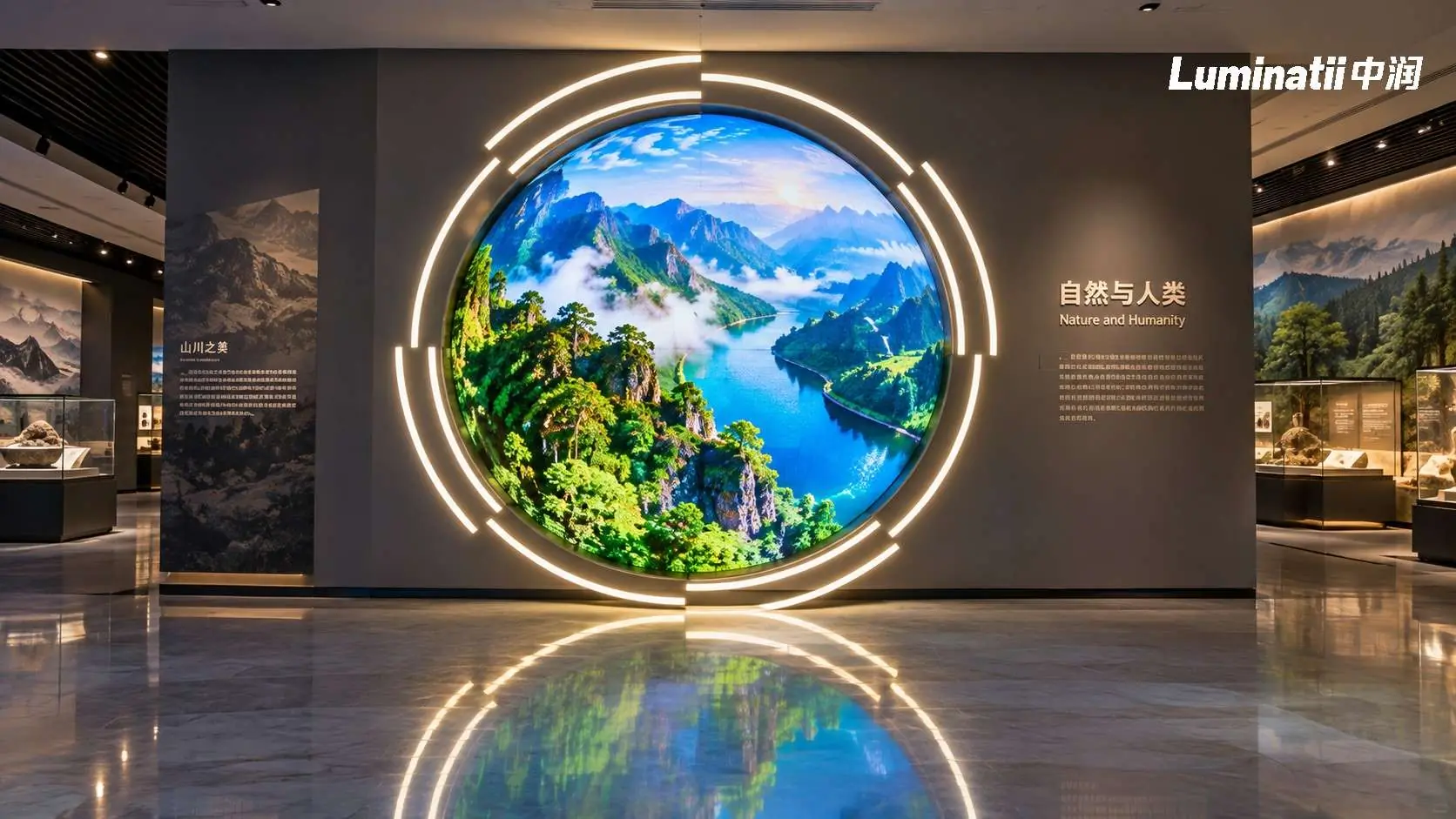
In practice they describe the same surface seen two ways. A 360° LED sphere display is viewable from every side because the screen wraps the whole globe; a full sphere LED display is the same product named by its coverage. If the sphere is only partially wrapped, it is a curved sphere segment, not a 360° display.
Most often as a landmark or advertising surface in a mall atrium, an exhibition, a museum hall or an outdoor plaza, where the ball is the attraction itself. Interior versions are used as immersive exhibit volumes and as planet-style globes in science museums.
Spheres delivered to date run 2 m to 26 m in diameter, including a 26 m outdoor sphere on a coastal site in the Philippines. 26 m is our largest reference rather than a limit: the surface is engineered to the project, built from tapered modules on a structure we design, so diameter follows structure and transport rather than a fixed catalogue.
Yes, and it is common in mall atria and exhibition halls. A hanging sphere is designed around the suspension point, the dead load, the maintenance route and the building's tolerance for dynamic movement, which is a different engineering case from a pedestal or embedded sphere.
Send your venue drawings, dome diameter and content plan — our engineers reply within one business day with a tailored configuration.
Get a Free Quote