Factory-direct LED Dome & Spherical Displays — Shenzhen, China
✉ enquiries@luminatii.com
☎ +86 177 0402 4640

"8K" sells well and explains almost nothing. On a dome, resolution is a system of three numbers: the total pixel canvas, the pixels per degree at the viewer's eye, and the resolution of the content master feeding the screen. Here is how the three fit together — and where the money should go.
Resolution is the most abused word in dome procurement, because three different measurements hide behind it. Buyers are quoted whichever one sounds most impressive; the audience only experiences one.
| Number | What it measures | What it tells you |
|---|---|---|
| Total canvas | All pixels across the whole sphere (4K, 8K and so on) | How much data the system moves — a headline number, not a viewing-experience number |
| Pixels per degree | Angular density at a specific eye position | Whether the image reads as photographic to the audience — the number that matters |
| Content master | Resolution of the fisheye film feeding the screen | The real ceiling on visible detail — a screen cannot invent what was never rendered |
A dome can be impressive on the first number and mediocre on the second: 8K spread across a huge sphere at coarse pitch can look softer than 4K packed into a compact dome at fine pitch. Conversely, a fine-pitch screen fed an under-resolved master shows the seams of its content, not its hardware. The three must be specified as one system — which is what we do before quoting a canvas. How pitch decides sharpness →
The Kongtong Island dome in Shandong is the project where resolution stops being theoretical: a 60 m diameter sphere with 5,300 m² of interior LED, driven at up to 8K. At that scale the canvas is not a marketing figure — it is a data-transport and thermal engineering problem solved across thousands of modules.
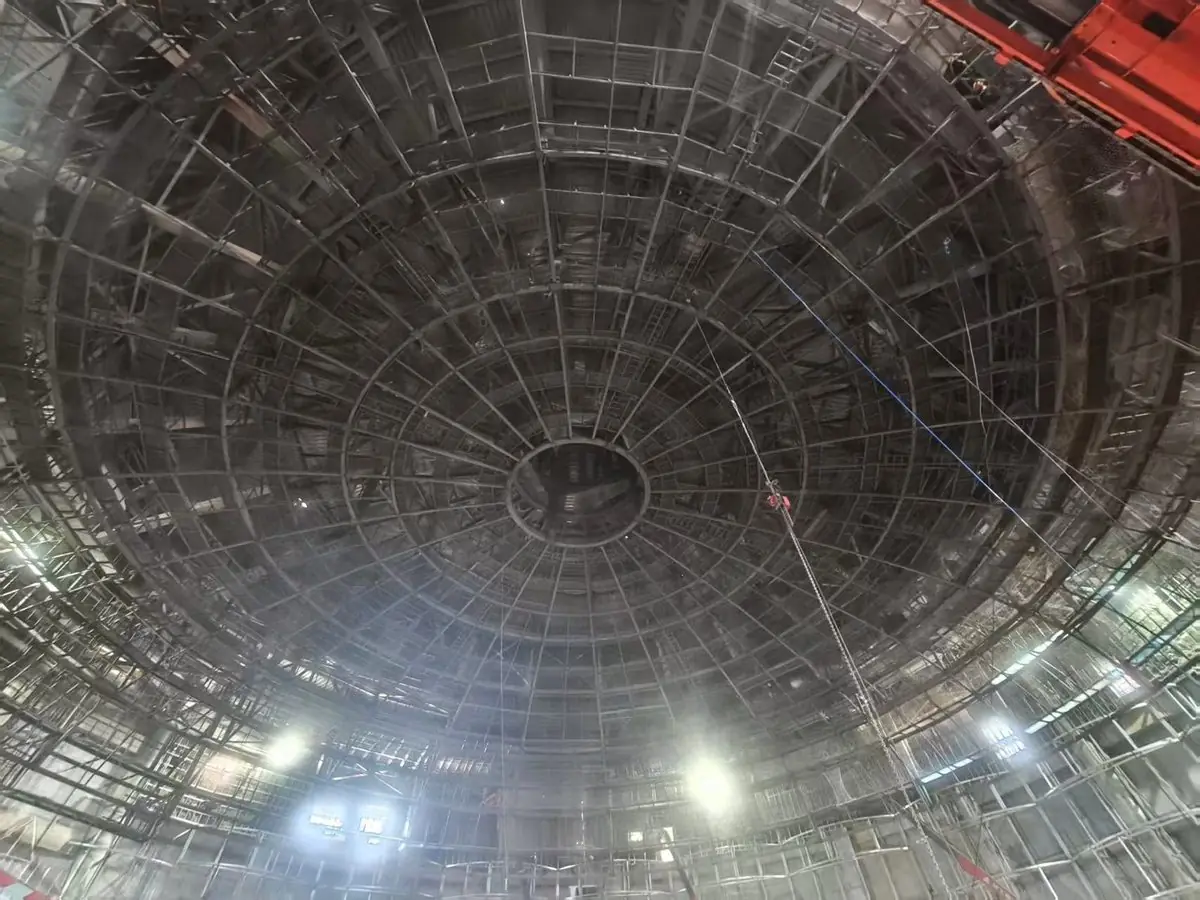
Three systems have to agree, and each one becomes harder at 5,300 m²:
Nothing here is unique to 60 m except the number of times it has to be right. That is the useful lesson for buyers: a large dome is a small dome repeated several thousand times, with the discipline held constant.
Dome content is authored as a fisheye master — a single circular frame that wraps the sphere. Its resolution sets the ceiling on visible detail long before the screen does.
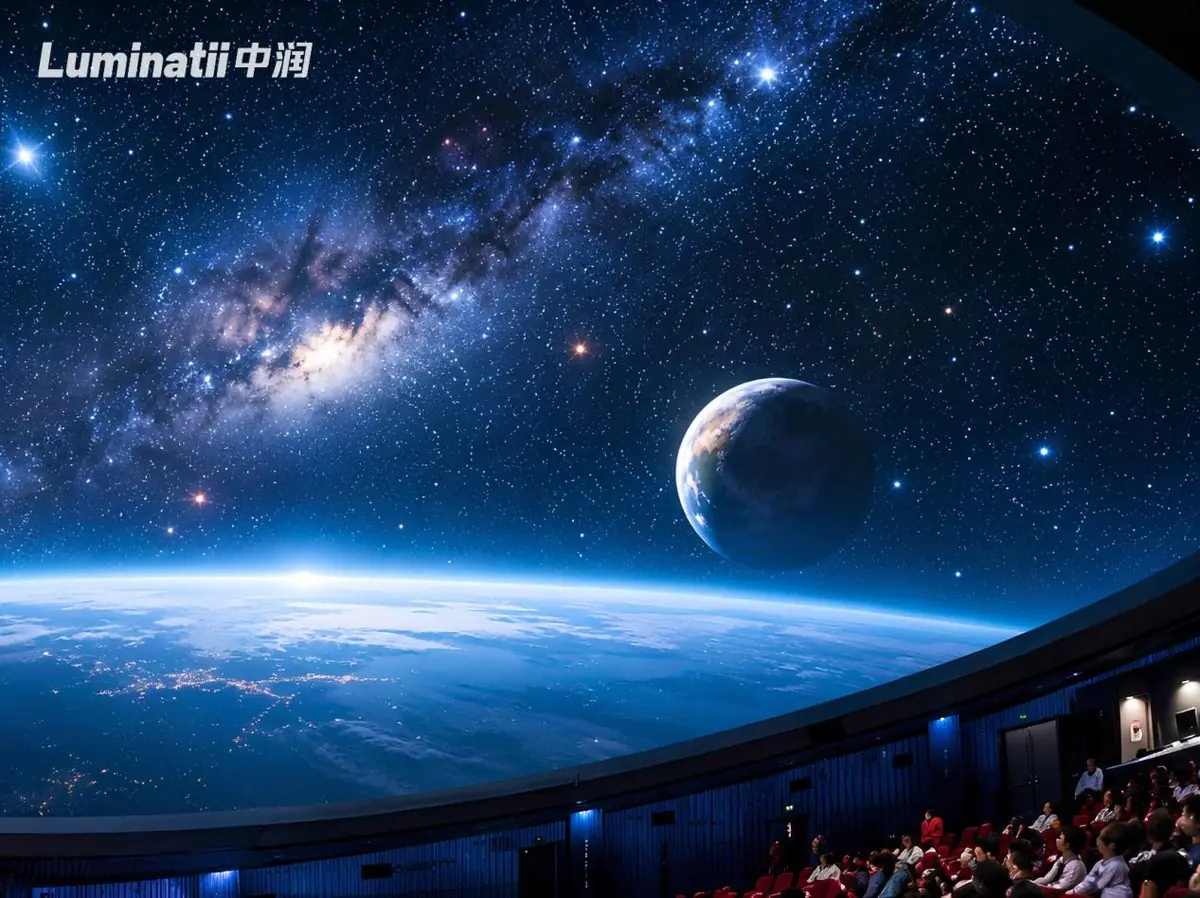
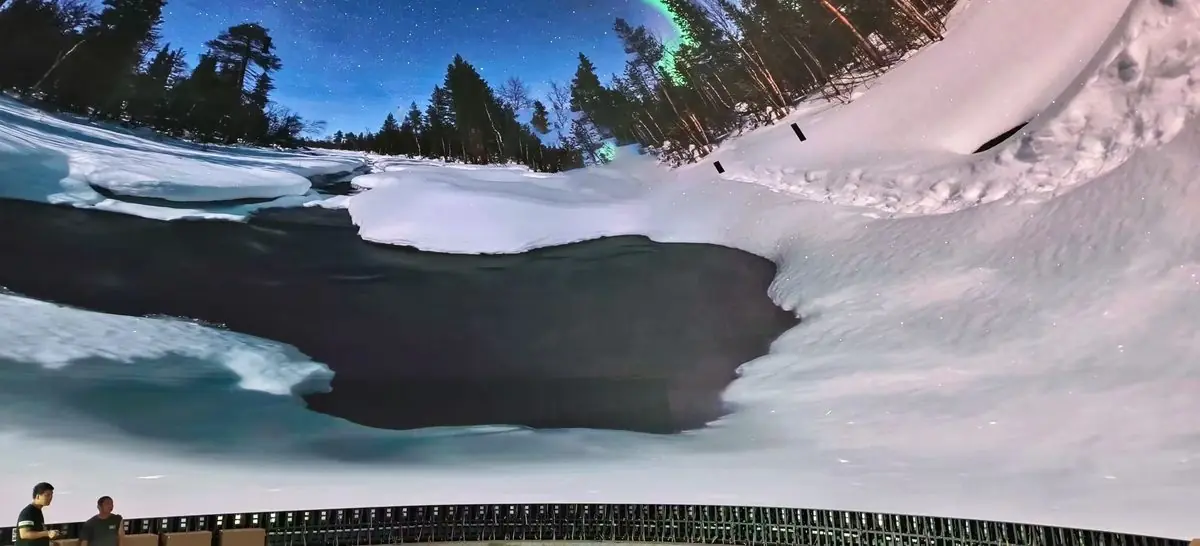
Two consequences follow. First, dark content dominates dome programming — space, night skies, underwater scenes — and dark content is where resolution and gray depth are tested together: a 4K master with 16-bit processing looks better than an 8K master crushed into 8-bit banding. Second, mapping flat video onto a sphere is a compromise, not a feature: a 16:9 frame stretched around a dome loses resolution where the audience looks most. We advise on content pipelines as part of the project, because a screen specified beyond its content budget is money spent on pixels that never light up with detail. Planetarium-grade content demands →
Canvas is not chosen; it falls out of two decisions — surface area and pitch. Divide the screen area by the area of one pixel cell (pitch squared), and you have the pixel count. That is why a 5,300 m² sphere at large-format pitch needs a driver architecture measured in tens of millions of pixels, while a 7 m dome at P1.9 lands at a fraction of that and still looks sharper to its audience.
Two practical consequences follow for procurement. First, never compare canvases across diameters — a smaller canvas on a smaller sphere can mean higher pixel density, not lower quality. Second, ask for pixels per degree at the nearest seat, because that is the only number that describes what the audience sees. We compute both before quoting, and we show the arithmetic to the buyer: a dome is a geometry problem with a budget attached, and transparency about the arithmetic is the fastest way to a sane specification.
There is also a maintenance dimension. Every additional pixel is a data path, a driver channel and a heat source inside a sealed sphere. Canvas beyond what the geometry can resolve is not free headroom — it is a decade of cooling load and service complexity bought for detail nobody can see. The right canvas is the one the venue's viewing distances justify, and no larger. What the structure has to carry →
Canvas should be chosen from the venue, not from a catalogue. These are the patterns behind our delivered projects.
| Venue type | Canvas emphasis | Delivered reference |
|---|---|---|
| Compact theater, 5–8 m | Fine pitch at modest canvas — detail where visitors stand | Beijing pair, P2 |
| Flying theater, 7–22 m | Fine pitch plus high refresh for fast pans and motion sync | Shenzhen P1.9; Chengdu 22 m |
| Walk-in dome, 14–28 m | Balanced canvas across a seating bowl; uniformity is the challenge | Changzhi 20 m; Huangshi 22/28 m |
| Landmark sphere, 40–60 m | Maximum canvas: up to 8K across thousands of square metres | Kongtong 60 m |
Send us the diameter you are considering and the content you intend to play; we will return pitch, canvas, driver architecture and the content resolution that actually fills it. Next: calibration → · Brightness → · Talk to the dome team →
One caution for tender documents: writing "8K dome" as a requirement tells suppliers almost nothing and can inflate every quote you receive. Write the viewing geometry and the content class instead — nearest audience distance, diameter, and whether the programming includes starfields or fine text. Suppliers who calculate will respond with a canvas that fits; suppliers who copy will respond with a number that sounds impressive and a price to match.
That single change in how the requirement is written tends to shorten the comparison stage more than any site visit, because it forces every bid onto the same engineering footing.
No — and that is the point of specifying a canvas rather than a headline. 8K was delivered on the 5,300 m² Kongtong sphere, where the geometry genuinely needs that many pixels. A 7 m dome runs a far smaller canvas at P1.9, because 8K across eight metres would mean a pitch no one manufactures and no content could fill. Canvas follows diameter and pitch.
Pitch, for the audience. Pixels per degree at the eye is what determines whether the image looks photographic; total canvas is just the arithmetic consequence of pitch multiplied by surface area. A supplier selling "8K" on a mid-size dome is probably selling a number, not a viewing experience — ask instead what pitch it corresponds to at the nearest seat.
It will look like good 4K — clean and sharp up to its own limit, with no more detail beyond it. That is acceptable for cinematic content, which is why many venues play 4K masters daily. But if the dome was specified for planetarium work, where the audience resolves individual stars overhead, the content pipeline has to be 8K-capable too. Specify screen and content together.
Through a distributed driver architecture: the dome is divided into module groups each fed locally, with parallel drive design so a single failed LED or module never takes its neighbours down. Data paths, power and refresh are engineered as one system — which is why 7,680 Hz refresh at 16-bit gray is a system claim, not a module claim.
Yes, with a caveat. Flat video can be mapped onto the sphere, but the geometry stretches it — a 16:9 frame becomes a band around the dome. Dome content is authored as a fisheye master for a reason; we can advise on conversion, but the audience always notices the difference between shot-for-dome and mapped-flat.
Send your venue drawings, dome diameter and content plan — our engineers reply within one business day with a tailored configuration.
Get a Free Quote