Factory-direct LED Dome & Spherical Displays — Shenzhen, China
✉ enquiries@luminatii.com
☎ +86 177 0402 4640

Diameter is the first number in every dome conversation and the last one that should be fixed. This page lists the sizes we have delivered, what each one physically requires from a building, and how to work backwards from seats and content to the right number.
Diameter is a consequence of four numbers: seat count, clear height, viewing distance and the content resolution you want at the back row. Fix those first and the diameter stops being a matter of taste.
Buyers often ask for a table of standard dome diameters, expecting something like a screen diagonal list. There is no such list worth having. Two 20 m domes can differ completely: one is a full hemisphere in a purpose-built theater, the other is a truncated shell inside a converted warehouse with a 12 m ceiling.
What a size chart can do is show the physical consequence of each diameter — how much screen area it produces, how much clear height it demands, and what it typically hosts. From there, the engineering work is matching one of those rows to an actual building.
Every dome we quote comes with a 3D model and a panel schedule, so the diameter, the band count and the module count are visible before you commit. Custom LED dome engineering →
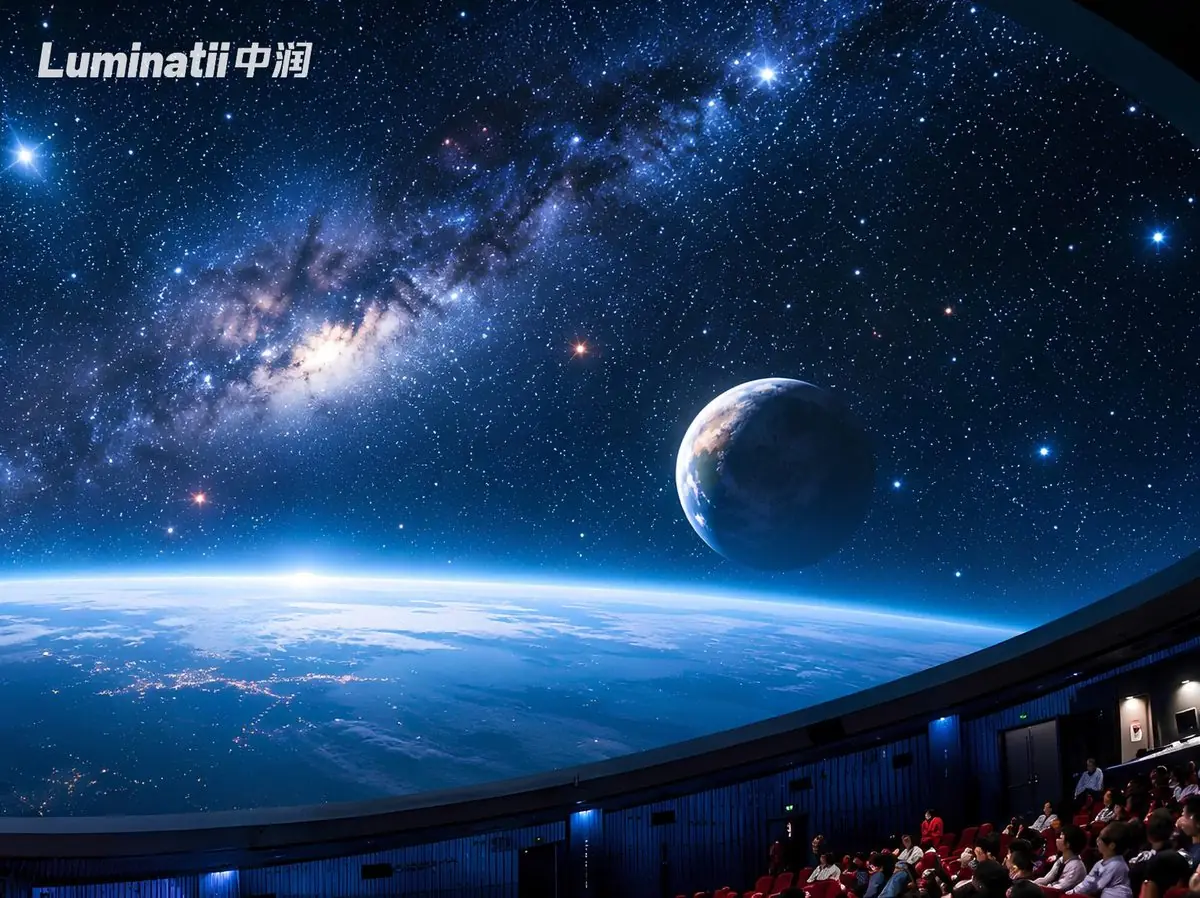
Screen areas are for a full hemisphere before openings, doors and truncation. The 60 m figure is the delivered screen area at Kongtong Island after openings were cut.
| Diameter | Screen area | Clear height | Typical use |
|---|---|---|---|
| 5 m | ≈39 m² | ≈2.5 m | Exhibit dome, small immersive capsule, museum corner |
| 8 m | ≈100 m² | ≈4 m | Twin-dome exhibit pair, small planetarium |
| 10 m | ≈157 m² | ≈5 m | Compact dome cinema, science center demonstration dome |
| 15 m | ≈353 m² | ≈7.5 m | Regional planetarium, medium dome theater |
| 20 m | ≈628 m² | ≈10 m | Dome cinema, theme park attraction, flying theater |
| 22 m | ≈760 m² | ≈11 m | Flying theater with motion platform |
| 28 m | ≈1,230 m² | ≈14 m | Full-sphere interior dome, large attraction |
| 30 m | ≈1,414 m² | ≈15 m | Landmark dome theater, tourism venue |
| 40 m | ≈2,513 m² | ≈20 m | Large-scale immersive venue, 720° configurations |
| 50 m | ≈3,927 m² | ≈25 m | Destination-scale dome, cultural tourism project |
| 60 m | 5,300 m² delivered | ≈30 m | Asia's largest LED dome, Kongtong Island, Shandong |
Diameters between these rows are not a problem — a 12 m or an 18 m dome is engineered the same way as a 20 m one. What changes between rows is the structure type, the module count per band and the access strategy for service.
Two domes of the same diameter can need different pitches, because the deciding number is the distance from the furthest seat to the surface behind it.
The most useful reference is not a formula but a list of built projects, because each one shows a pitch that satisfied a real audience at a real distance. Our delivered configurations run from a fine pitch in the 7 m flying theater to P6 on the 60 m Kongtong flagship, and the pattern is consistent: the smaller the dome, the finer the pitch, because the audience sits proportionally closer to the surface.
Pushing a finer pitch into a large dome multiplies module count, power and heat. Pushing a coarse pitch into a small dome makes the image read as a grid. The engineering task is finding the pitch where the back row stops seeing pixels and the budget still closes.
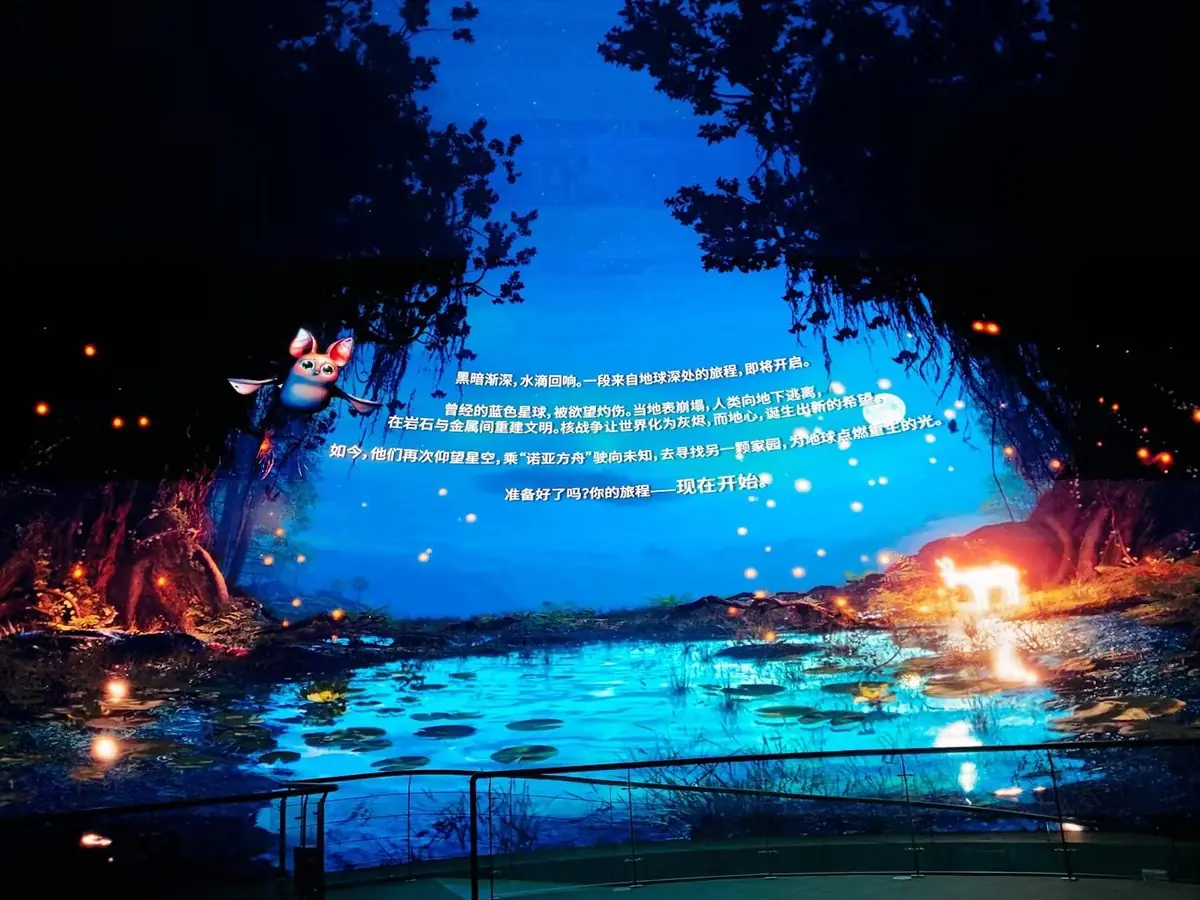
| Delivered project | Diameter | Pitch delivered | Closest viewer |
|---|---|---|---|
| Shenzhen flying theater | 7 m | P1.9 | 2–3 m |
| Beijing twin domes | 5 m and 8 m | P2 | 2–3 m |
| Changzhi, Shanxi | 20 m | P2 | close front row |
| Hezheng museum sphere | 6 m sphere | Custom | 1–3 m |
| Huangshi Land Sky Theater | 28 m full sphere | Custom | far side of the bowl |
| Huangshi Motion Flying Theater | 22 m | Custom | far side of the bowl |
| Kongtong Island flagship | 60 m | P6 | far |
A large diameter LED dome is not a scaled-up small dome. Four engineering cases change at once.
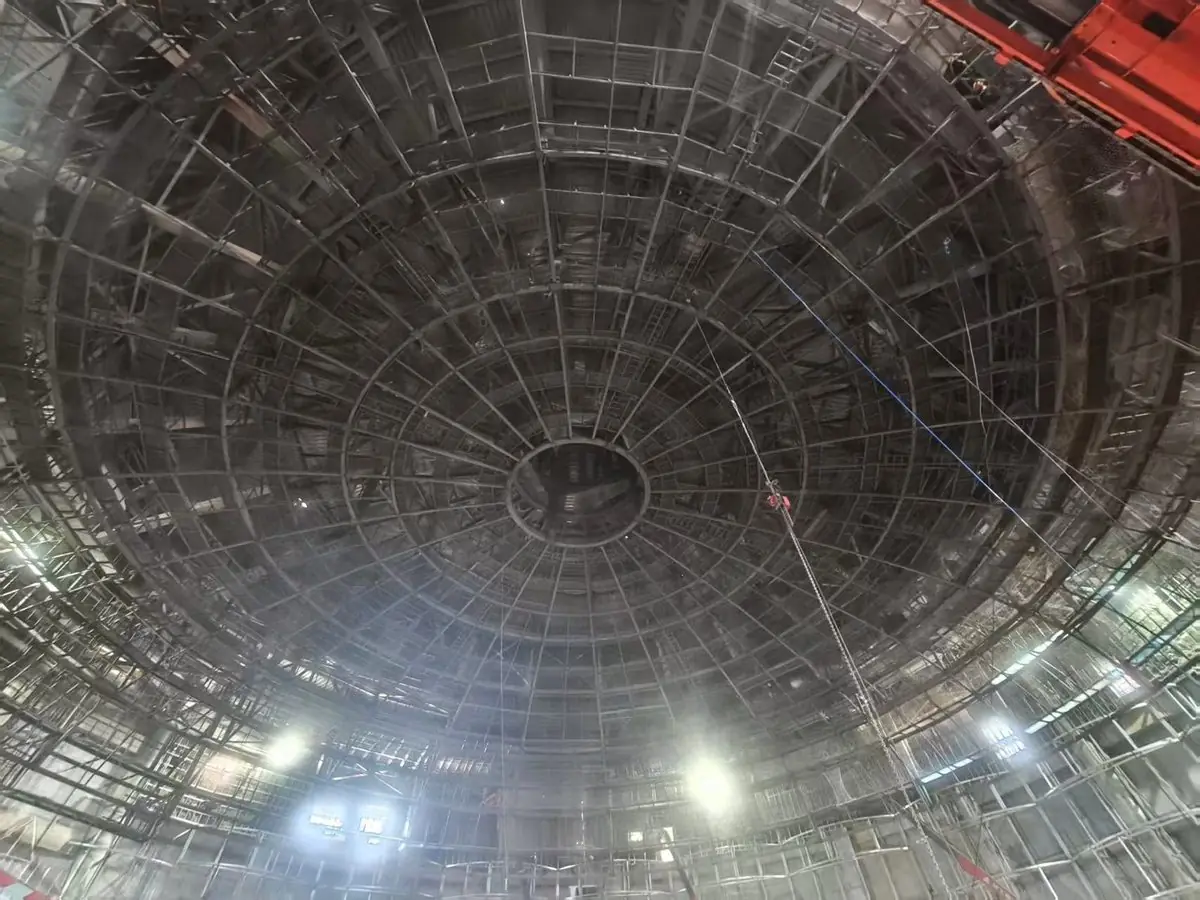
Above roughly 30 m the shell needs its own foundation, a calculated wind case and a defined erection sequence. We design the steel and the display interface together, with weld inspection and acceptance records.
Screen weight on our 60 m dome runs 8.5 kg/m², against a 15–25 kg/m² industry norm. On a 5,300 m² surface that difference is measured in hundreds of tonnes of steel and foundation.
At 60 m, a rear maintenance walkway is not an accessory. Access routes, lifting points and module replacement from the front are designed with the shell so a single technician can reach any module.
A 60 m dome at 8K means the content has to survive being stretched across 5,300 m² with the audience seated underneath it. Content production, mapping and playback are part of the same scope, because a display of that size with weak content reads as an empty ceiling.
The Kongtong Island dome was built in around 180 days, including 8 lifting and openable LED screens, 4 sets of 3D wire rigging, 6 mechanical doors and 10 lifting floor panels integrated into the shell.
The 60 m Kongtong Island dome → · LED dome steel structure →
A sphere has a different sizing logic from a dome, because it is seen from outside and from every side.
A 5 m LED sphere display in a mall atrium is read from 3 to 10 m away, so the pitch has to be fine and the content has to work from below. A 20 m LED sphere display on a facade is read from across a plaza, so the pitch can be coarser and the structure becomes the dominant engineering.
Spheres delivered to date range from 2 m to 26 m in diameter. The 2 m end is reception-globe scale, where the module count per band is the constraint. The 26 m end is a full outdoor sphere on a coastal site, where wind load, salt spray and service access govern the design.
Custom LED sphere engineering → · LED sphere screen platform →
Work through these five steps in order. Most projects arrive at a diameter within one iteration.
If you send us the room drawing and the intended show format, we will come back with two or three feasible diameters and the trade-offs between them, rather than a single number to argue about.
Send your room drawing → · What drives dome screen cost → · All delivered projects →
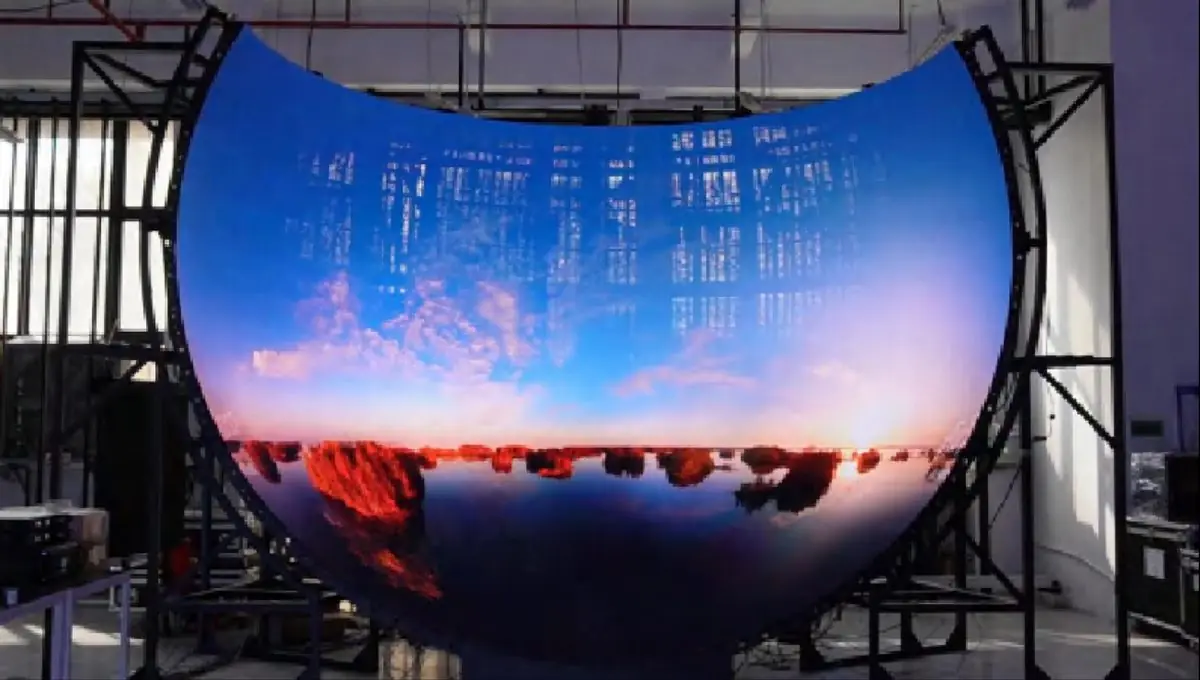
Domes delivered to date range from 5 m to 60 m in diameter, including a 60 m, 5,300 m² dome on Kongtong Island. There is no fixed upper limit: each dome is engineered from the venue's geometry, so a larger span is a new structural design rather than a catalogue item.
There is no catalogue ceiling. What limits a dome is the building, the structure and the erection sequence, not the display. Beyond roughly 60 m the shell starts to behave like a building, so foundation, wind load and the lifting plan become the governing engineering — all of which we take on within the same scope.
A dome is a hemisphere, so its rise equals its radius: a 20 m dome needs about 10 m of clear height above the springing line, a 30 m dome needs about 15 m, and a 40 m dome needs about 20 m. If the room is lower, the dome is truncated, tilted or built as a partial shell instead of a full hemisphere.
A 20 m hemisphere covers about 314 m² of floor and roughly 628 m² of screen surface before openings. Seating is laid out inside that circle, so a 20 m dome typically holds an audience in the low hundreds with a stage or a motion platform, depending on the show format.
Yes. We have delivered 5 m, 6 m, 7 m, 8 m, 14 m and 20 m domes, mostly for exhibit venues, small flying theaters and science centers where ceiling height is the binding constraint. Small domes are not simplified products — they usually need a finer pixel pitch because the audience sits close to the surface.
Our largest delivered sphere is 26 m in diameter, a full outdoor sphere for a coastal landmark in the Philippines. Spheres delivered to date run from 2 m to 26 m, and larger diameters are engineered to order rather than limited by a standard size.
Send your venue drawings, dome diameter and content plan — our engineers reply within one business day with a tailored configuration.
Get a Free Quote